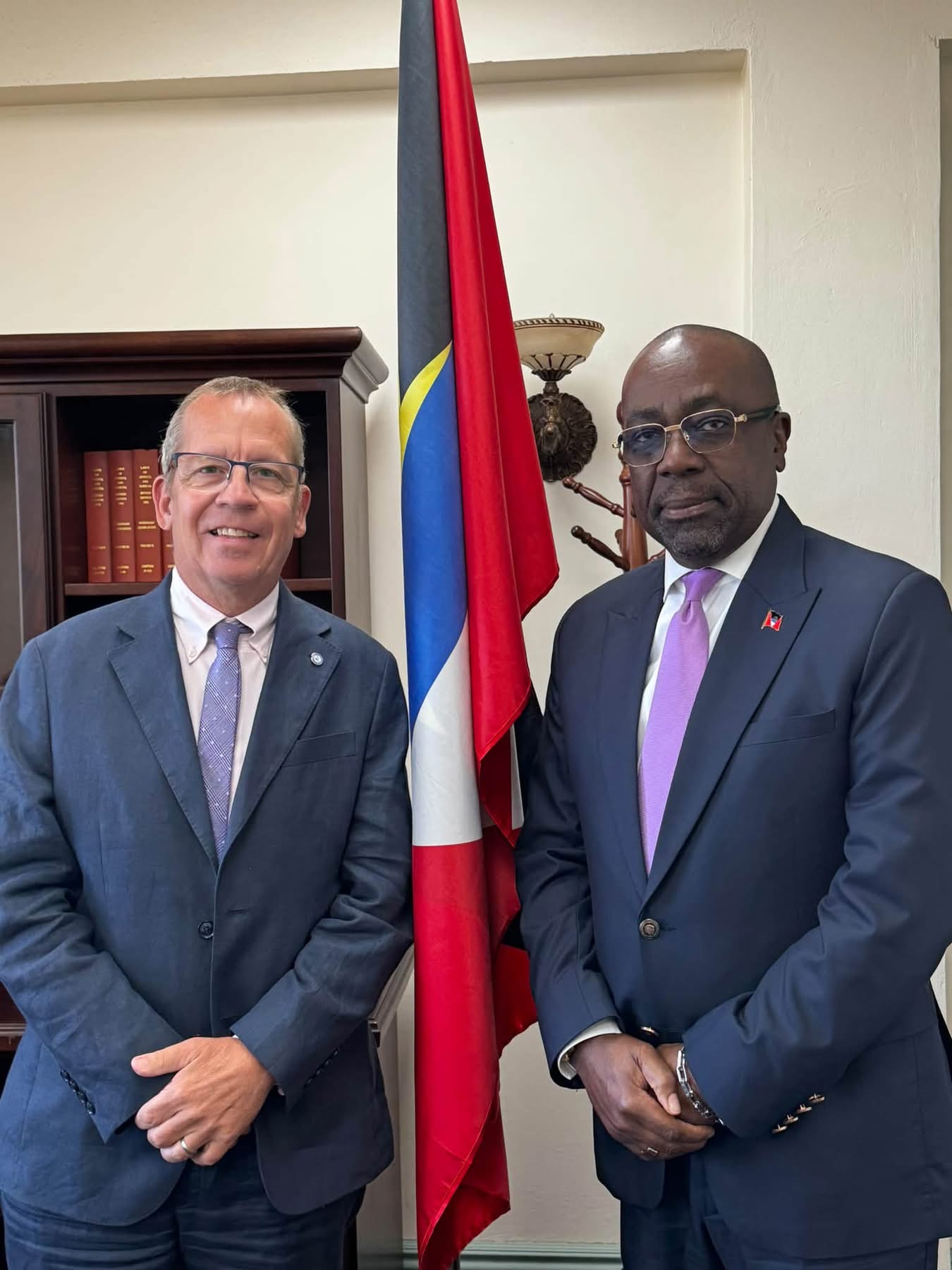
In a high-level diplomatic engagement held in St. John’s, Antigua and Barbuda, Minister of Foreign Affairs the Honourable E. P. Chet Greene welcomed United Nations Resident Coordinator for Barbados and the Eastern Caribbean Simon Springett for a productive courtesy call focused on deepening cross-institutional collaboration across a suite of national and global development agendas. The wide-ranging bilateral dialogue covered key priority areas including streamlined inter-agency coordination, inclusive digital transformation, targeted development financing, and expanded strategic alignment between Antigua and Barbuda’s national governance and the broader United Nations operational system. A central topic of discussion was the upcoming 23 October 2026 signing of the 2027–2031 Multi-Country Sustainable Development Cooperation Framework (MSDCF), a milestone that will position Antigua and Barbuda as the very first Eastern Caribbean nation to formalize its commitment to the updated UN regional cooperation architecture. The new framework is intentionally structured to advance the implementation of Antigua and Barbuda’s landmark 2024–2034 Agenda for Small Island Developing States (ABAS), while embedding robust, standardized systems to track on-the-ground outcomes, measure incremental progress, and enforce greater public accountability for all development-related investments and initiatives. During the exchange, Minister Greene outlined critical upcoming national milestones, most notably Antigua and Barbuda’s second Voluntary National Review (VNR) scheduled for 2027, a formal assessment process designed to map the country’s progress against the UN Sustainable Development Goals (SDGs), identify unaddressed implementation gaps, and tighten policy alignment between the global SDG framework and the locally tailored ABAS roadmap. The two leaders also explored the feasibility of launching a Voluntary Local Review (VLR) mechanism, a policy tool that would embed SDG localization at the community level and create more granular, hyper-local tracking of sustainable development outcomes outside of national-level reporting. Minister Greene further emphasized the ongoing strategic value of advancing the Small Island Developing States (SIDS) Centre of Excellence, a purpose-built regional hub that will deliver targeted research, grassroots innovation, tailored capacity-building programs, and context-specific practical solutions to address the unique, disproportionate development challenges faced by small island nations across the Caribbean. Additional agenda items included planning for an upcoming UN Conference on Trade and Development (UNCTAD) training workshop and high-level dialogue to be hosted in Antigua and Barbuda under the regional project titled “Stronger and Greener Productive Capacities for Just Transitions in Caribbean SIDS”. The event is set to facilitate targeted cross-stakeholder dialogue on sustainable economic diversification, equitable green transition pathways, and the expansion of local productive capacities that will boost long-term economic resilience and global market competitiveness for vulnerable small island economies. The constructive courtesy visit concluded with both parties reaffirming their shared commitment to sustained, results-focused partnership between the Government of Antigua and Barbuda and all UN operational entities, with a shared recognition that coordinated, locally centered collaboration is the most effective path to turn global sustainable development commitments into tangible, measurable improvements in quality of life for all Antiguans and Barbudans.
Antigua and Barbuda to become first Eastern Caribbean country to sign new UN development framework following Greene meeting