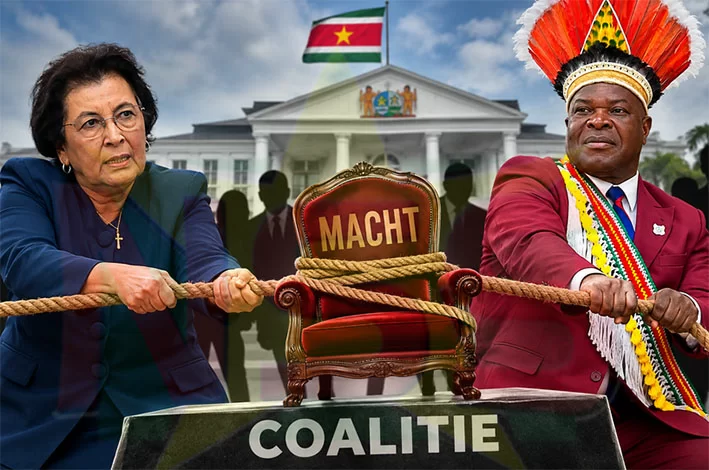
A high-stakes confrontation at Suriname’s Telecommunication Authority (TAS) this week has pulled back the curtain on a long-standing pattern of political governance in the country, where partisan interests, coalition deals and raw power routinely override legal frameworks and institutional mandates. What began as a routine attempt by the TAS Supervisory Board (RvC) to assume its legally assigned governance responsibilities devolved into open conflict, with board members alleging they were forcibly removed from the premises and widespread confusion over the unapproved presence of police officers at the site.
The clash quickly spilled over into the National Assembly, where members of the ABOP party fiercely defended sitting TAS director Wendy Jap-A-Joe, walking out of plenary proceedings mid-debate after a heated exchange. What was initially framed as a narrow labor and legal dispute has rapidly transformed into a full-blown political power struggle, raising urgent questions about whether the rule of law will prevail over the interests of the most politically powerful.
Veteran political observers note that this pattern of prioritizing political influence over institutional process is not new. ABOP leader Ronnie Brunswijk openly prioritized retaining political clout during the previous Santokhi administration, and that approach has continued unchanged under current President Jennifer Simons. While bargaining for influence is a standard part of any coalition governing arrangement, it becomes actively harmful when institutional operations and administrative procedures are made fully dependent on partisan approval.
Brunswijk has attempted to distance himself from the confrontation, claiming ABOP is not fighting to keep the TAS director post, which he says was allocated to coalition partner NPS as part of a pre-government power-sharing deal. He also denies ordering his parliamentary caucus to mount the aggressive defense of Jap-A-Joe that led to the parliamentary walkout. But these claims directly contradict both the caucus’s public actions and Brunswijk’s own long-stated position that ABOP parliamentarians do not make major independent decisions of this nature. Brunswijk has publicly opposed the RvC’s attempt to take over leadership, insisting Jap-A-Joe must remain in post until a court issues a final ruling on the dispute. Even without a direct order to his caucus, political analysts agree Brunswijk retains full political accountability for the group’s actions.
Contradictory public statements about behind-the-scenes coalition agreements have only deepened public uncertainty and distrust. The ABOP’s actions have created the clear impression that a private deal was struck to allow Jap-A-Joe to remain in post, a claim President Simons explicitly denied Wednesday evening. Simons now faces growing pressure to publicly disclose all existing coalition agreements covering institutional appointments and responsibilities, and to clearly outline where the boundaries of partisan bargaining end. Critics emphasize that no private political deal can ever override legally defined institutional powers, and that state bodies are not pieces of property to be divided up between coalition partners.
Surinamese jurist Jennifer van Dijk-Silos has noted the core legal dispute turns on the conflict between Jap-A-Joe’s statutory appointment term and his formal employment contract, a question that will ultimately require a judicial ruling. But even a clear legal disagreement, she argues, does not justify a political power struggle that inflicts lasting damage on the integrity of a core state institution. While Simons has stated she respects the rule of law and will await the court’s decision, analysts say her responsibility goes far beyond passive waiting. As head of government, she is obligated to guarantee that ministers, agency directors, oversight boards and state institutions can all exercise their legally mandated powers without constant partisan interference and backroom negotiation.
Many analysts agree the escalation at TAS should never have been allowed to happen. The physical confrontation, parliamentary tensions and unanswered questions about the unauthorized police presence all demonstrate how far inter-party relations have deteriorated in the current coalition. Minister of Justice Harish Monorath has launched an internal investigation after confirming the national police leadership never issued an order to deploy officers to the TAS building. This deployment must be fully clarified, observers stress, because police officers must never be seen as serving the interests of a single political party.
Every new clash over coalition power sharing erodes Simons’ authority as president. If she is forced to constantly mediate to keep one coalition partner satisfied, there is a growing risk that preserving the coalition will become a higher priority than delivering effective, accountable governance. Political stability only has value if it enables the government to deliver on its policy promises. For years, Suriname’s political leaders have publicly committed to reforming state-owned enterprises and public institutions, promising more professionalism, expert leadership, stronger oversight and less political interference. Yet disputes over appointments and control have sparked repeated conflicts, derailing progress on these promised reforms. It is worth noting that Simons centered her election campaign on a promise to break with this old pattern of governance.
Unlike ordinary state-owned enterprises, the TAS is a statutory regulatory body with a mandate to oversee the entire national telecommunications sector. When its governance structures spin out of control due to political infighting, it undermines public trust in professional leadership across all state institutions. When political loyalty routinely displaces expertise, and institutions spend all their energy fighting internal power battles instead of delivering on their public mandates, the entire country suffers. While Brunswijk and the ABOP have every right to advocate for their political interests, when every major government decision becomes dependent on their approval, the entire administration becomes hostage to internal power dynamics. Simons must break this cycle. Preserving the coalition cannot come at the cost of undermining her own presidential authority.
Across Suriname, public pressure is growing for Simons to take a harder line against the ABOP. Some voices have even called for a restructuring of the coalition and early general elections. But analysts warn that a coalition collapse or early elections are no silver bullet, and any such process must strictly follow constitutional provisions. At the same time, holding the coalition together at any cost does not justify unlimited damage to the country’s governance. While a court ruling can resolve the specific legal dispute around Jap-A-Joe’s appointment, it cannot fix the dysfunctional political culture that allowed this crisis to escalate in the first place. That is Simons’ real challenge: to deliver on her promise of change by setting clear boundaries to unacceptable partisan pressure.
The longer Brunswijk and the ABOP are allowed to embed their power influence into daily government operations, the weaker the governing coalition will become. The longer Simons allows this dynamic to continue, the greater the risk she will lose the public trust that brought her to office. Suriname does not need a government that only exists to stay united; it needs a government that is actually capable of governing.