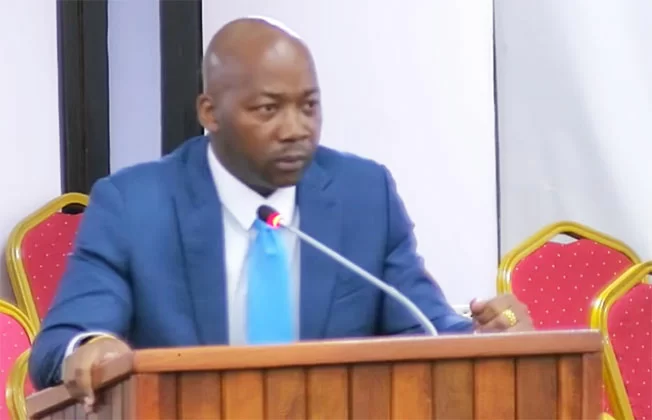
Scheduled rolling blackouts across Suriname are projected to continue for approximately five more weeks, potentially extending through the end of November, Natural Resources Minister David Abiamofo confirmed Thursday during an address to the National Assembly. In his remarks to legislators, the minister outlined that strain on the country’s current power generation capacity will remain high for the immediate future, and required preventive maintenance work could add an extra week of controlled power cuts to the timeline.
Abiamofo emphasized that Energiebedrijven Suriname (EBS), the country’s national power utility, is deploying all available resources to maintain consistent generation output where possible. Even so, several generation units must be temporarily taken offline to complete critical preventive upkeep, with outages for individual units lasting between two and four days. Delaying this scheduled maintenance indefinitely is not a viable option, the minister noted, because deferred work significantly raises the risk of catastrophic, longer-term equipment failures that would worsen the power crisis.
During periods of extreme heat, national electricity demand has surged to as high as 290 megawatts, with a record peak of 296 megawatts recorded earlier this week. Current combined generation capacity from all operational power facilities only ranges between 274 megawatts and 291 megawatts under current operating conditions. This gap creates supply deficits during peak demand hours, a gap that widens further when any generation unit goes offline for maintenance or unplanned repairs.
Output from the Afobaka Hydroelectric Plant, one of Suriname’s core generation facilities, remains stable at roughly 110 megawatts currently, though reservoir water levels sit two to three feet below the long-term average. The minister anticipates that the situation will improve slightly next week, when the plant’s newly reactivated sixth generation unit will add approximately 30 megawatts of additional hydropower capacity to the national grid.
Over the coming weeks, preventive maintenance is also scheduled for thermal generation units operated by Staatsolie Power Company Suriname (SPCS) and EBS’s facility on Saramaccastraat. For the longer term, the government has laid out a multi-pronged strategy to expand total generation capacity. SPCS is set to add two 17-megawatt thermal generation blocks, for a total of 34 megawatts of new thermal capacity. EBS is also advancing a 28-megawatts utility-scale solar energy project, and discussions are ongoing for an additional 100 megawatts of thermal generation expansion at EBS facilities. Those discussions between the utility and the national government are still ongoing, Abiamofo said.
The minister warned that large-scale thermal generation expansion is a multi-year process, requiring between two and three years for planning, procurement and construction. By contrast, solar energy projects can be brought online much more quickly to help ease near-term capacity strains.
To minimize disruption to critical public services, Abiamofo confirmed that scheduled rolling blackouts will exclude key infrastructure wherever possible. Drinking water treatment stations operated by SWM will be spared from planned outages, as will hospitals, the Santo Boma prison, and the country’s main international airport. If any of these facilities do lose power, the minister noted, the outage would stem from an unplanned fault rather than the controlled loadshedding program.
Responding to questions about power supply for the country’s mining sector, Abiamofo clarified that Suriname is bound by a contractual agreement to deliver 30 megawatts of power to Rosebel Gold Mines. All other mining companies operating in the country generate all or most of their own power on-site to meet operational demand. The minister pledged to provide the National Assembly with detailed written information in the coming days about planned investments across hydropower, solar energy, and thermal generation projects.