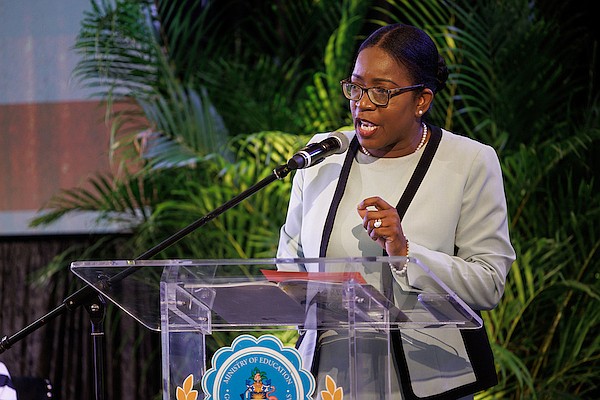
The Bahamas’ Ministry of Education, Science and Technology has launched a sweeping strategic initiative to overhaul the nation’s education landscape, setting a bold national target of boosting the high school graduation rate to 85 percent by 2030 alongside four core pillars of reform, senior government officials confirmed at a public launch event hosted at Baha Mar this week.
Education Director Dominique McCartney-Russell, who first announced the plan during the launch event, outlined that the ambitious roadmap is anchored in four interconnected priorities that touch every layer of the country’s education system. The first priority centers directly on student outcomes, with a targeted focus on strengthening foundational literacy and numeracy skills, early identification of individual learning gaps, and expanding flexible pathways to success that cater to diverse student interests. These pathways range from traditional academic tracks to technical vocational training, entrepreneurship, innovation, and technology-focused programs, ensuring no student is locked out of opportunity regardless of their career goals.
The second priority invests in the backbone of the education system: Bahamian educators and school leaders. McCartney-Russell emphasized that no education system can outperform the quality of the people leading it, noting that the plan prioritizes expanded professional development opportunities, stronger school leadership training, and systemic support to reward and elevate excellence across the teaching profession.
Third, the ministry aims to revamp internal operations to boost governance, public accountability, and overall management efficiency. McCartney-Russell explained that all administrative and policy changes will remain aligned to the core mission of advancing student success, eliminating misalignment and wasted resources that distract from that central goal.
The fourth and final priority drives systemic modernization, focusing on full digital transformation of teaching and learning, upgrades to aging school infrastructure, and building campuses that are equipped to meet the evolving skill demands of the 21st-century global economy.
McCartney-Russell stressed that these four pillars are not siloed initiatives, but connected commitments to a single unifying national mission: ensuring every Bahamian child has an equitable shot at success, regardless of where they live or what personal circumstances they face. While the 85 percent 2030 graduation rate serves as a clear, measurable key performance indicator for the reform effort, she added that the government’s long-term ambition extends far beyond that metric, working toward a future where access to opportunity is universal across the archipelago.
Notably, the ministry emphasized that systemic change cannot be delivered by the government alone, framing the initiative as a collective national effort where every stakeholder has a role to play. To formalize cross-sector collaboration, the launch also introduced the new Bahamas Education, Science and Technology (BEST) Foundation, an independent non-profit organization led by a private-sector dominated board of directors. The foundation is designed to give private businesses, philanthropic groups, and community partners a structured avenue to contribute financial and material resources directly to school improvement and student opportunity expansion, rather than channeling contributions through government bureaucracy.
Education Minister Chester Cooper noted that the BEST Foundation holds personal importance for his work, explaining that the entity’s mission is to turn widespread public goodwill for education improvement into tangible, on-the-ground impact for students. “It’s not about giving to government. It is about giving to our children and giving them a better chance, a chance to learn, a chance to discover their gifts, a chance to pursue dreams that might otherwise remain beyond their reach,” Cooper said, urging all members of the public to join what he framed as a national education revolution.
The launch event, which was attended by Prime Minister Philip Davis and multiple senior government officials, also centered student and educator voices. Attendees viewed student performances, watched pre-recorded video messages from Family Island educators highlighting unmet resource needs for both students and teaching staff, and heard directly from students about the opportunities and resources they hope the reform plan will deliver. In addition to the strategic roadmap, the ministry also unveiled a refreshed institutional brand as part of its broader transformation effort.