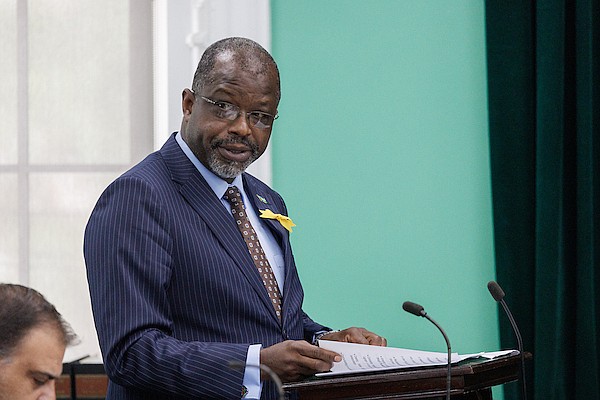
More than a decade after a police shooting left a 32-year-old Bahamian man permanently paralyzed, a fresh legal dispute has erupted over the nearly $942,000 in damages he was awarded by the courts, with the national government announcing plans to appeal the ruling to reduce the payout. Attorney General Wayne Munroe confirmed the government’s position to local media this week, noting that the state will move forward with the appeal unless the claimant, Thorne Clarke, agrees to allow his existing National Insurance benefits to be deducted from the total award.
According to Munroe, the decision to exclude existing state benefit payments from the damages calculation constitutes a clear error of law. Under existing rules, any public benefits paid out to cover the same loss addressed in a civil damages award — including disability support, unemployment compensation, and other related payments — must be subtracted from the total final amount the government is ordered to pay. “If the court is awarding you compensation for being disabled, any disability benefits you have already received should be deducted from that sum,” Munroe explained.
Clarke was just 22 years old when he was shot by police on February 13, 2016, near the Wilson Tract area. The bullet left him paralyzed from the chest down, a permanent disability that has required lifelong round-the-clock medical care and adaptive equipment. Assistant Registrar Jonathan Deal handed down the $941,893.91 judgment on September 21, marking the end of a years-long legal battle that began when Clarke filed suit against the Commissioner of Police and the Attorney General in 2018.
A default judgment was entered against the defendants in 2019 after they failed to file a formal defense, but the process of assessing damages dragged on for an additional seven years. Clarke originally sought $2.064 million in compensation, while government legal representatives proposed a total award of roughly $539,000. To date, Clarke has only received an $80,000 interim payment, approved after he developed a severe pressure sore that required urgent surgical intervention. That leaves $861,893.91 outstanding before adding interest and legal costs, and Clarke told local reporters this week that his recommended surgery still has not been scheduled, even as he works to coordinate care.
Even with the full award, Clarke says the payout will not come close to covering the lifetime of medical and accessibility costs he faces. He requires regular supplies including disposable diapers, catheters, and pressure-relief wheelchair cushions that need frequent replacement, and he still lacks a fully accessible vehicle and critical modifications to his home to accommodate his disability. The shooting has also decimated his family’s financial stability: his mother closed her small business and left work to care for him in the years after the incident, while his father continued working past retirement age just to cover basic household bills.
To date, Clarke says he has never received an official apology from law enforcement, nor has he been given the names of the officers involved in the shooting. Police have claimed that Clarke attempted to drive his vehicle at an officer, who opened fire out of fear for his safety — a claim Clarke has repeatedly denied. Because the case ended in a default judgment, these conflicting accounts were never tested in a formal trial, with post-judgment proceedings focusing exclusively on calculating damages.
Munroe noted that Clarke has so far rejected a proposed settlement to resolve the dispute, and that the government’s legal team has concluded the current damages assessment is legally flawed. “There is already a court order and an assessment, but based on my review of the file, the failure to deduct National Insurance benefits is wrong as a matter of law,” Munroe said. “The question now is how we correct that legal error.” This position marks a shift from Munroe’s earlier public comments, when he stated the government should prioritize settling claims it is liable for to avoid running up unnecessary legal costs, and that his office was still reviewing whether to appeal any portion of the award.
For his part, Clarke says he hopes his high-profile case will bring greater urgency to resolving civil claims involving life-altering injuries, and push policymakers to improve accessibility standards for people living with disabilities across the Bahamas.