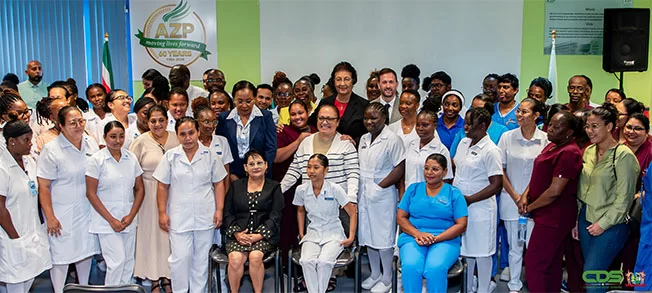
Paramaribo Academic Hospital (AZP) in Suriname has launched an ambitious one-year training initiative aimed at upskilling 175 of its registered nurses and raising the standard of acute care delivery across the facility. The €600,000+ Basic Acute Care (BAZ) program is designed to equip participating nurses with the critical skills needed to intervene rapidly when patients experience sudden health declines, a key gap that the hospital aims to close through targeted investment in workforce development.
The official launch ceremony, held October 19 in the auditorium of AZP’s Medical Diagnostic and Treatment Center, was attended by Suriname’s President Jennifer Simons, who used the occasion to highlight both the program’s importance and the ongoing challenge of nurse emigration from the country, primarily to the Netherlands. Over the 12-month program, participating nurses will master evidence-based resuscitation protocols, learn to rapidly identify respiratory distress, develop skills for timely intervention in both internal and external bleeding cases, and gain training to spot early warning signs of deteriorating patient health. A custom-built online learning platform called KWEKI has also been developed to let trainees deepen their knowledge outside of in-person sessions.
The training is being led by the Netherlands-based ExpertCollege-Nightingale Institute, an organization specializing in acute care training for healthcare professionals. The investment forms part of the Surinamese government’s Health Care Facilities Readiness Initiative, a broader push to strengthen local healthcare infrastructure. AZP Nursing Director Faucia Niamut noted that the curriculum balances structured theoretical learning with hands-on practical training to ensure nurses can apply new skills directly in clinical settings.
During her remarks at the launch, President Simons emphasized that high-quality patient care extends far beyond technical medical and nursing knowledge. She stressed that care providers must also prioritize addressing the fear, pain, and anxiety that patients bring when they seek treatment. Beyond praising the new training program, she drew attention to the widespread outflow of Surinamese nursing professionals to the Netherlands, a trend that has strained local healthcare capacity.
President Simons confirmed that she has already raised the issue with Dutch Prime Minister Rob Jetten, putting forward a collaborative proposal to address the brain drain. “If you need nurses from Suriname, you need to help us train them here,” she stated. Her proposal outlines a bilateral partnership framework: the Netherlands would contribute to expanding nurse training capacity in Suriname, and a portion of the newly trained professionals would be allowed to work temporarily in the Netherlands to gain international experience, before returning to strengthen Suriname’s domestic healthcare system. While no final agreement has been reached yet, President Simons said she will continue advancing the proposal in future bilateral discussions.
Suriname’s Minister of Public Health, Welfare and Labor André Misiekaba echoed the government’s commitment to improving care, noting that healthcare should first and foremost be a community-focused public service, not a profit-driven enterprise. He emphasized that quality of care must remain the top priority, even if it comes at the cost of reduced commercial revenue. Misiekaba confirmed that the government is prepared to make significant investments in growing and upskilling the local healthcare workforce, and called on domestic and international institutions and experts to strengthen collaboration and pool available knowledge. The government’s long-term roadmap aims to build a solid foundation for Suriname’s healthcare system over the next three to four years, with the ultimate goal of delivering guaranteed, accessible care to all Surinamese communities within five to ten years.