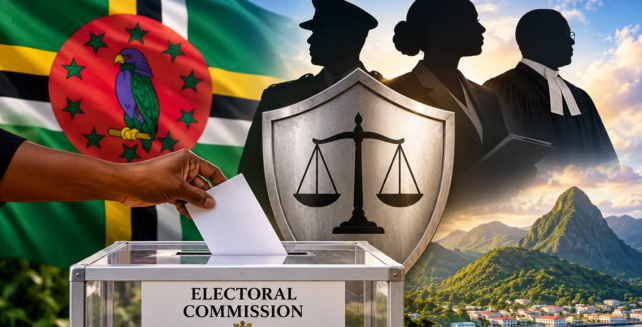
Dominica is currently facing a growing constitutional debate centered not on procedural rules of elections, but on the foundational integrity of the body tasked with managing them: the Electoral Commission. At the heart of this discourse is a critical, existential question: do members of the commission truly operate as the independent constitutional body the nation’s founding law mandates, or do they function as partisan actors disguised as independent officials? If the latter holds true, demands for their exit from office are not just partisan political posturing — they are a non-negotiable requirement under the constitution.
The nation’s constitution lays out clear, unambiguous rules for the Electoral Commission’s mandate and structure. Section 38 of the constitution grants the body full responsibility for voter registration and the overall administration of general elections. Section 56 further defines its composition: a chairman appointed by the President acting on the President’s own independent judgment, two members appointed by the President on the advice of the sitting Prime Minister, and two additional members appointed on the advice of the Leader of the Opposition. Most critically, the constitution includes a core safeguard: in carrying out its constitutional functions, the commission must not be subject to direction or control from any other person or state authority. This foundational principle of independence was later reaffirmed in the 2024 Electoral Commission Act, Section 6 of which restates the commission’s independent status and freedom from external control, and adds a formal mandate that all elections be conducted in a free, fair, transparent, impartial, and credible manner, alongside a code of conduct requiring strict neutrality and the avoidance of conflicts of interest. For this reason, independence is not a discretionary courtesy granted to commissioners — it is a binding constitutional requirement that spans three core dimensions: institutional independence from political interference, personal independence of commissioners, and full financial autonomy.
Constitutional standards for electoral bodies do not only require legal independence on paper — they require that the public perceive the body to be independent. Under the long-standing common law principle of reasonable apprehension of bias, or nemo judex in causa sua (no person may be a judge in their own case), a body that fails to appear independent to a reasonable, informed citizen fails to meet constitutional requirements. By this standard, the current Dominica Electoral Commission falls short.
First, the existing appointment structure creates inherent structural vulnerability. While the split nomination system (two from the prime minister, two from the opposition) was designed to achieve partisan balance, it carries unique risks in a small nation like Dominica. The President, who appoints the commission chairman, is himself elected by the House of Assembly on the nomination of the sitting prime minister — a dynamic that leads the public to reasonably question whether independent judgment can survive existing political arithmetic. Legal scholars have long warned that without stronger guardrails, it is nearly impossible for a politically appointed head of state to select truly neutral electoral officials.
Second, the public professional and political associations of current commissioners have fueled widespread concern. During parliamentary debate on the 2024 Electoral Commission Bill, formal concerns were raised over potential conflicts of interest among sitting members. Public reports confirm that three current commissioners, including the chairman, hold ties to Dominica’s high-stakes Citizenship by Investment (CBI) program — a flagship government policy that generates hundreds of millions of dollars in state revenue and is administered directly under the control of the executive branch.
To be clear, involvement in the CBI program is not inherently illegal. The constitutional problem here is the clear conflict of interest. Commissioners are tasked with acting as neutral referees in electoral contests between the ruling government and opposition parties. When these referees hold concurrent financial or advisory ties to the government’s most lucrative policy, it creates a textbook violation of the Electoral Commission’s code of conduct. Even if this conflict never influences an actual decision, its mere existence erodes public trust in the commission’s independence and undermines the overall integrity of the electoral process.
These risks have already been flagged by international election monitors. The Inter-American Commission on Human Rights, which has tracked electoral reform in Dominica since 2018, previously noted that draft reform bills omitted critical safeguards to guarantee the commission’s independence. Observer missions from the Organization of American States, the Commonwealth, and CARICOM have repeatedly called for institutional modernization for the same reason: an electoral body that is perceived to be politically captured cannot deliver legitimate, credible elections, even if its technical administration on polling day is flawless.
There can be no negotiation on this core requirement of independence. A partisan or seemingly partisan Electoral Commission cannot fulfill its constitutional mandate under Section 38. Every core function it carries out — from voter registration and voter list purification to eligibility verification and election day administration — depends entirely on public confidence that the referee has no personal or financial stake in the election outcome.
The Caribbean Court of Justice, in rulings following the 2019 general election, explicitly warned that future Dominican elections should not proceed with the same institutional taints. That judicial warning was not about the security of ballot boxes — it was about the fundamental institutional legitimacy of the entire electoral process. When Dominican citizens question whether commissioners are acting independently or as partisan loyalists, they are not engaging in partisan insult. They are applying the exact constitutional standard the framers of the constitution intended.
If the current commission wishes to disprove public perceptions of partisan capture, the path forward is already laid out in existing law. First, all commissioners must comply with the 2024 Act’s Section 18 requirement for full public disclosure of all direct and indirect interests, including stakes in CBI-approved projects, corporate directorships, and government contracts. Second, any commissioner with a material interest in a major government policy that is a central electoral issue should automatically recuse themselves from all decisions related to electoral policy, funding, and voter eligibility. Third, voluntary resignation is an ethical and constitutional duty for commissioners who cannot demonstrate full personal and financial independence. While Section 56(6) of the constitution allows for removal of members for inability or misbehavior, proving political bias in a formal tribunal is often difficult. Under the commission’s code of conduct, breach of neutrality counts as misconduct. For commissioners unable to prove their independence, voluntary resignation is the only honorable and constitutionally consistent course of action — it is not a punishment, but the required cost of upholding democratic guardrails. Finally, long-term structural reform is needed: Dominica should amend Section 56 of the constitution to require public vetting of all commission nominees, bipartisan or supermajority parliamentary approval for the chairman, a five-year cooling-off period for individuals with recent active partisan ties or lucrative government-dependent contracts, and the establishment of an independent commission secretariat funded through a dedicated independent Electoral Commission Fund, rather than via discretionary ministerial allocations.
The Dominican constitution does not demand perfection from the Electoral Commission, but it does demand uncompromised independence. Independence is not just a slogan printed in legislation — it is a daily practice of maintaining distance from executive power, avoiding financial ties that create conflicts, and upholding visible, unquestionable neutrality. Until Dominican citizens can answer the core question of “Who are the people leading our Electoral Commission?” with the answer “five independent citizens we have no reason to distrust,” the commission’s work will remain constitutionally incomplete, no matter how smoothly it manages polling day operations. If the current commission cannot meet this fundamental constitutional test, as the public widely intuits, it has no business continuing to hold the office that the constitution reserves only for democratic guardians.