In a ceremony held on October 15 marking the official handover of the Booby Alley apartment development to the government of Antigua and Barbuda, the nation’s prime minister delivered a bold statement reaffirming his administration’s unwavering commitment to its diplomatic relationship with the People’s Republic of China. Stating that the country would defend this friendship in every international forum, regardless of potential repercussions, the prime minister emphasized that China stood with Antigua and Barbuda at a critical time when the nation sought support to build its core socioeconomic infrastructure.
This public stance on China is not the only controversial decision facing the current administration, however. In a separate policy move that has drawn sharp criticism, the prime minister has agreed to accept up to 28 deportees annually from the United States for an unspecified number of years. This agreement moved forward even after U.S. Secretary of State Marco Rubio explicitly confirmed that the deportee pool would include individuals convicted of serious violent and sexual offenses, including pedophilia and rape.
In an op-ed critical of the government, writer Yves Ephraim argues that both decisions reveal a clear and disturbing pattern: the interests of ordinary Antiguan and Barbudan citizens are consistently being sidelined to accommodate the priorities of foreign powers. The irony, Ephraim notes, is impossible to ignore: the same government that refuses to reject the U.S. deportation deal at the cost of domestic public safety is willing to risk angering Washington by standing firm in its support of Beijing.
While the nation acknowledges China’s past development assistance, Ephraim questions whether this gratitude should require risking national survival in the growing geopolitical rivalry between China and the United States. He draws a stark parallel: if a stranger assists you during a period of hardship, would you sacrifice your own innocent children to face danger on that stranger’s behalf to appease their enemy? He argues that the current administration appears willing to risk harsh U.S. sanctions similar to those imposed on Cuba, rather than prioritize the long-term security of its own population.
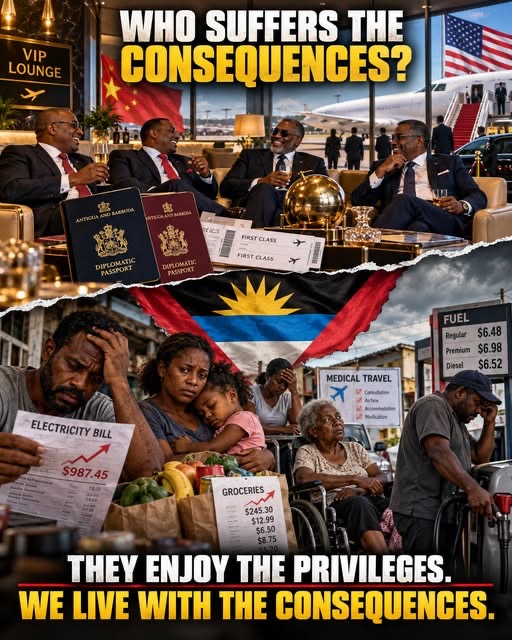
Ephraim further points out that the political leadership is insulated from the negative consequences of their decisions. Antigua and Barbuda’s leaders hold diplomatic passports that grant them unrestricted travel, including to the United States, a privilege denied to most ordinary citizens. They are also exempt from many of the taxes they impose on the general public, meaning they avoid the financial burdens their policies create. This raises critical questions about accountability: who will ultimately bear the cost of these policy choices, if not the leaders who made them?
The criticism extends to the deportation deal, where Ephraim argues public safety is once again being sacrificed to appease Washington. The safety of women and children across the country is put at risk to accommodate the absorption of convicted rapists and pedophiles into local communities, he claims. The government has framed the agreement as a humanitarian gesture, but Ephraim highlights a glaring contradiction: the administration refuses to accept Haitian refugees who are citizens of fellow CARICOM member states, yet will accept Haitian individuals deported from the U.S. under the deal. No official has yet explained this inconsistent policy.
Additional examples of misplaced priorities are cited, including the government’s hosting of the Commonwealth Heads of Government Meeting (CHOGM). Over $25 million in taxpayer funds has been spent on a new convention center that is projected to be used fewer than 12 times per year, at a time when critical domestic infrastructure – such as out-of-service MRI machines at local hospitals – remains unrepaired. The government has also raised vehicle licensing fees by 40%, with no clear long-term benefit for ordinary citizens. While a small group of connected individuals will profit from the event, Ephraim questions how the remaining 99,900 residents of the country will see any lasting gain, particularly given widespread business disruptions from road closures and shutdowns in the capital St. John’s.
These policy choices come amid a period of severe economic strain for Antigua and Barbuda, with electricity costs rising more than 100%, fuel prices increasing by more than 24%, and grocery prices reaching unprecedented highs. Ordinary residents face additional barriers: those requiring specialized medical treatment unavailable locally cannot travel to the U.S. for emergency care, a fact recently acknowledged by the country’s own foreign minister. Students seeking university education unavailable at the local University of the West Indies campus are also barred from accessing U.S. institutions. Even opening a basic bank account has become so burdensome that many struggle to participate fully in the domestic economy. Public beach access, a core quality of life benefit for locals, is gradually being restricted and handed over to foreign investors.
After decades of consistent policy that prioritizes foreign interests over domestic welfare, Ephraim challenges both the leadership and the public to confront the reality of life for ordinary Antiguans and Barbudans. He says he cannot find evidence that his quality of life has improved over the past decade, and invites residents who have experienced different outcomes to share their stories. The op-ed closes with a pressing question for the nation: are citizens content to always be the ones who suffer the consequences of leaders who put outsiders first?