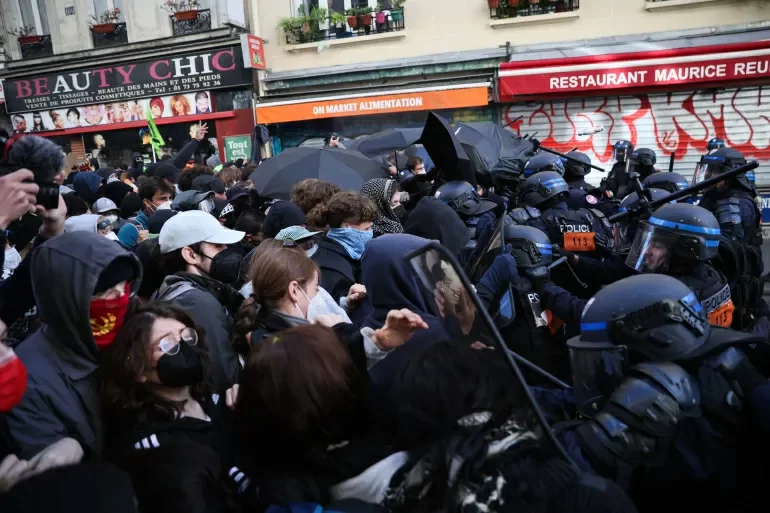
Widespread nationwide protests over soaring living costs and declining school conditions in France devolved into destructive rioting and looting across multiple major cities over the weekend, leaving nearly 1,000 law enforcement officers injured and prompting a sharp public rebuke from President Emmanuel Macron.
The unrest left a trail of damage across the country, stretching from Paris in the north to Marseille in the south, and including Lyon and Limoges. In Limoges, the city’s 19th-century historic town hall suffered extensive fire damage, while hundreds of shops and public facilities were targeted for vandalism and looting across all affected regions.
By the end of the weekend, French law enforcement agencies had taken nearly 2,400 people into custody, with more than 850 arrests alone carried out in the capital Paris. To regain control of downtown areas, police deployed tear gas and other crowd control measures, but fresh clashes between demonstrators and officers continued into Sunday in Paris. In total, close to 1,000 police officers and gendarmes were injured during the unrest, seven of them with serious injuries. French officials note the arrest count is preliminary and may be updated as processing of detainees continues.
In a nationally televised address Sunday, Macron struck a tone of anger and shame over the violence, drawing a clear line between peaceful demonstrators with legitimate social and economic grievances and actors who engaged in looting, arson and property destruction. The president emphasized that all individuals responsible for violence and vandalism would be held legally accountable for their actions.
To address the fallout from the unrest, Macron announced plans to ramp up national security measures, launch a full government evaluation of the weekend’s events, and deploy a dedicated crisis cell to support communities and residents impacted by the violence. Notably, the president stopped short of declaring a national state of emergency or implementing a nationwide curfew, a move many political observers had speculated he might announce.
The unrest grew out of months of mounting public discontent over France’s rising cost of living, skyrocketing fuel prices, and long-standing systemic issues in the country’s public education system. For weeks, young French people have led protests against inadequate school infrastructure, persistent staff shortages, and chronically underfunded education programs. What began as a targeted education protest movement broadened into a larger national pushback against declining purchasing power and the Macron administration’s broader economic policies. While the vast majority of demonstrators participated in peaceful actions, isolated clashes and violence flared in multiple locations, eventually escalating into the widespread unrest seen over the weekend.
The scale of property damage and violence has sparked intense national debate over the government’s handling of the protests and the preparedness of French security services. The administration has already committed to a full review of the weekend’s events and law enforcement response to identify areas for improvement.
The unrest has also sharpened existing political divides in France ahead of the 2027 presidential election. Opposition figures across the political spectrum have attacked the Macron government for failing to control the situation. Left-wing leader Jean-Luc Mélenchon blamed the administration for the breakdown of public order, while Jordan Bardella, head of the far-right National Rally party, called Macron’s Sunday address weak and argued the government has failed to provide adequate protection for French citizens.
Analysts note the riots are not solely a public safety issue, but a reflection of broader national frustration over economic conditions, public service investment, and declining public trust in government. While Macron has called for calm, respect, and national unity in the wake of the violence, his administration now faces the dual challenge of restoring full public order and addressing the deep-seated social and economic grievances that drove the mass protests.