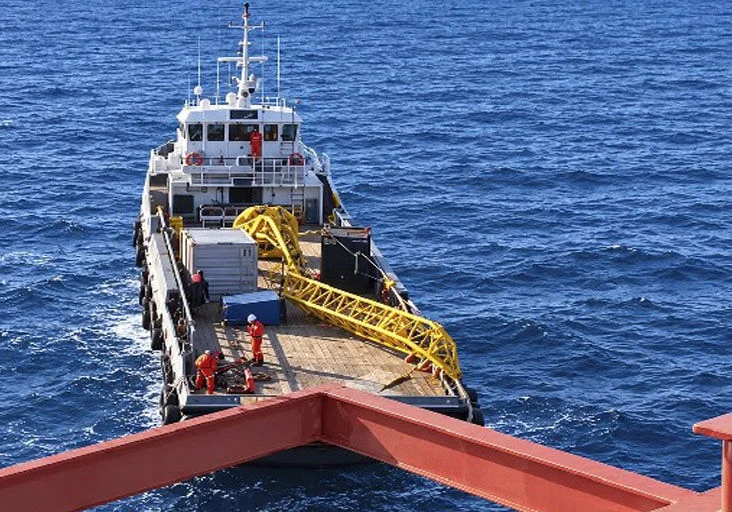
A workplace accident at one of Perenco’s offshore drilling operations has triggered a full safety audit across the company’s regional assets, with regulators launching a deep dive into crane certification and operational protocols after a structural failure left a worker injured.
The incident unfolded at approximately 4 p.m. local time Wednesday at the Samaan Alpha Drilling Field, part of Perenco’s Teak, Samaan and Poui (TSP) offshore oil and gas complex. During routine lifting operations, the crane involved unexpectedly detached from its mounting pedestal. Perenco confirmed the details of the mechanical failure in an email correspondence with the Express Thursday morning, noting that the detachment occurred during standard work activity.
Immediately following the accident, Perenco activated its formal emergency response protocol, mobilizing personnel stationed on the platform and nearby support vessels to contain the situation. The stranded crane operator was successfully retrieved without additional harm, and the injured worker was evacuated to onshore medical facilities for urgent assessment. The worker has since been released from care, according to official statements from both OSHA and Perenco. In response to the incident, the company has voluntarily paused all crane operations across its entire TSP portfolio while initial assessments are completed.
The Occupational Safety and Health Authority and Agency (OSHA) Inspectorate, the national body charged with overseeing workplace safety, confirmed it has launched a formal ongoing investigation into the root causes of the accident. In a public statement released Wednesday, OSHA outlined that the scope of the probe extends far beyond the immediate incident site: investigators will conduct comprehensive desktop audits of operational documentation, review the job descriptions and training requirements for all crane operators working across the TSP fields, and validate the certification status of every crane in operation at the three sites. This wider review is designed to identify systemic gaps that could lead to similar accidents in the future, mitigating broader risk across the complex.
OSHA emphasized that it is too early in the investigative process to draw conclusions about what caused the crane failure, what contributing factors may have been at play, or whether any violations of the Occupational Safety and Health Act have occurred. All final determinations will be rooted exclusively in the evidence collected and findings from the ongoing probe, the agency said. It also reaffirmed its commitment to conducting the investigation independently, impartially, and in line with its statutory mandate, noting that further updates will be released only when appropriate and without compromising the investigation’s integrity.
In a separate statement released the same day as OSHA’s announcement, the Ministry of Labour, Small and Micro Enterprise Development said that line minister Leroy Baptiste had personally expressed concern over the incident and extended well wishes to the injured worker for a full and fast recovery. The ministry also reiterated its longstanding commitment to holding employers accountable for meeting their legal obligations under the Occupational Safety and Health Act, Chapter 88:08, and ensuring that adequate protections are in place to prevent worker harm.
OSHA used the occasion of the incident to issue a reminder to all employers across high-risk industries of their core responsibilities under national safety legislation. The law requires employers to provide and continuously maintain safe, healthy working environments where reasonably practicable. This mandate includes implementing robust work systems, proactive risk management measures, safe and well-maintained equipment and plant, and formal emergency response arrangements to address workplace accidents when they occur.