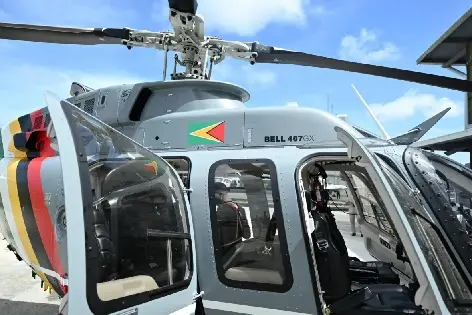
During ongoing proceedings of a presidential Commission of Inquiry (COI) investigating the sinking of the MV Barima ferry in Guyana, senior military officials have revealed critical gaps in the country’s search-and-rescue air capabilities that hampered response efforts three months after the disaster. The testimony, delivered in mid-October 2026, centers on the state of the Guyana Defence Force (GDF) helicopter fleet when the ferry sank in July 2026.
According to evidence given to the five-member inquiry panel, the GDF had only one airworthy helicopter available to deploy for search and recovery operations in the weeks following the sinking: a US$5.9 million Bell 407 single-engine helicopter purchased by the force almost a year prior. Two additional GDF aircraft, a US$10.1 million Bell 429 and a Bell 412, were classified as non-deployable and unserviceable at the time, with questions about their maintenance status deferred to the GDF’s maintenance management department by testifying air corps officers.
Captain Simon Gordon, the GDF Air Corps Flight Operations Officer, confirmed the fleet’s limited operational status in his testimony. “As was captured in my log, on the 19th of July 2026, only one helicopter was used up until the 27th, because that was the only serviceable helicopter at the time and it so happened to have been a single-engine aircraft,” Gordon told the commission. He declined to speculate on the operational restrictions that kept the Bell 407 confined to coastal search areas, deferring that explanation to the helicopter’s flight crews, but noted the clear performance gap between single and multi-engine rotorcraft.
Gordon emphasized that multi-engine aircraft offer greater operational range, longer flight time, and critical safety redundancies that enable offshore operations. “If one engine fails, the aircraft can still fly. If it’s a single-engine aircraft and that engine fails, then that produces another casualty or a non-enjoyable situation,” he told the COI.
Bell 407 pilot Lieutenant Colonel Kevin Langevine echoed those limitations, confirming the aircraft’s regulatory and safety restrictions for offshore flight. “The Bell 407 being a single-engine aircraft operates with limitations as it relates to going offshore. That aircraft is not certified to fly offshore unless there are certain parameters that can be met in terms of glide distance and operational capability. As far as the night operations go, that is also a limitation for the single-engine Bell 407 aircraft,” Langevine said. He added that the helicopter was fitted with a searchlight to allow limited nocturnal search operations on the first night of the response.
Langevine told the commission he flew search missions on the Bell 407 on July 22, 24 and 25. On his first flight, the crew traveled along the coastline between Hampton Court and Waini Point, scanning for survivors or remains of passengers from the sunken ferry, when dozens of bodies had already been recovered from coastal waters. Search operations were conducted at low altitudes between 20 and 40 feet above the water, and the crew did not use binoculars, relying instead on visual spotting. Langevine noted the crew could safely spot remains up to three nautical miles from the aircraft, but the mission focused exclusively on coastal areas because command had informed the crew most bodies were washing ashore rather than remaining offshore.