Following the release of the 2027 national budget, the government of Trinidad and Tobago has unveiled its annual Public Sector Investment Programme, detailing hundreds of millions in planned spending to upgrade two critical public sectors: national security and education. The multi-billion-dollar investment framework includes targeted allocations that will reshape core capabilities for the country’s security agencies and bring long-overdue upgrades to educational infrastructure across the nation.
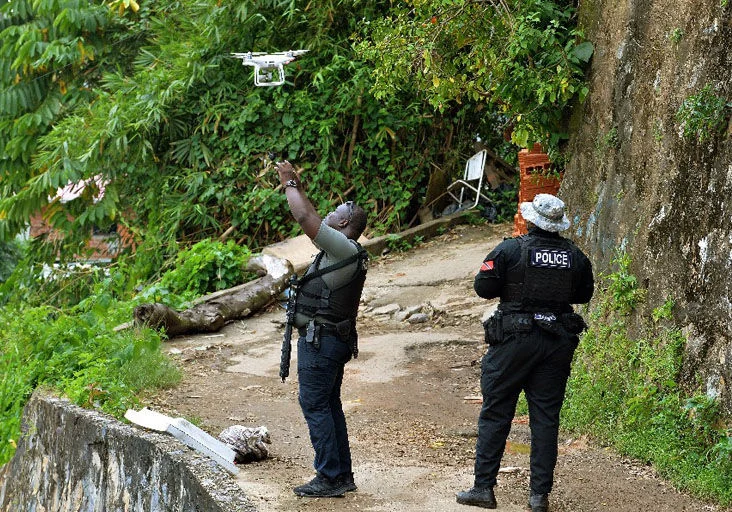
For the Trinidad and Tobago Air Guard, a $5 million allocation has been earmarked to launch a dedicated military Unmanned Aerial Vehicle (UAV) Unit, a cornerstone investment in the country’s border security and intelligence gathering efforts. This funding forms part of a broader $9.7 million package designated for infrastructure and equipment upgrades at the Ulric Cross Air Station, scheduled for disbursement during the 2027 fiscal year. According to official program documentation, the new UAV unit will significantly boost the Air Guard’s core operational capacities, including intelligence gathering, wide-area surveillance, target acquisition, and reconnaissance missions, strengthening the country’s ability to monitor territorial waters and respond to national security threats.
The national government is also directing substantial investment to upgrade the country’s forensic science capabilities. The Trinidad and Tobago Forensic Science Centre will receive $1 million in initial funding to acquire a suite of advanced analytical equipment, headlined by a high-resolution scanning electron microscope designed to improve the detection of gunshot residue at crime scenes, and an automated drugs-of-abuse testing system for toxicology screenings. Additional planned purchases include a mobile C-arm digital X-ray machine, a mass spectrometer, a Maxwell RSC 48 nucleic acid extraction instrument, and a gas chromatograph outfitted with dual mass spectrometry and nitrogen phosphorus detection for complex forensic analysis. A further $2 million has been allocated to advance the construction of a new forensic laboratory and pathology facility, covering remaining design work, project management fees contracted to the Urban Development Corporation of Trinidad and Tobago (UDeCOTT), consultancy services for contract administration, statutory approvals, engineering reviews, and ongoing technical support. Another $1 million will fund modifications to the existing Forensic Science Centre campus, including the purchase of a custom-built refrigerated mortuary container and associated civil, mechanical, and electrical infrastructure upgrades. Completing the security sector allocations, the Trinidad and Tobago Prison Service has been assigned $25.4 million to support ongoing infrastructure projects and operational programs in 2027.
Education emerges as the largest recipient of public investment in the 2027 program, with total allocations for school improvements and digital learning exceeding $300 million. The Ministry of Public Utilities will receive $311.1 million to lead the national Vacation Repair Programme and Emergency Repair Programme for public schools, with a new inter-ministerial memorandum of understanding planned between the Ministry of Public Utilities and the Ministry of Education to formalize a coordinated delivery framework for the projects. An additional $70 million has been assigned to the Resilient Schools Infrastructure Programme, which will launch reconstruction, modernization, or expansion work on seven aging school facilities in 2027. The four-year initiative targets infrastructure upgrades for 24 high-need schools across the country, with initial seed funding provided through a concessional loan agreement with the Development Bank of Latin America and the Caribbean.
To advance the government’s digital education transformation agenda, $100 million has been allocated under the national Acquisition and Delivery of Laptops and Tablets project to purchase devices and accessories for distribution to students and teaching staff across the public education system. The broader Digital Education Programme receives a total allocation of $115 million, including $10 million for expanding broadband and wireless connectivity in public schools and $5 million to upgrade the Ministry of Education’s core server infrastructure, including the purchase of a new network-attached storage server to support the ministry’s data management and cybersecurity platforms. A further $85 million is designated to fund national and additional merit-based scholarships for students who achieve qualifying results on Advanced Level examinations.
At the primary education level, $23 million is allocated for new construction and upgrading projects, covering outstanding payment obligations for the air-conditioned Marabella Girls’ and Boys’ Primary Schools, completion of Block C at Curepe Presbyterian Primary School, and remaining payments for ongoing work at San Juan Boys’ Government Primary School. An additional $15 million will fund targeted improvements, refurbishment, and extension works at primary schools across the country, addressing critical needs including electrical system upgrades, sewer repairs, plumbing fixes, flooring replacement, and ceiling and roofing repairs. For public secondary schools, $10 million has been allocated to cover similar refurbishment and extension projects to address aging infrastructure gaps.