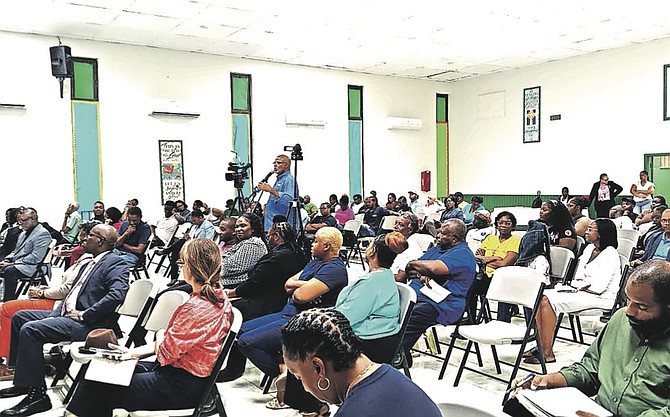
The Bahamian government is pressing forward with a transformative affordable housing initiative across Grand Bahama, anchored by a planned $50 million loan from the Inter-American Development Bank (IDB) to revitalize decaying residential stock in the island’s Garden Village neighborhood. Housing and Land Reform Minister Keith Bell confirmed that preliminary work is already well underway for the multi-phase project, which will deliver roughly 270 rent-to-own housing units to address the island’s growing unmet demand for low- and middle-income accommodation. The first phase of the redevelopment is centered on the Bain Brothers tract, where the government has already initiated property acquisitions, finalized architectural designs, secured demolition permits, and completed required pre-construction approvals. “We are ready to clear sites and break ground once the financing is finalized,” Bell stated, noting that securing the IDB loan is the final major milestone to accelerate progress. As part of the formal process for the IDB funding, the Ministry of Housing and Land Reform hosted a public consultation Wednesday evening for the program, branded Sustainable Housing Opportunities for Urban Transformation (SHOUT), at Freeport’s Pro-Cathedral of Christ the King. The event was also attended by Grand Bahama Minister Ginger Moxey and Shirley Gayle Sinclair, the IDB’s country representative for the Bahamas who oversees the SHOUT initiative. While preliminary preparatory steps have been wrapped up, Bell emphasized that the Garden Village project must meet the IDB’s strict procurement, environmental, and occupational safety standards before full construction can launch. These requirements include formal competitive contractor tendering, rigorous workplace health and safety protocols, detailed site risk assessments, regulated handling of any hazardous construction materials, and binding safeguards to protect both construction workers and nearby residential communities. Non-compliance with these standards, Bell warned, could put the loan approval at risk, and he declined to announce a firm construction start date as the government works to satisfy all conditions. To avoid mass resident displacement, the project will be rolled out in incremental phases, with developers demolishing and reconstructing structures one segment at a time. The phased model allows residents to move into newly completed units before their current homes are demolished, eliminating the need for temporary off-site relocation. Bell stressed that no resident will be forced to leave their home without a confirmed alternative living arrangement arranged by the government. “We build new housing first, then relocate residents, then demolish the old structures,” Bell explained. “This approach keeps disruption to a minimum while we upgrade the entire neighborhood.” Moxey noted that the Garden Village transformation is a joint effort between the Grand Bahama Ministry and the Ministry of Housing and Land Reform, aligned with the national Cities Forward initiative’s core priorities of inclusive development, climate resilience, and sustainable urban growth. The full redevelopment footprint extends beyond the Bain Brothers tract to include Bain Buildings, Garden Villas, existing properties along Drake Avenue, and vacant Urban Renewal land earmarked for additional multi-unit affordable housing. Years of neglect and repeated hurricane damage left the existing buildings in a state of severe disrepair, Moxey explained, making large-scale redevelopment unavoidable to improve resident safety and quality of life. She welcomed the IDB partnership, noting that the proposed financing unlocks long-stalled plans to upgrade substandard housing across the island. The first phase will see five aging blue buildings demolished and replaced with new affordable rent-to-own units, with work proceeding one building at a time to keep resident disruption low. Beyond the Garden Village project, Moxey confirmed that pre-construction work is already complete for a separate new housing development at Heritage Subdivision, where the first phase will open 18 new residential lots, with construction set to begin imminently. Bell also outlined the government’s broader long-term housing expansion strategy for Grand Bahama, identifying Wellington Pinder – where the government controls roughly 100 acres of developable land – East Coral, West Heights, and multiple other locations across the island as future housing development sites. Affordable housing expansion is not limited to Grand Bahama, Bell added: construction has already launched on new projects in Abaco, with additional developments in active planning or early implementation in New Providence, Eleuthera, San Salvador, and Andros. The overarching goal of the national initiative, Bell said, is to expand access to homeownership for low-income households and prospective buyers who have historically been locked out of the property market. Key policy measures to advance this goal include the popular rent-to-own model for new units, targeted tax concessions for affordable housing development, and plans to add new government-owned rental units across Grand Bahama. The ministry is also prepared to assist individuals who have lost money to scammers who falsely promised to secure housing for them, Bell confirmed. He declined to share specific details of ongoing cases, as they are currently before the courts, but noted that the government is working with affected claimants to find paths to affordable homeownership that fit their individual circumstances. Reaffirming the government’s commitment to inclusive housing access, Bell emphasized that vulnerable groups including single mothers and small business owners will be prioritized to ensure no community is left behind in the national expansion effort. Moxey framed Wednesday’s public consultation as a critical step to center resident voices in the redevelopment process, giving local communities the chance to share concerns, feedback, and priorities for the project ahead of construction. For residents of Garden Village, who have lived in deteriorating, substandard housing for years, the initiative represents a long-awaited chance to dramatically improve their quality of life, she added.
Government moving ahead with plans to redevelop deteriorating residential buildings in GB’s Garden Village