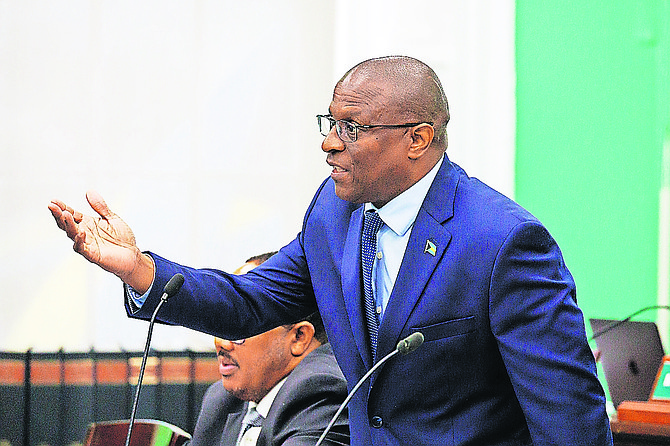
A growing political firestorm has erupted in The Bahamas over the opaque management of nearly $700 million tied to the country’s National Investment Fund (NIF), with opposition leader Michael Pintard doubling down on demands for full accountability as the Public Accounts Committee (PAC) probes gaps in governance and record-keeping.
As head of the PAC, the parliamentary body tasked with overseeing public spending, Pintard confirmed this week that the committee has still not secured critical financial documentation required to trace where the hundreds of millions in allocated funds went, and identify which officials authorized transactions carried out in the NIF’s name. His investigation has uncovered that a five-member oversight board for the fund was appointed as early as August 2025 — but the administration never made the appointments public, nor included the board in its latest official register of government committees.
The five board members confirmed by Pintard are: Sean Longley, the designated chair; Central Bank Governor John Rolle; Dianne Bowe-Pindling; Brian Jones; and Andre Rahming. Pintard has raised pointed questions about why the governing administration concealed the board’s existence for months, despite repeated inquiries from both opposition lawmakers and independent media outlets.
Most alarmingly, Pintard says evidence gathered by the PAC shows the appointed board was never convened to oversee fund activities, even as hundreds of millions of dollars were allocated and moved under the NIF’s banner. “Money was apparently being allocated and transactions were taking place in the name of the National Investment Fund, to the tune of hundreds of millions of dollars,” Pintard said in an update on the investigation. “Government statements and reports referred to activity under the Fund. Yet the evidence received so far indicates that the legally appointed Board was not involved. Indeed, one piece of correspondence received by the PAC indicates that the Board members did not even know that these activities were taking place in the Fund’s name.”
The investigation is also scrutinizing the legal standing of an NIF-labelled account held at the Central Bank of The Bahamas. According to Pintard, witness testimony and documents reviewed to date confirm the account was not created by the appointed NIF board. Instead, it was established and run through an unregulated separate arrangement directly controlled by the Ministry of Finance and the Treasury. The committee has yet to receive a clear explanation of what legal authority the two agencies relied on to open and operate the account. “Instead the testimony and documents received so far suggest that the account was created and operated under a different arrangement and under the sole control of the Ministry of Finance and the Treasury,” Pintard said. “The Committee is therefore asking a very simple but important question: If this account was not established and operated by the National Investment Fund created under the law, then what exactly was the nature of this account?”
The committee’s findings have amplified longstanding public concerns over roughly $700 million in excess government borrowing that the administration itself has publicly linked to the NIF. To date, Pintard says the PAC has not received complete transaction records that would allow investigators to confirm the final destination of the funds, the movement channels used, the specific accounts involved, or the nature of all completed transactions. “The Government publicly connected approximately $700 million in ‘excess borrowing’ to the National Investment Fund,” he said. “But the Committee does not yet have the transaction details needed to account for that money. We do not have a complete explanation of where the funds went, how they moved, what accounts were used or what transactions were carried out. The Bahamian people deserve a clear accounting of that money.”
Pintard also criticized the Ministry of Finance and the Treasury for failing to comply with formal document requests, even as the Central Bank and the Department of Legal Affairs have cooperated fully and promptly with the investigation. He noted that Central Bank Governor John Rolle and the Director of Legal Affairs have already provided useful testimony and key records to the committee, but the same cooperation has not been forthcoming from finance and treasury officials. While Financial Secretary Simon Wilson and the Treasurer have both appeared before the PAC for questioning, Pintard said large gaps remain in the official documentary record.
“We need the records of the transactions to determine how the money was spent,” Pintard said. “We also need the Ministry of Finance to point to the specific legal authority that allowed it to carry out transactions in the name of the NIF without the involvement of its Board. These are not minor or technical details. They go directly to who controlled the money, who approved the transactions and what lawful authority they relied upon.”
The governing administration has previously defended its decision to have the Ministry of Finance and Treasury manage NIF operations, pointing to the Public Finance Management Act and formal legal guidance to justify its structure. The PAC is on track to wrap up its core investigative work this month, with a full public report targeted for release by mid-November. Pintard emphasized that the probe remains ongoing, and no final conclusions have been issued to date.
In closing, Pintard renewed his call for PAC proceedings to be broadcast live to the public, revealing that the Speaker of Parliament has twice rejected formal requests to stream the committee’s meetings on the official Parliamentary Channel.