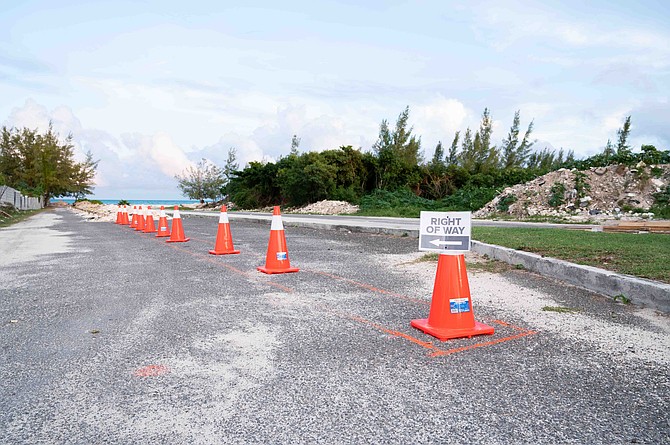
A contentious construction project for a boundary wall near Stokes Beach in Yamacraw has ignited a fierce public debate over public shoreline access in The Bahamas, pitting government authorities against a local beach advocacy group over regulatory compliance and public rights. At the center of the disagreement is Jamal Strachan, chairman of the country’s Beaches and Parks Authority, who has pushed back against growing criticism of the project, emphasizing that public access to the coastline will remain fully intact despite widespread community concerns.
The controversy erupted after a video of heavy machinery conducting excavation work near the beach spread across local social media channels, prompting alarm among residents and activists who feared the development would permanently cut off public land access to the popular shoreline. Critics have also claimed that construction was suspended after regulators intervened because the private property owner failed to secure required environmental clearance for the project.
Addressing these claims in a public defense of the approved project, Strachan clarified that the work stems from a correction to a previously erroneous property survey. He confirmed that the Ministry of Works has already issued a legally valid construction permit for the wall along the adjusted boundary line. Rejecting assertions that the project amounts to a covert privatization of public beach access, Strachan acknowledged that the existing public access route will likely need to be realigned to accommodate the new boundary. He stressed, however, that a clear, usable route to the shoreline will remain open to all Bahamian residents once construction is completed.
These claims stand in direct contradiction to statements from Dis We Beach, a local advocacy organization dedicated to protecting public beach access. The group says construction has indeed been halted, citing unresolved safety concerns and the developer’s failure to obtain mandatory environmental clearance from the relevant government body. According to Dis We Beach representatives, the property owner has acknowledged plans to build the wall all the way out to the high-water mark, a proposal that would effectively block traditional public access along that stretch of coastline.
The group also confirmed that Zane Lightbourne, who serves as both the Member of Parliament for Yamacraw and the country’s Environment Minister, has publicly raised safety concerns about the proposed wall structure. While the Ministry of Works issued the construction permit, Dis We Beach points to Bahamian regulations that require separate environmental clearance from the Ministry of Environment before any coastal construction can begin. The organization says the Environment Ministry ultimately stepped in to pause work on the project after the oversight was brought to officials’ attention.
Local reporters from The Tribune have launched their own investigation into the approval process, seeking to confirm whether all required regulatory clearances were obtained and clarify the official current status of construction work. Dis We Beach first learned of the project when community members alerted the group to active excavation on the site. During their initial visit to the property, organization representatives met with on-site security staff, left contact information to request a meeting with the developer, and observed that the existing access point remained unobstructed at that time. Even so, the group says it is seeking formal, written guarantees that public access will not be restricted once the wall is completed.
Following the initial site visit, Dis We Beach representatives spoke directly with the property owner, who has indicated a willingness to engage in dialogue over the group’s safety and access concerns. This latest dispute comes amid decades of ongoing tension over public beach access across The Bahamas, where repeated conflicts between private property developers and coastal communities have consistently raised questions about Bahamians’ legal right to reach shorelines via land routes.
Dis We Beach says the current standoff over the Yamacraw wall underscores the urgent need for new national legislation that explicitly protects and codifies public land access to all Bahamian beaches. In a public statement posted to the group’s Facebook page, representatives argued that access to the public foreshore cannot be limited to access by sea alone. “Access to the public foreshore must mean more than being able to reach it by sea. Bahamians must have protected, practical access by land, too,” the statement read. The organization says it continues to investigate the situation and will release additional updates as more information becomes available.