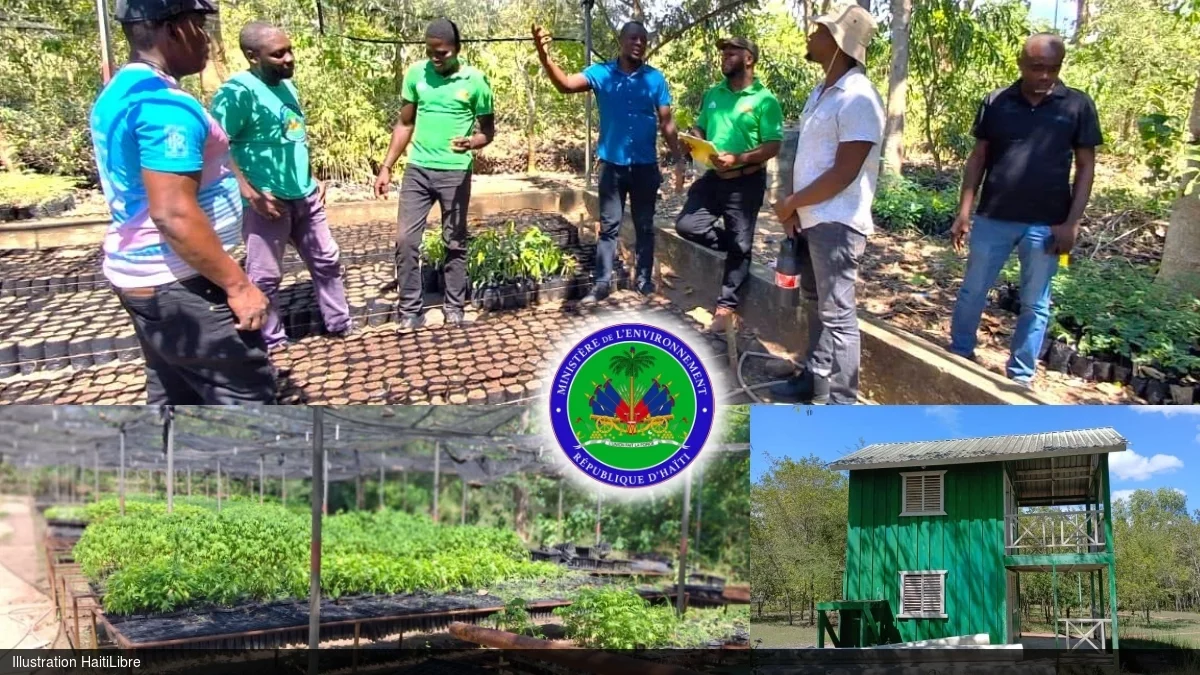
Against a backdrop of growing climate vulnerability across the Caribbean, Haitian environmental authorities and global development partners have launched a key preliminary assessment to advance a large-scale ecosystem restoration and climate adaptation initiative in Haiti’s northeast. On October 12, 2026, a joint technical team made up of specialists from Haiti’s Ministry of the Environment (MdE) and global non-profit Heifer International traveled to the Dosmond Nursery Center in the border commune of Ouanaminthe to evaluate the site’s experimental nursery model. The core objective of the field visit was to analyze how this established operating framework could be adapted to meet the urgent ecosystem restoration needs of the nearby Trois-Rivières watershed.
This assessment is an early milestone in the execution of a flagship eight-year project: “Improving Climate Resilience in the Trois-Rivières Region of Haiti through Integrated Flood Management”, which receives core financing from the Green Climate Fund (GCF). The initiative is implemented in formal partnership with the United Nations Development Programme (UNDP), with Heifer International bringing on-the-ground expertise to deliver targeted activities across the project zone. When fully rolled out, the program will deliver landscape restoration interventions across more than 25,000 hectares of ecologically degraded land within the Trois-Rivières watershed, one of the country’s most flood-prone regions.
During the day-long mission, technical experts conducted a granular review of the Dosmond Nursery Center’s full operational infrastructure. This included hands-on evaluation of production facilities, controlled germination tables, dedicated seedling development zones, and protective shade structures. Beyond physical infrastructure, the team also assessed the site’s organizational workflows and on-the-ground technical practices, to identify which approaches could be replicated when new community nurseries are established across the project’s intervention areas.
The overarching goal of expanding local nursery capacity is to build a steady, accessible supply of native forest, fruit, and agroforestry seedlings to underpin large-scale reforestation, soil conservation, and degraded ecosystem restoration efforts across the watershed. When complete, these interventions are projected to deliver far-reaching benefits: more effective integrated watershed management, and a steady reduction in the environmental vulnerabilities that amplify the risk of catastrophic flooding in the region, a threat that has repeatedly displaced local communities and damaged critical livelihood infrastructure.
A central pillar of the project’s design is the intentional inclusion of local communities in every stage of future nursery development, from initial establishment to day-to-day operation and long-term governance. This community-centered approach aligns directly with the National Community Reforestation Strategy, a national policy framework formally launched by the Ministry of the Environment in partnership with the Ministry of Agriculture just one month prior, on September 17, 2026.
By centering intentional skills transfer, cross-stakeholder sharing of context-appropriate best practices, and grassroots community participation, project organizers aim to embed ecosystem restoration work into a long-term sustainable local dynamic. This model is designed to not only strengthen natural resource protection across the watershed, but also generate inclusive, locally rooted economic opportunities for rural households that depend on the region’s natural resources for their livelihoods.
The Dosmond assessment mission serves as a critical preparatory step to identify evidence-based technical and organizational solutions that will guide upcoming interventions across the Trois-Rivières watershed. Insights and lessons collected during the field visit will inform strategic decision-making around the development and community-led governance of all new nurseries planned under the GCF-funded project.
Moving forward, Haiti’s Ministry of the Environment will continue advancing its national climate adaptation and restoration agenda alongside its international and local partners, with a focus on delivering integrated watershed management that unites landscape restoration, climate risk reduction, agroforestry expansion, and community empowerment into a single cohesive strategy.