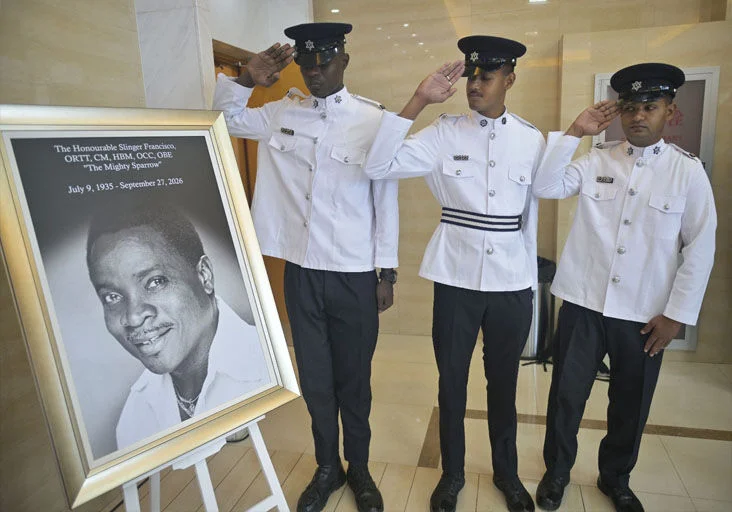
When fans of legendary calypso icon Slinger Francisco, better known by his stage name Mighty Sparrow, traveled across Trinidad and Tobago to pay their final respects at the Southern Academy for the Performing Arts (SAPA) on Tuesday, many left with unmet expectations. What had been advertised as a public viewing of the beloved performer’s body turned out to be a ceremony featuring a permanently sealed casket, leaving dozens of admirers who had hoped to see the icon one last time disappointed.
Among the attendees was 61-year-old percussionist Anselm Callender, who traveled from St Margaret’s Village in Claxton Bay for the event. This was not Callender’s first visit to SAPA in 48 hours: he stopped by on Monday to sign the official condolence book, and returned early Tuesday morning, arriving by 10:30 a.m. ready to say his final goodbye. For Callender, the connection to Sparrow runs far deeper than casual fandom. In 1983, he got his first break as a professional musician stepping in to back Sparrow at the Palms Club’s Miss Mahaica Show, when the star’s regular percussionist failed to show up for the performance.
“It was the first time I ever backed a major artist,” Callender recalled. “When I walked on, he just looked at me and said, ‘young boy, you ready?’ The drummer told me to just follow his lead, and that’s how it happened.” Like many fans, Callender praised Sparrow’s thoughtful, accessible lyricism, naming the iconic track *Education* as his all-time favorite. “Every song he sang made sense. A young person or an elder could understand it. He never sang nonsense,” he said.
Seventy-year-old Maren Alexander of Gasparillo shared Callender’s disappointment. She had made the trip to SAPA alongside a close friend, after jumping at the chance to see the legend one last time. “When I heard about the viewing, I told my girlfriend, ‘We’re going, we’re going to see Sparrow’,” Alexander told reporters. “But all we got to do was sign the condolence book. I came to see the man’s face, and I didn’t get to. That’s the hurtful part.” Alexander, who had followed Sparrow’s career since she was a young girl, celebrated his iconic stage presence and his enduring legacy as a cultural icon for Trinidad and Tobago. “He knew how to work a crowd. He would dance, he would go all across the stage, he kept the energy going the whole time,” she said. “He put our country on the map. Even though he was born in Grenada, he’s one of us. He’s a Trini through and through.”
While visitors were not able to view Sparrow’s body, the event did feature a constant soundtrack of the legend’s most beloved hits for attendees to enjoy.
Renowned Moko Jumbie master Junior Bisnath attended the viewing with a custom commemorative banner honoring the “Calypso King”, which he invited other visitors to sign before gifting it to the Francisco family. Bisnath, who has created tribute banners for nearly every iconic calypsonian who has passed in recent decades — including legends like Roaring Lion and Lord Kitchener — called the work a duty to Trinidad and Tobago’s cultural heritage. He thanked the national government and the Ministry of Culture and Community Development for their work to repatriate Sparrow’s body after his passing.
The banner is covered in vintage photos of Francisco spanning his decades-long career, as well as documentation of his countless victories as Calypso King and Road March champion. Bisnath emphasized Sparrow’s unmatched contribution to global calypso, noting his masterful command of language and willingness to tackle nearly every social and political topic in his music. “He used the English language so versatilely that he could say one word and mean something entirely different,” Bisnath explained. “He sang on almost every topic you can imagine. That’s what makes Sparrow the Calypso King — the King of the world, really.”
Also in attendance at SAPA was Ancel Roget, president general of the Oilfields Workers’ Trade Union (OWTU), who was joined by a contingent of union members. Roget used the moment to call on the national government to issue a formal national honor to Sparrow, noting that the legend had brought more international recognition to Trinidad and Tobago than any politician ever could. Roget explained that Sparrow was far more than just an entertainer: his music consistently centered the struggles of working-class Trinbagonians, which led the OWTU to award him a formal labor honor back in 2015.
“On October 29, 2015, we took the decision to give Sparrow an award on behalf of all Trinidad and Tobago’s working people,” Roget told reporters outside the venue. “Through all his songs and all his lyrics, he really addressed the issues of the small man. He sang about labor issues, about the harm capitalism causes to everyday people and the masses.” Roget added that he was grateful for the chance to have met Sparrow personally, and that the icon had a lasting impact on his own life.
Sparrow passed away last month at his home in New York City at the age of 91. Following the SAPA viewing, his body will lie in repose for public viewing from 10 a.m. to 6 p.m. Wednesday at the National Academy for the Performing Arts (NAPA) in Port of Spain. Per a formal request from the Francisco family, the public is asked not to take photographs or record video during any of the public viewing events.
On Friday, a national procession will kick off at 10 a.m. from Port of Spain’s Independence Square, traveling along Frederick Street for a national, public and cultural farewell. A formal tribute program will follow at NAPA from 1:30 p.m. to 3:30 p.m., featuring performances from steel orchestras, moko jumbies, traditional masquerade groups, and other local cultural performers, alongside dedicated tribute installations. The Ministry of Culture confirmed that arrangements are being made to allow the public to view the tribute celebration from the Grand Stand at Port of Spain’s Queen’s Park Savannah, with additional logistical details to be released in the coming days.