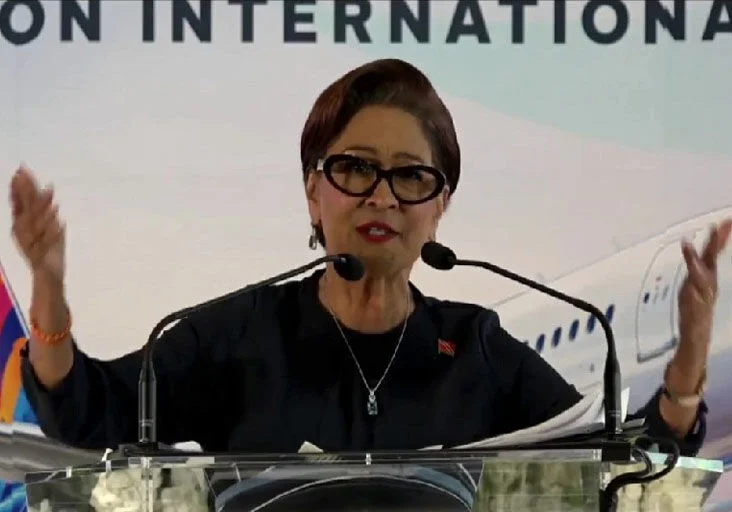
A landmark constitutional overhaul put forward by Trinidad and Tobago Prime Minister Kamla Persad-Bissessar would secure Tobago two guaranteed representation slots on the Senate’s Independent benches, marking a historic shift in the island’s standing within the national parliamentary structure.
Persad-Bissessar unveiled the plan during a formal ceremony marking the commissioning of the new East Terminal at ANR Robinson International Airport in Tobago, confirming that pre-discussions with Tobago House of Assembly (THA) Chief Secretary Farley Augustine had earned his full backing for the measure, even as the government acknowledges the proposal must still clear a structured parliamentary approval process. Local media outlet The Express reports the constitutional amendment will require a special majority vote in parliament to move forward, a high bar that leaves the final outcome dependent on cross-party support from sitting legislators.
Currently, the country’s constitution only enshrines guaranteed representation for Tobago in the lower House of Representatives, where the island holds two constitutionally protected elected seats. If approved, the reform would extend this guarantee to the upper Senate for the first time in the nation’s history. Under the existing framework, the President holds full discretionary power to appoint all nine Independent senators with no mandate to include Tobagonian representatives, even though a small number of Tobagonians have held Independent Senate seats in past and current iterations of the body.
The proposed amendment would not expand the total number of Independent senators, which remains capped at nine. Instead, it would mandate that the President must appoint a minimum of two Tobagonians from those nine positions, embedding geographic equity for Tobago directly into the nation’s founding legal document. Persad-Bissessar framed the change as a critical step toward closing long-standing representation gaps, extending the same equity principle her government applied to recent local government reforms in Trinidad.
Earlier this year, the administration passed legislation to expand Trinidad’s local government system from 14 to 17 municipal corporations, creating three new boroughs and upgrading Chaguanas to official city status, changes designed to correct historic inequities in resource allocation and community representation. “We passed that to get greater recognition, equitable recognition, and the allocation of resources to communities throughout Trinidad,” the prime minister noted, arguing that the same commitment to fairness must now apply to Tobago. Echoing a shared regional sentiment, she added, “Because as Farley told us, when Tobago wins, Trinidad wins. And when Tobago and Trinidad wins, everybody wins. Everybody wins.”
For decades, Tobago has held constitutional protection for two seats in the House of Representatives, a provision that recognizes the island’s unique identity within the republic and ensures its residents have a guaranteed voice in the elected lower chamber. Today, those two seats are held by David Thomas of Tobago East and Joel Sampson of Tobago West, both members of the Tobago People’s Party. “It’s not guaranteed which party will win them, but you’re guaranteed to have two people, Tobago and Trinidad people, sitting in the House of Representatives,” Persad-Bissessar explained, noting that the existing constitutional arrangement left a critical imbalance: no parallel guarantee existed for Senate representation.
“While Tobago is guaranteed representation in the House, the Constitution provides no corresponding guarantee for representation in the Senate. Today, I am pleased to announce that my Government proposes to introduce legislation in our Parliament to amend our Constitution to guarantee Tobago two Senate seats. And this will be in addition to your two guaranteed seats in the House,” she said. Acknowledging the legislative road ahead, she added, “We will have to see how the parliamentarians vote.”
This reform comes amid a publicly strained relationship between Persad-Bissessar and the current cohort of Independent senators, whom she has repeatedly criticized for voting down key government legislation, including controversial special operations policing measures and public procurement framework amendments. By reshaping the composition of the Independent bench to require two Tobagonian appointments, the reform could alter the voting dynamic of the upper house, though the prime minister framed the change solely as a step toward equity.
To contextualize the proposal, it is important to outline the existing structure of Trinidad and Tobago’s Senate. The 31-member body is entirely appointed by the President, with breakdown as follows: 16 government senators selected on the advice of the Prime Minister, 6 opposition senators selected on the advice of the Leader of the Opposition, and 9 Independent senators appointed entirely at the President’s sole discretion. Unlike politically aligned senators, Independent senators are chosen from outstanding leaders across economic, social, community, and professional fields, with no requirement for consultation with political leadership. All Senate appointees must be citizens of Trinidad and Tobago over the age of 25, meet statutory disqualification requirements, and vacate their seats when parliament is dissolved; the President also holds discretionary authority to revoke Independent Senate appointments at any time. Currently, only one Tobagonian, attorney Candice Jones-Simmons, holds an Independent Senate seat, with two other prominent Tobagonians having served in the role in previous years.
If passed, the reform will cement Tobago’s equal standing in national governance, aligning the island’s representation with the national anthem’s call for Trinidadians and Tobagonians to stand “side by side” as the islands of the blue Caribbean Sea.