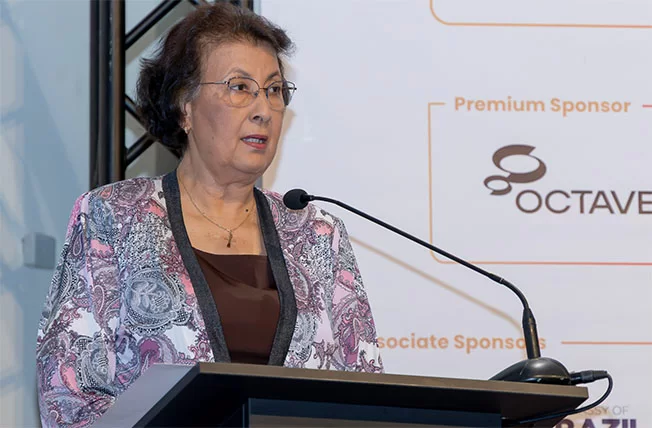
As Suriname prepares for projected rapid expansion of its burgeoning oil and gas sector, President Jennifer Simons has issued a urgent call to avoid the pitfalls of overreliance on non-renewable resource extraction, framing broad economic diversification as a non-negotiable strategic priority rather than an optional policy choice. Simons outlined her vision for inclusive, long-term national development during the opening address of the fourth International Business Conference (IBC), hosted on Tuesday at the Assuria Hermitage High-Rise, with the three-day event running from October 13 to 15 2026 under the central theme “From Energy to Industry, Investing in the Suriname Guyana Value Chain”.
In her remarks to international and regional investors, Simons emphasized that the development of Suriname’s energy sector will only qualify as a true success if it delivers tangible, widespread benefits to the national population, rather than just short-term extraction revenue. She argued that resource growth should act as a catalyst to cultivate robust local enterprises, build a skilled national workforce, spawn entirely new domestic industries, and lift overall living standards across the country. “Extraction alone is not success,” Simons stressed. “Success means productive industries, stronger local enterprises, skilled people, and benefits that reach communities across the entire country.”
To achieve this sustainable development model, the Surinamese government is pushing for targeted growth beyond the oil and gas space, highlighting untapped potential in high-impact sectors including agriculture, agro-processing, sustainable ecotourism, logistics, and technology. Simons made clear that the ultimate goal of economic expansion is to build a society centered on human dignity, widespread well-being, and equal access to opportunity for all citizens.
A core pillar of Simons’ development agenda is strengthening regional integration and cross-border value chains. She highlighted the existing collaborative frameworks with neighboring Guyana, Brazil, and French Guiana, noting that as Suriname prepares to take on the incoming CARICOM presidency, the nation will pursue a more active leadership role in advancing cohesive regional economic cooperation. “Suriname is not just a destination for standalone projects,” Simons said. “We are a partner in building sustainable and competitive regional enterprises.” The president added that international cooperation must extend beyond isolated individual investment projects, to support the growth of interconnected, durable businesses across the entire region.
To boost investor confidence, the Surinamese administration is implementing targeted reforms to improve the national investment climate, with a focus on increasing regulatory transparency, establishing predictable policy frameworks, and streamlining government efficiency. Simons confirmed that key pieces of pro-investment legislation, including a new Investment Act and the CETA bill, are in their final stages of drafting at the Ministry of Foreign Affairs, International Trade and Cooperation, with completion of the legislative process targeted for 2027.
The president also placed strong emphasis on anti-corruption efforts, noting that institutional integrity and a well-functioning rule of law are fundamental prerequisites to attracting long-term, responsible investment. “Corruption undermines trust, distorts competition, and discourages accountable investment,” she warned.
A key policy priority for the government is strengthening local content requirements to ensure that Surinamese businesses and workers can fully benefit from incoming large-scale investment. The recently established Local Content Board is tasked with expanding opportunities for domestic enterprises and workers to participate in major national projects, and Simons called on international investors to actively engage local suppliers, transfer critical skills and advanced technology to domestic stakeholders, and support workforce development across sectors beyond oil and gas.
Simons also underscored that economic development will not proceed at the cost of environmental protection or the livelihoods of inland communities. Protection of Suriname’s native forests, river systems, and biodiversity will be an integral part of all national development policy, she said, with indigenous and tribal communities included as full, equal partners in all planning and implementation processes.
Closing her opening address, Simons challenged conference attendees to move beyond rhetorical commitments and produce concrete outcomes from the 2026 IBC. She stressed that the success of the gathering will not be measured by the number of participants or the scale of announced ambitions, but by the tangible investment proposals, binding business agreements, and long-term sustainable partnerships that emerge from the event.