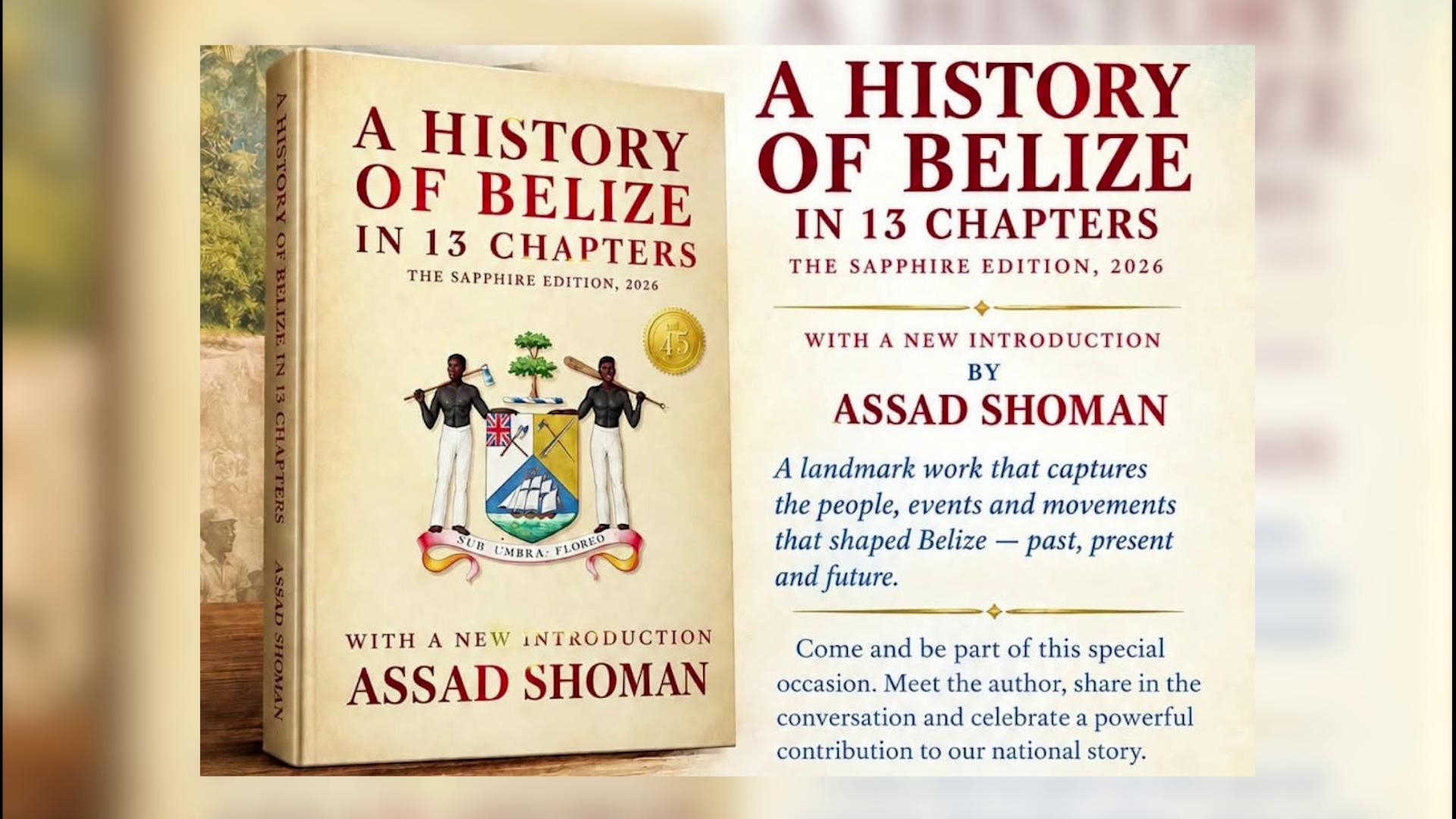
Scheduled for release in 2026, the anniversary reprint of prominent Belizean historical work *A History of Belize in Thirteen Chapters* has ignited a fierce national controversy over its cover art, reopening long-unhealed wounds from Belize’s colonial era and forcing a broader reckoning with how the nation confronts and represents its problematic past.
At the center of the dispute is the 1907 colonial-era Coat of Arms of Belize chosen by the book’s author, Assad Shoman, for the new edition’s cover. To casual observers, the image appears to echo a familiar national symbol, but a closer look reveals its deeply problematic nature: two Black lumber workers are drawn as crude, cartoonish caricatures, reflecting the dehumanizing way colonial rulers depicted Black Belizean laborers at the turn of the 20th century. The mahogany tree and logwood industry symbols on the image’s shield directly reference the extractive colonial economy that relied on the exploited labor of Black and Kriol communities, who form the foundational ethnic group of modern Belize.
The National Kriol Council has emerged as the lead critic of the cover, with organization president Wilford Felix condemning the choice as a blatant insult to all Kriol Belizeans and the ancestors who fought and died to secure Belizean sovereignty. Felix argues that positioning the degrading racial caricature on the front of a mainstream national history book does not simply document past prejudice—it gives new life and a prominent public platform to an offensive, dehumanizing portrayal. He emphasizes that the image utterly fails to honor the foundational role Kriol people played in building Belize, and called the controversy a turning point: after decades of passive representation of Kriol heritage, Felix says the community will no longer tolerate misrepresentation and disrespect of its identity and history. He stressed that disrespect of marginalized communities does not always come as an obvious attack, and that Belizeans must remain vigilant against subtle, unintentional slurs that erode racial dignity.
Author Assad Shoman has pushed back on this criticism, defending his choice of cover art as a deliberate effort to confront, rather than celebrate, Belize’s colonial legacy. Shoman first encountered the 1907 Coat of Arms during a 2019 lecture by former Institute of Social and Cultural Research director Nigel Encalada, and argues that hiding offensive historical images does nothing to address the harms of colonialism. Instead, he believes displaying the caricature forces Belizeans to directly face the racism and structural inequality that shaped the colonial era, rather than sweeping uncomfortable truths about the past under the rug.
For Felix, however, good intentions do not erase real-world harm: even if Shoman’s goal was to spark dialogue around decolonization, the cover still inflicts unnecessary disrespect on the community depicted in the degrading caricature.
Historian Hector Silva, who has studied the evolution of Belize’s Coat of Arms, explained that the problematic 1907 design was eventually updated after independence. The revised national Coat of Arms replaced the crude, dehumanized figures with realistic, nuanced portrayals of Belizean woodcutters, preserving the symbol’s nod to Belize’s logging roots while giving the workers dignity and a distinctively Belizean identity. Silva noted that the updated design was personally reviewed by founding leader George Price, who insisted the revised image give the woodcutters “a living personality” rather than the generic, dehumanized caricature of the 1907 original.
The current debate over the book cover has also reignited long-running discussions about Belize’s modern national Coat of Arms, with some activists calling for further updates to better reflect the country’s full gender and ethnic diversity. Silva, however, argues that the current symbol serves a specific purpose: to document Belize’s economic and historical roots as a nation, not to represent every demographic group. He noted that the current Coat of Arms was formally adopted on independence and should remain unchanged as a permanent marker of national history.
What began as a dispute over a single book cover has now grown into a nationwide conversation that cuts to the core of Belizean national identity. Shoman’s goal of using the controversial cover to spark dialogue about decolonization has succeeded far beyond expectations, but the debate has also laid bare a deeply challenging question: how can a post-colonial nation confront the racist imagery of its past without re-inflicting harm on marginalized communities in the present? When it comes to painful historical memory, should harmful imagery be displayed and confronted, explained in context, or set aside entirely? As this ongoing debate makes clear, how a nation remembers its history can often be just as divisive as the history itself.