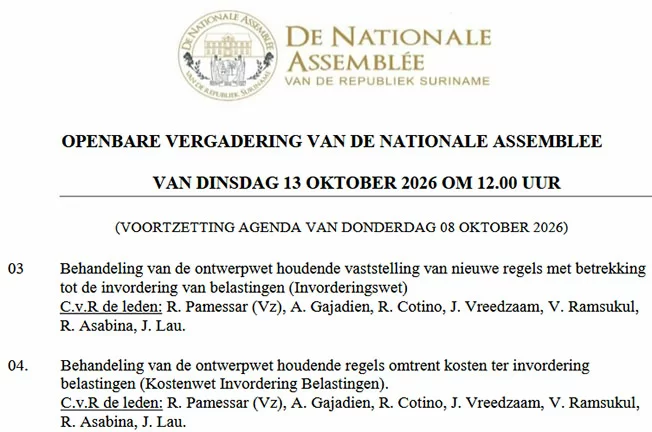
Parliamentary discussions over a proposed set of legislative changes that would expand and regulate the Dutch Tax and Customs Administration (Belastingdienst)’s collection powers continue this week, with lawmakers raising a wide range of concerns over forced collection rules, statute of limitations for tax debts, appeal procedures, and safeguards for small business owners and ordinary citizens. Dutch Minister of Finance and Planning Adelien Wijnerman has responded by confirming that the government will table an official amendment note addressing the outstanding questions, with the review of the draft legislation resuming on the same day the debate was reignited.
The legislative package under review consists of two drafts: the Collection Act and the Tax Collection Costs Act. Speaking during the plenary review, Wijnerman emphasized that the Tax Administration needs adequate legal authority to successfully recover outstanding unpaid tax debts, which are critical to sustaining public finances and government services. At the same time, she stressed that taxpayers are entitled to transparent procedural rules, reasonable timeframes for response, and robust legal protection against overreach.
Forced collection measures have emerged as the most contentious point of the debate. Under the current draft proposal, if a taxpayer fails to settle their debt after receiving an official reminder, the tax collector is granted the authority to issue a formal forced collection order directly. This order would serve as a legal basis for asset seizure and forced sale, eliminating the requirement to obtain an enforcement title from a civil court for each individual unpaid tax assessment.
Wijnerman clarified key procedural guardrails included in the current draft: taxpayers receive a mandatory 14-day grace period to settle their debt after the reminder is sent. The proposal also allows for third parties that owe money to a delinquent taxpayer to be ordered to transfer those funds directly to the tax administration, and includes imprisonment as a measure of last resort for the most severe cases of non-compliance.
Lawmakers have also raised multiple questions around the proposal’s 5-year statute of limitations for tax debts. Wijnerman confirmed that if the Tax Administration fails to take formal enforcement action within the statutory window, it loses the right to pursue coercive measures such as asset seizure or debt offsetting after the limitation period expires. However, one lawmaker has highlighted ongoing ambiguity around the common practice of extending the statute of limitations to account for the duration of appeal procedures, noting that there is no clear legal basis for this extension in the current draft text, creating a need for further clarification.
The minister also addressed widespread complaints about automatic rejection of appeals by the Tax Administration’s digital systems. She noted that an official review will be launched to determine whether these automatic rejections represent substantive decisions on the merits of appeals or simply administrative procedural steps. Wijnerman underscored that digital tools are only meant to support the processing of tax matters, and that an authorized public body must remain responsible for issuing lawful, well-reasoned decisions. No technical system error, she added, should be allowed to undermine the legal protections guaranteed to taxpayers.
In the area of support for vulnerable groups, Wijnerman acknowledged that small business owners typically operate with far smaller financial and administrative buffers than large corporations, and that implementation of the new rules must account for differences in ability to pay, business continuity, and basic livelihood security. She pointed to existing provisions for payment plans and delayed payment in the legislation, and noted that additional support will be made available for citizens who struggle to navigate digital tax procedures. To align the bill with recent judicial restructuring, Wijnerman confirmed that references to the old Board of Appeal will be updated to refer to the newly established Tax Court, with additional amendments planned for provisions around delayed payment and tax secrecy rules.