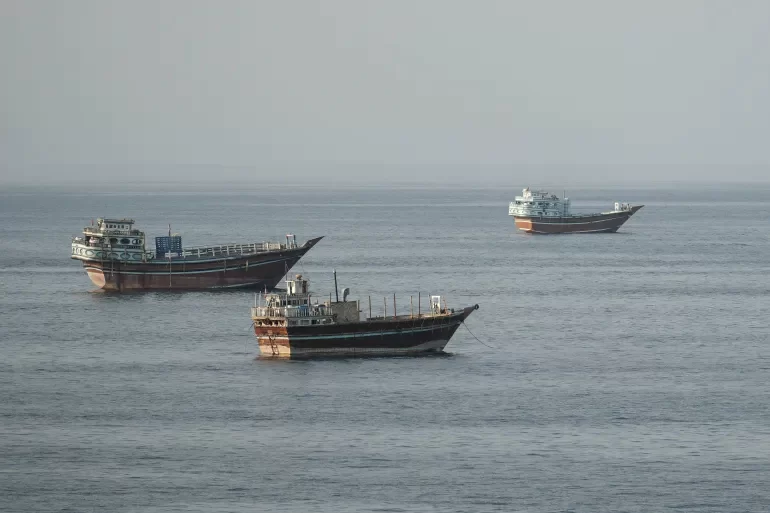
Tensions in one of the world’s most critical energy chokepoints have spiked sharply in recent weeks, as Iran has ramped up attacks on oil tankers operating in and around the Strait of Hormuz — expanding its campaign to target vessels using an alternative shipping route off the coast of Oman. The escalation comes as diplomatic efforts to end the ongoing regional conflict remain deadlocked, with Tehran using the shipping disruptions to increase pressure on Washington and hinder oil exports from Arab Gulf states.
In a recent public statement, senior Iranian security official Mohsen Rezaei confirmed that the Iranian military and the Islamic Revolutionary Guard Corps (IRGC) are deliberately targeting vessels participating in what Tehran describes as a U.S.-supported alternative transport system. This network relies on ship-to-ship transfers of crude oil from smaller vessels to large tankers, allowing Gulf exporters to move their cargo to global markets without passing through the Strait of Hormuz. Rezaei claimed that multiple ships are targeted daily, asserting that five to six vessels come under attack each night — a claim that remains unconfirmed by independent third-party observers. Iranian authorities frame the attacks as a response to attempts to circumvent Iranian shipping restrictions in the region, and have issued repeated warnings that any vessel using the Omani coastal route without official Iranian permission is a legitimate target.
New publicly reported incidents over the past weekend underscore the growing risk to commercial shipping. On October 11, the United Kingdom’s maritime security authority UK Maritime Trade Operations (UKMTO) announced that an oil tanker exiting the Strait of Hormuz had been struck by an unidentified projectile. The vessel sustained visible damage, but all crew members escaped uninjured. A separate suspected attack was also reported near the Omani anchorage of Sohar, with authorities still investigating the details of the incident and the extent of any damage.
These recent events are part of a dramatic surge in anti-shipping activity across the region. Data compiled by Reuters shows that between September 28 and October 5, at least 12 separate incidents involving tankers were recorded, including direct attacks, attempted strikes, and intimidation via drones and radio warnings. This marks the highest weekly total of such incidents since the outbreak of the current conflict on February 28, 2026. In addition to direct attacks, the IRGC has also issued warnings about sea mines laid in the strategic strait, claiming multiple tankers have hit the mines — though full details of these claims have yet to be independently verified.
The escalating attack campaign aligns with a months-long diplomatic impasse over efforts to end the conflict. Tehran has set out seven non-negotiable conditions for fully reopening the Strait of Hormuz to commercial traffic, including a complete end to hostilities and the lifting of the U.S. naval blockade on Iranian southern ports. In his October 11 statement, Rezaei dismissed the U.S. response to Iran’s proposal as insufficient, noting that while some demands have been partially accepted, key terms remain unresolved. The Iranian government has insisted that no agreement can be finalized until all seven conditions are met in full, with mediators from Qatar and other regional states working overtime to break the deadlock. For its part, the United States has maintained its naval blockade of Iranian southern ports, saying the measure is intended to halt Iranian oil exports, and U.S. military forces have already intervened against vessels the Pentagon accuses of attempting to break the blockade. Beyond shipping disruptions, Iran has issued new threats to target U.S. interests and digital infrastructure — including data centers and artificial intelligence facilities — across the United Arab Emirates and other regional hubs, raising fears of further escalation beyond the maritime domain.
The disruptions carry profound consequences for the global energy market, as the Strait of Hormuz has long been one of the world’s most vital energy transit routes. Before the outbreak of the current conflict, roughly one-fifth of all global oil and natural gas trade passed through the waterway. The alternative Omani coastal route emerged as a workaround that allowed Gulf oil exporters to continue moving a portion of their cargo to international markets after regular traffic through the strait was shut down. Maritime analysts confirm the route is backed by U.S. military presence in the region, but the recent wave of attacks has made safe, efficient transport along this route far more difficult.
Data from maritime intelligence firm Windward, cited by Al Jazeera, illustrates the sharp collapse in traffic through the strait: in the final week of September, an average of just 31 vessels passed through the strait each day, down from roughly 138 daily transits before the conflict began. The growing risk of attack has sent shipping costs skyrocketing. Windward reports that freight costs now account for 25 to 30 percent of the total cost of Gulf crude, compared to just 1 to 3 percent before the conflict. To offset these increased costs and attract buyers, some state-owned Gulf oil producers are now offering crude at discounts of up to $35 per barrel below official benchmark prices.
Global oil prices have already reacted to the rising tensions. On October 11, Brent crude futures rose roughly 2 percent to hit $106.79 per barrel, with market analysts attributing the increase directly to ongoing attacks and persistent uncertainty over Gulf oil exports.
For Iran, targeting the alternative shipping route is a calculated strategic move: by disrupting all Gulf oil exports regardless of route, Tehran aims to prevent regional exporters from adapting to the closure of the strait and maintaining steady flows to global markets, turning energy market pressure into a bargaining chip against Washington. Hamidreza Azizi, an Iran analyst at the International Crisis Group, notes that Tehran sees little incentive to rush into a deal under current conditions, as the Hormuz disruptions generate widespread economic impacts that strengthen its negotiating hand. Yet the escalating confrontation also carries significant economic risks for Iran itself, as continued disruption to global oil trade keeps energy markets unstable, drives up transportation costs worldwide, and deepens broader international economic uncertainty.