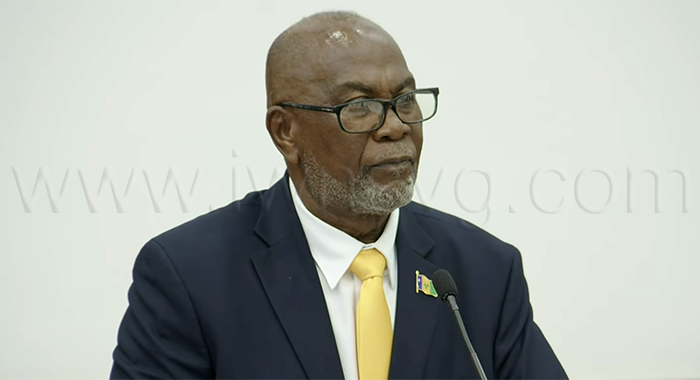
Acting Prime Minister St. Clair Leacock is standing firm behind his controversial assessment that St. Vincent and the Grenadines (SVG) is currently facing a state of financial breakdown, backing up his claim with fresh data from the 2023 national audit report that pinpoints long-standing fiscal challenges inherited from the previous administration.\n\nIn an interview aired Monday on the *New Times* program hosted by NICE Radio, Leacock emphasized that his frank description of the country’s finances was not a political stunt designed to shift blame, but a necessary first step toward addressing the crisis. \”I stand by my statement,\” he told listeners. \”In order for you to fix a problem, you have to acknowledge that you have a problem.\” Leacock first made the “broke” claim during a Friday appearance on another NICE Radio show, *Keepin’ It Real*.\n\nWhen the New Democratic Party (NDP) administration took power in November, top national financial officials warned the new leadership that the economy was already on the edge of collapse, Leacock recalled. Senior financial leaders including the director general of finance and planning, the director of planning, and the budget officer all delivered the same stark assessment: the incoming government inherited an economy at a precipice, with effectively no operating capital left and massive existing debt obligations. \”meaning that the economy, if we weren’t careful, we’ll break our neck in St. Vincent and the Grenadines. We didn’t have any money,\” he recounted.\n\nLeacock’s remarks have drawn public pushback from critics who dispute the current government’s bleak economic assessment, prompting the acting prime minister to draw a clear line between the fiscal position inherited by the NDP and the administration’s own policy choices. He called efforts to hold the current government responsible for the country’s fiscal woes \”politically dishonest.\”\n\nTo substantiate his argument, Leacock turned to official figures from the 2023 Audit Director’s report, which lays out the rapid growth of debt servicing costs that are eating up an ever-larger share of public revenue. The report records total public debt servicing costs at $303.6 million for 2023, a $62 million increase — equal to a 25.7% jump — from the prior financial year. This marks the fastest annual growth in debt costs in the last five years, the report confirms. The audit also explicitly notes that \”these indicators suggest a growing share of government resources is being absorbed by debt obligations\” and that \”cash flow challenges persisted throughout the financial year.\”\n\nLeacock broke down the meaning of these audit findings for ordinary citizens, explaining that persistent cash flow shortfalls mean government spending obligations consistently outpaced incoming revenue across 2023. \”That in 2023, you consistently find yourself in a situation where the amount of money you have to pay out is greater than the amount of money that was coming in,\” he said. \”So in 2023, the government was not receiving enough money on the recurrent side of the budget to pay its debt, to pay for its expenditure.\”\n\nHe connected this crisis to a 2023 comment made by former prime minister Ralph Gonsalves, who admitted that a $477.9 million increase in SVG’s debt to Taiwan within seven months had put \”a hook in the gill\” of any administration that sought to break diplomatic ties with Taipei. Leacock noted Gonsalves’ comment was a candid acknowledgment of the crippling financial bind the previous government left for its successor.\n\nLeacock also highlighted a major shortfall in 2023 capital revenue, which serves as further evidence of the pre-existing fiscal gap. Official projections predicted $223 million in capital receipts, but only $93 million was actually collected. Of that total, $121.5 million came from domestic bond transactions — essentially new borrowing that will have to be repaid in future years, Leacock clarified.\n\nThe acting prime minister warned that continuous unrestricted borrowing is not a sustainable path forward for SVG, using a everyday analogy to illustrate the risk of deepening the crisis without a clear repayment plan. While he acknowledged that governments need to borrow at times, he stressed that endless accumulation of debt will only worsen the country’s long-term financial struggles.\n\nTo address the crisis, the NDP administration has implemented targeted spending controls to stabilize public finances, and is prioritizing attracting private sector investment as an alternative to endless government borrowing. The government is also working to boost output in key productive sectors including agriculture, tourism, and fisheries, Leacock said, combining external expert advice with a locally tailored policy approach.\n\nLeacock announced that he will lay out a more detailed breakdown of the audit figures during upcoming parliamentary estimates and budget debates, committing to base all discussions on the official audit report rather than unsubstantiated political claims from either side of the aisle. \”Not what Friday says, Leacock says, or Nature says, but what the Director of Audit report says,\” he stated, referencing Prime Minister Godwin Friday and Infrastructure Minister Nigel \”Nature\” Stephenson.
Latest Audit Report shows SVG was ‘broke’ under ULP — Leacock