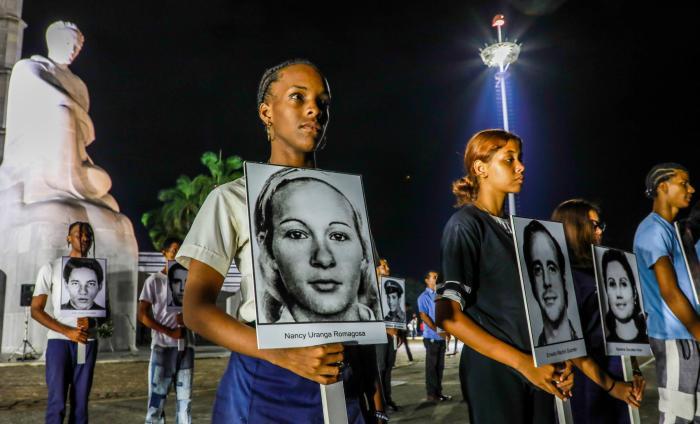
Half a century after a deadly act of state-sponsored terrorism cut short 73 lives, the trauma of the attack still lingers deeply across Cuban national memory. On the eve of the 50th anniversary of what Cubans universally call the Barbados crime, hundreds of young people gathered for a solemn candlelight vigil at the base of Havana’s José Martí Monument to pay tribute to the lives lost in the 1976 plane bombing.
On October 6, 1976, a Cuban passenger jet carrying 73 people crashed into the waters off Barbados just minutes after departing the island nation’s main airport. There were no survivors. Investigations later confirmed two explosive devices hidden aboard the aircraft had triggered the fatal crash, a deliberate attack targeting innocent civilians, the overwhelming majority of whom were Cuban nationals.
Among those killed were 24 members of Cuba’s national youth fencing team, who were returning home after a historic victory that saw the team claim every gold medal at the Central American and Caribbean Championships. Many of the young athletes were under 20 years old when their lives were cut short. Also killed were 33 other Cubans and 13 passengers from other nations.
For five decades, October 6 has held a searing place in Cuba’s collective consciousness, far more than a footnote in the country’s modern history. For the 50th anniversary, Cuban youth led the commemorations to honor the dead and keep alive demands for accountability for the attack, which has long been tied to anti-Castro militant groups backed by foreign state sponsors.
Addressing the crowd of attendees, Elisbel Durán Borroto, a member of the National Bureau of the Young Communist League (UJC), reaffirmed the nation’s commitment to preserving the memory of the victims. “We do not forget that justice remains pending,” she said. “We will not allow history to be erased, nor pain to turn into silence. We will not allow impunity to masquerade as oblivion.”
Durán Borroto added that the annual commemoration serves a larger purpose: “We remember the victims of the Barbados bombing to reaffirm that terrorism will never be the path, and that solidarity among peoples is the only road to peace.”
The vigil was also attended by senior political figures, including Marydé Fernández López, head of the Communist Party Central Committee’s Office for Liaison with the UJC and mass organizations, Meyvis Estévez Echevarría, First Secretary of the UJC, and other Party and government officials from Havana. In remarks shared during the event, leaders emphasized that the bombing was not an attack on Cuba alone, but an act of terrorism against innocent civilians that the world cannot afford to forget.
Following last night’s youth-led vigil, public tributes and commemorative events are scheduled across Cuba through October 6 to honor the victims. The late revolutionary leader Fidel Castro, who led Cuba through the immediate aftermath of the attack, once called the 73 victims symbols of the global fight against terrorism. Fifty years on, Cuban officials and young people alike say that legacy remains as relevant as ever, as the nation continues to wait for full accountability for the attack.