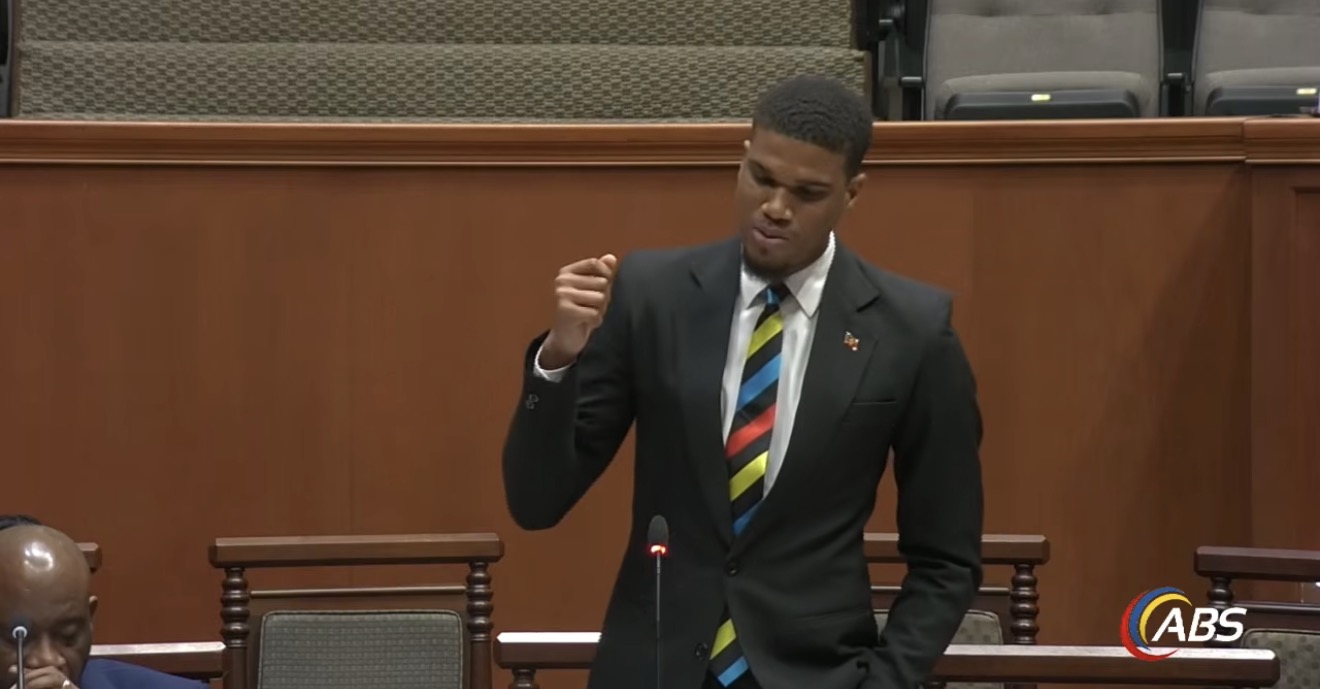
During legislative debate over the 2026 Firearms Amendment Bill, opposition Senator Jonathan Wehner has sparked discussion on criminal justice reform in Antigua and Barbuda, calling for harsher proportional punishment for the most brutal, premeditated homicides while pushing for expanded investment in upstream youth crime prevention. Wehner argued that for individuals who commit unrepentant, cold-blooded killings—specifically calling out the murder of pregnant women—no standard prison term can adequately match the severity of the crime.
He stressed that premeditated, remorseless acts of murder should never receive what he labeled a “slap on the wrist” punishment. Wehner pointed to existing unenforced laws already on Antigua and Barbuda’s statute books, suggesting these frameworks should be activated for exceptional cases of extreme violence, though he did not specify which laws or what alternative forms of punishment he was referencing. “When you take a life intentionally and callously, without any remorse, no jail term is sufficient,” Wehner stated, adding that killing a pregnant person demands particularly serious consequences that fit the gravity of the act.
Wehner acknowledged the core focus of the Firearms Amendment Bill is adjusting minimum and maximum prison sentences for firearms-related offenses, and he voiced support for stronger penalties for gun crime. He emphasized that legislators carry a fundamental responsibility to ensure punishments align with the severity of deliberate, cruel criminal acts. While he admitted that no legal penalty can erase the grief, trauma, and suffering inflicted on the family and friends of murder victims, he maintained the justice system still has an obligation to impose proportional punitive measures for the most horrific crimes. Wehner also noted that lawmakers from both governing and opposition blocs are aligned on the principle that brutal criminal acts deserve serious consequences.
Breaking from common partisan rhetoric, Wehner rejected the idea that the current government is solely responsible for Antigua and Barbuda’s overall crime situation. “It would be totally disingenuous to pin all crime on government failure—that’s just political fodder, and it’s not responsible,” he said, stressing that every sector of society has a role to play in reducing violence. He argued that effective crime fighting does not begin after an offense is committed and police launch an investigation; instead, meaningful progress depends on long-term prevention efforts that intervene before criminal behavior develops.
To advance this prevention agenda, Wehner proposed targeted annual government grants for youth-focused organizations that engage young people in productive, positive activities. He noted that a budget line for grants to community organizations and individuals already exists, but that the government has provided little transparency around how these funds are distributed. Wehner recommended that grassroots youth groups receive annual grants of either 2,500 Eastern Caribbean dollars or 5,000 Eastern Caribbean dollars to sustain and expand their community programs, highlighting the National Youth Parliament Association of Antigua and Barbuda as a long-trusted organization that already delivers impactful work with young people across the country.
Wehner framed the proposal as consistent with the opposition’s role in governance: not only challenging government policies when necessary, but also offering concrete, actionable solutions to pressing national issues. He concluded by reaffirming his support for tougher penalties for gun-related crime, while emphasizing that punishment alone cannot address root causes of violence—prevention programs that steer young people away from criminal activity must accompany stricter sentencing to create long-term public safety gains.