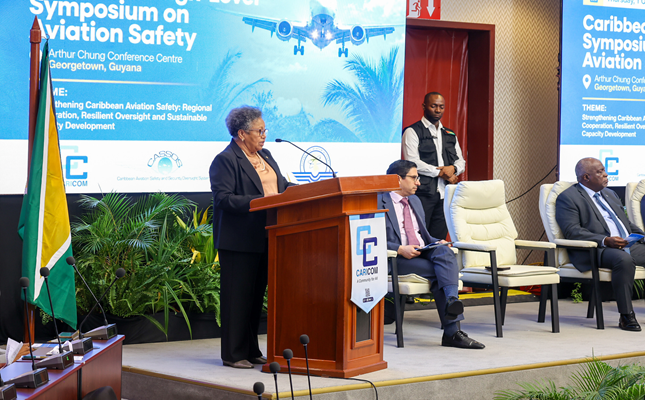
GEORGETOWN, Guyana – 1 October 2026 – The Caribbean High-Level Symposium on Aviation Safety opened its doors Thursday in Guyana’s capital, bringing together regional leaders, international aviation bodies, and development partners to address the foundational role of air safety in advancing Caribbean integration. In her keynote opening remarks, CARICOM Secretary-General Dr. Carla Barnett framed regional air connectivity not as a luxury for the bloc, but as an non-negotiable necessity that underpins nearly every pillar of Caribbean economic and social life.
The gathering, convened in partnership with the Government of Guyana and the Guyana Civil Aviation Authority, draws attendees from across 15 CARICOM member states, as well as representatives from the International Civil Aviation Organisation (ICAO), the Caribbean Development Bank (CDB), the European Union Aviation Safety Agency (EASA), and the Caribbean Aviation Safety and Security Oversight System (CASSOS). Dr. Barnett opened the symposium by extending gratitude to host nation Guyana and collaborating organizations for their work in advancing the regional aviation safety agenda.
Against the backdrop of Caribbean small island developing states (SIDS) and low-lying coastal developing economies, Dr. Barnett emphasized that reliable, safe air transportation sustains the region’s largest economic sector – tourism – while also facilitating cross-border trade, attracting foreign direct investment, enabling rapid emergency response to natural disasters, and keeping geographically separated families connected. For a bloc spread across hundreds of miles of ocean, safe aviation is not just an infrastructure concern: it is the backbone of meaningful economic and social integration. No matter the size of the member state, whether a small archipelagic nation or a larger continental Caribbean country like Guyana, communities, students, artists, traders, and visitors all rely on the unspoken guarantee that air travel will be safe.
Dr. Barnett acknowledged that national civil aviation authorities across the region face growing pressures, from tightening international regulatory requirements to rapid technological shifts, persistent workforce gaps, and strained national budgets. For small national administrations with limited resources, these challenges cannot be solved alone. This reality, she argued, makes collective regional cooperation not just beneficial, but indispensable.
CASSOS, the bloc’s regional aviation safety oversight body, stands as a key example of effective collective action, Dr. Barnett noted. By pooling specialized expertise across the region, aligning regulatory frameworks, and building shared technical capacity, the system enables CARICOM states to meet global safety standards that would be unsustainable for many small nations to maintain individually. To keep up with evolving industry demands, Dr. Barnett called for sustained investment and resourcing to ensure CASSOS remains agile and fully equipped to address emerging safety challenges.
She also pointed to the Caribbean Community Multilateral Air Services Agreement, signed to date by 13 CARICOM member states, as a landmark step toward building a fully integrated regional air transport market. But she stressed that expanded connectivity can only deliver shared prosperity if it is built on a foundation of strong, consistent safety oversight. “A more connected Caribbean must also be a safer Caribbean,” she argued, noting that safety, regulatory trust, and operational reliability are non-negotiable foundations for an integrated regional air market.
The symposium is set to conclude with a formal Declaration on Aviation Safety, which Dr. Barnett said will serve as a critical roadmap to turn shared goals into tangible, collective action. With clear priorities, closer coordination between national aviation authorities, sustainable resourcing for regional oversight, greater investment in skilled technical workforces, and a shared commitment to measurable progress, the region can deliver stronger aviation safety and build a more connected, resilient, and prosperous CARICOM.
Closing her remarks, Dr. Barnett urged delegates to move past discussion to decisive action, shifting from individual national constraints to collective solutions, and from formal commitments to on-the-ground implementation. She closed by wishing the symposium productive deliberations and impactful outcomes, noting that she looked forward to reviewing the meeting’s final results once proceedings conclude.