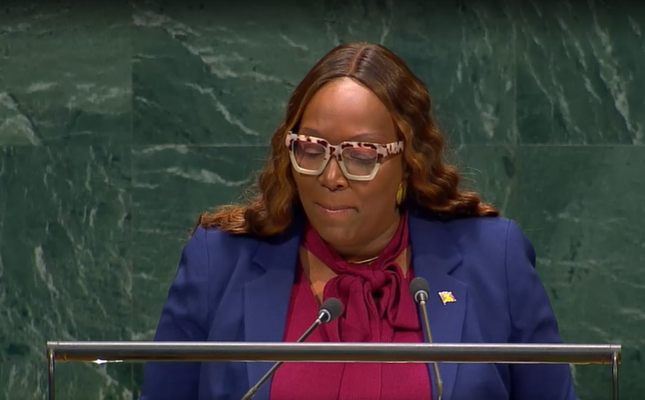
Against the backdrop of the conclusion of the United Nations’ 81st General Assembly General Debate, Caribbean community (CARICOM) nations led a urgent push for action on Haiti’s deepening security crisis, with Grenada at the forefront calling for an immediate extension and full rollout of the multinational Gang Suppression Force.
As armed gangs continue to expand their territorial control into regions long considered secure for civilians, Haiti has seen a catastrophic surge in violence that has displaced hundreds of thousands of people and inflicted disproportionate harm on vulnerable groups. Credible reports of widespread sexual violence against women and girls have added urgency to international calls for intervention.
Speaking on the final day of the General Assembly’s general debate on September 28, Grenada’s Permanent Representative to the UN, Ingrid Jackson, framed the crisis as a defining test of global multilateral cooperation. She argued that incremental, resilience-focused responses to successive global crises are no longer sufficient: the international community must address the root structural conditions that leave populations vulnerable to instability.
“We must renew our global system, strengthen our multilateral partnerships, and summon the collective will necessary to build a world worthy of the next generation. And that transformation must begin with people,” Jackson told the assembly.
Jackson’s core appeal centered on the timely renewal of the Gang Suppression Force’s mandate, alongside its full, rapid deployment in coordinated partnership with the Haitian National Police. She stressed that the force must receive adequate personnel, sustainable financing, proper equipment, and logistical backing to carry out its mandate effectively, with binding human rights safeguards built into all operations. Labeling Haiti a failed state, Jackson emphasized that these security interventions are non-negotiable to lay the groundwork for credible, free, fair, and inclusive elections led by Haitians themselves.
For months, CARICOM and other international stakeholders have prioritized the restoration of security and constitutional governance in Haiti, a goal Jackson reiterated in her address, noting that the promise of stability and democracy for the Haitian people remains unfulfilled. “It is a promise to the Haitian people that the international community must honour, not with pity, but with purpose, not temporarily but sustainably,” she said. “And even as we respond to the security crisis, humanitarian assistance must remain at the centre of our efforts.”
Just one day after Jackson’s address, on September 29, the UN Security Council delivered on the CARICOM call, adopting Resolution 2829 (2026) that formally renews the Gang Suppression Force’s mandate and extends the authorization of the UN Support Office in Haiti (UNSOH).
During a press briefing on September 30, Stéphane Dujarric, spokesperson for UN Secretary-General António Guterres, confirmed that the Secretary-General welcomed the Security Council’s action and urged UN member states to capitalize on this momentum to accelerate deployment of the force’s remaining personnel. Only with full deployment can the force fully execute its mandate to support Haitian national security efforts, Dujarric noted.
Dujarric added that security support is a critical prerequisite to creating space for broader progress, including the restoration of democratic institutions through peaceful, inclusive elections. He emphasized that security action must be paired with sustained, coordinated efforts to address the full spectrum of Haiti’s overlapping crises, spanning political instability, institutional collapse, human rights violations, humanitarian need, and long-term underdevelopment.
The briefing also shed light on the compounding risks facing Haiti’s vulnerable population, even as the international community moves forward with security plans. The country remains in the midst of the Atlantic hurricane season, which runs through the end of November, putting vulnerable communities at extreme risk of flooding and landslides. Currently, nearly 1.5 million Haitians are displaced across the country, the majority living outside the capital of Port-au-Prince in overcrowded collective shelters, informal camps, or with host families – all settings that offer little protection from severe weather.
Humanitarian partners are working alongside Haitian national and local authorities to roll out early warning systems, develop contingency response plans, and pre-position emergency supplies ahead of anticipated storms. But Dujarric warned that two major barriers – widespread insecurity and chronic funding shortfalls – continue to cripple these preparedness efforts. The 2026 UN humanitarian appeal for Haiti, which requests $880 million to support roughly four million vulnerable people, is currently less than 50% funded. “We ask for more money and more flexible money to help fund these operations,” Dujarric said.
The spokesperson also addressed the latest outbreak of deadly violence in Haiti’s Artibonite department, confirming that the Secretary-General condemned a brutal gang attack on the commune of Gros-Morne on September 28 that killed at least 11 civilians. “This horrific attack is another reminder of the heavy toll that gang violence continues to take on Haitians living in areas under the control or just under the influence of armed gangs,” Dujarric said. “It also underscores the urgency of strengthening security efforts in Haiti, including through the full deployment of the Gang Suppression Force, which is there in Haiti in support of the Haitian National Police, as well as we need to improve the broader efforts to address the drivers of violence and instability that we have seen in Haiti.”
According to UN Office of the High Commissioner for Human Rights data, more than 3,000 people were killed in gang-related violence across Haiti in the first six months of 2026 alone.