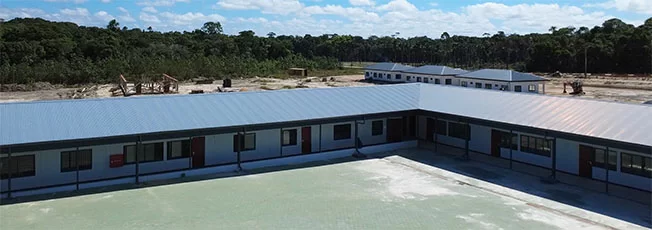
After decades of limited access to post-primary education for local youth, the Brokopondo district of Suriname has welcomed its first fully operational secondary school, Brokopondo High, marking a milestone in the region’s push for community-centered sustainable development.
The new private educational institution was developed on the initiative of the Platform of Traditional Authority Bearers of Brokopondo, a local group rooted in the belief that long-term equitable progress for the district can only be built by investing in the skills and potential of its own population. For years, young people in Brokopondo who completed primary school were forced to relocate far from their homes and families to continue their education, creating significant financial and social barriers that left many without access to secondary learning. The launch of Brokopondo High directly addresses this gap by bringing quality secondary education within the district’s borders.
A key feature of the project is its sustainable funding model, backed entirely by the Suriname Environmental and Mining Fund (SEMIF). Established under the terms of the country’s 1994 minerals agreement, SEMIF was created to channel revenues from natural resource extraction toward community-focused sustainable development projects, with education identified as a top priority. Unlike most private schools, Brokopondo High requires no out-of-pocket tuition payments from parents or guardians. All education costs are covered through SEMIF’s scholarship scheme, which awards funding based on student performance and effort. This model ensures access remains open to low-income local youth while encouraging academic commitment. The program’s core goal is to provide intensive, tailored support to admitted students and prepare them fully for higher education or professional training after graduation.
Organizers deliberately chose a private institutional model to guarantee long-term operational continuity, attract and retain qualified teaching staff, and maintain high-quality learning facilities that meet modern educational standards. Brokopondo High is structured as a six-year program, allowing students to enroll immediately after completing primary school and receive consistent, long-term academic support throughout their secondary education. Beyond the standard core curriculum, the school places special emphasis on building 21st-century competencies, including critical thinking, collaborative problem-solving, digital literacy, and practical vocational skills.
The campus sits on a 16-hectare plot of land, with phased development planned to expand facilities in coming years. Current plans include the construction of on-campus student housing to accommodate learners from remote parts of the district, a large assembly hall, full sports amenities, and an on-site agroforestry training system that will provide hands-on learning opportunities aligned with the region’s environmental and economic priorities.
The project has been developed through a cross-sector partnership that brings together local traditional leadership, national government bodies, and the private mining sector. Additional stakeholders include Rosebel Gold Mines, Suriname’s Ministry of Education, the President’s Cabinet, and the Brokopondo District Commissioner’s office. With the school now officially open, the first cohort of students has begun their classes. Project leaders project that over time, Brokopondo High will open access to secondary and post-secondary education to hundreds of young people across the district, unlocking new economic opportunities and laying the foundation for long-term self-determined sustainable development in Brokopondo.