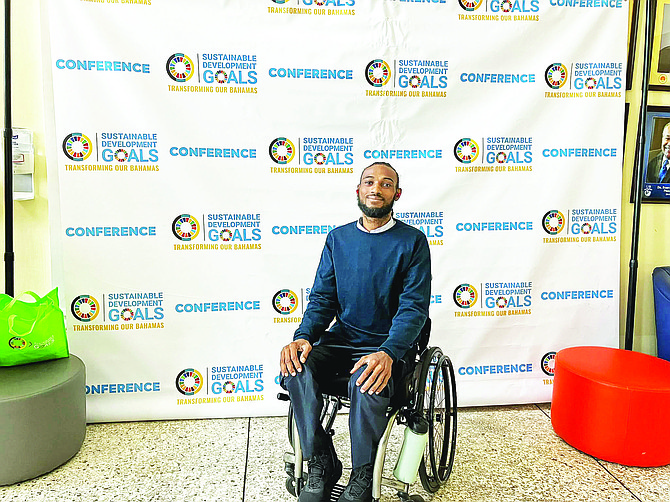
For Thorne Clarke, a 32-year-old man left permanently paralyzed and wheelchair-dependent by a 2016 police shooting, a nearly $1 million civil damages award handed down last month marks a legal milestone – but not closure. Seven years after a Bahamian court entered a default judgment against the Commissioner of Police and the Attorney General for failing to file a defense in his civil lawsuit, Clarke has finally been awarded $941,893.91 in compensation for his life-altering injuries. Yet in an interview with The Tribune, Clarke revealed he has never received an apology from law enforcement, nor has he been given the identities of the officers involved in the shooting that changed his life forever.
The 2016 encounter that left Clarke paralyzed has never been fully clarified due to the state’s procedural default. Police have maintained that Clarke attempted to drive his vehicle into an officer during the incident, a claim Clarke has repeatedly and vehemently denied. Because the default judgment was entered before a full civil trial could examine conflicting testimony, no official factual findings have been issued on the circumstances of the shooting, and Clarke says he has not received any formal communication from police about the incident from 2016 to today.
Clarke says an official public apology would be far more than a symbolic gesture. It would, he argues, help repair eroded public trust between law enforcement and communities that have historically been harmed by unaccountable police conduct. While he expressed gratitude for the damages award, he emphasized that the sum falls far short of covering the lifelong costs of his paralysis – including ongoing medical care, adaptive equipment, accessible transportation, and home modifications. He added that a faster resolution would have allowed the funds to improve his quality of life much earlier, as he adapted to the permanent changes to his body.
The damages assessment was finalized by Assistant Registrar Jonathan Deal in a September 21 ruling. Clarke filed his lawsuit in 2018, originally seeking $2.064 million in compensation. He previously received an $80,000 interim payment to address urgent medical needs after he developed a severe pressure ulcer that required surgical intervention. As of Clarke’s recent interview, the surgery had not yet been scheduled, though he is making arrangements, and described his current overall health as “pretty good.” The $80,000 advance leaves an outstanding balance of $861,893.91 before applicable interest and legal fees are added.
The lifelong financial burden of Clarke’s disability is staggering, and many costs have already been covered out of pocket by his family. Clarke requires regular replacement of core adaptive supplies: the pressure relief cushions he uses to prevent additional ulcers cost more than $400 each and must be replaced regularly, and his wheelchair needs to be replaced every three to five years due to constant wear and mechanical failure. Without access to an accessible vehicle, he relies entirely on family and friends for transportation. The shooting also upended his family’s financial stability: his mother left her job to care for him in the years immediately after the incident and eventually closed her small business entirely, while his father came out of retirement to work longer hours to cover recurring medical and living expenses. The family has paid to install basic ramps and modify their bathroom to accommodate Clarke’s wheelchair, but many critical home accessibility modifications remain unfinished due to cost.
Emotionally, the first years after the shooting were an agonizing adjustment. Clarke fell into deep depression, struggled with unmanaged anger, and withdrew socially as he came to terms with lifelong paralysis. Today, however, he has found purpose through his work with the National Commission for Persons with Disabilities, his employer, which has accommodated his disability by installing an on-site changing station. Though his condition sometimes requires him to leave work early, Clarke has turned his experience into advocacy: through his role, he meets many disabled people who lack even the limited resources and family support he has access to, and he now advocates for broader accessibility and systemic change.
Clarke plans to allocate the majority of his damages award to cover his ongoing disability-related needs. He hopes his high-profile case will push courts and government agencies to resolve life-changing injury claims far more quickly, and draw national attention to disabled Bahamians who have no damage awards or family resources to cover their basic needs. Beyond policy, he is calling on private businesses to reimagine accessibility, arguing that it is far more than just installing a single wheelchair ramp – it requires rethinking access to employment, public spaces, and basic community activities for all people with mobility disabilities.
“A lot of people ask me early on, you know, what do you do for fun or where do you go, and I normally respond with: ‘Where do you think I can go?’” he said. “We need to start treating accessibility as an essential rather than a luxury.”