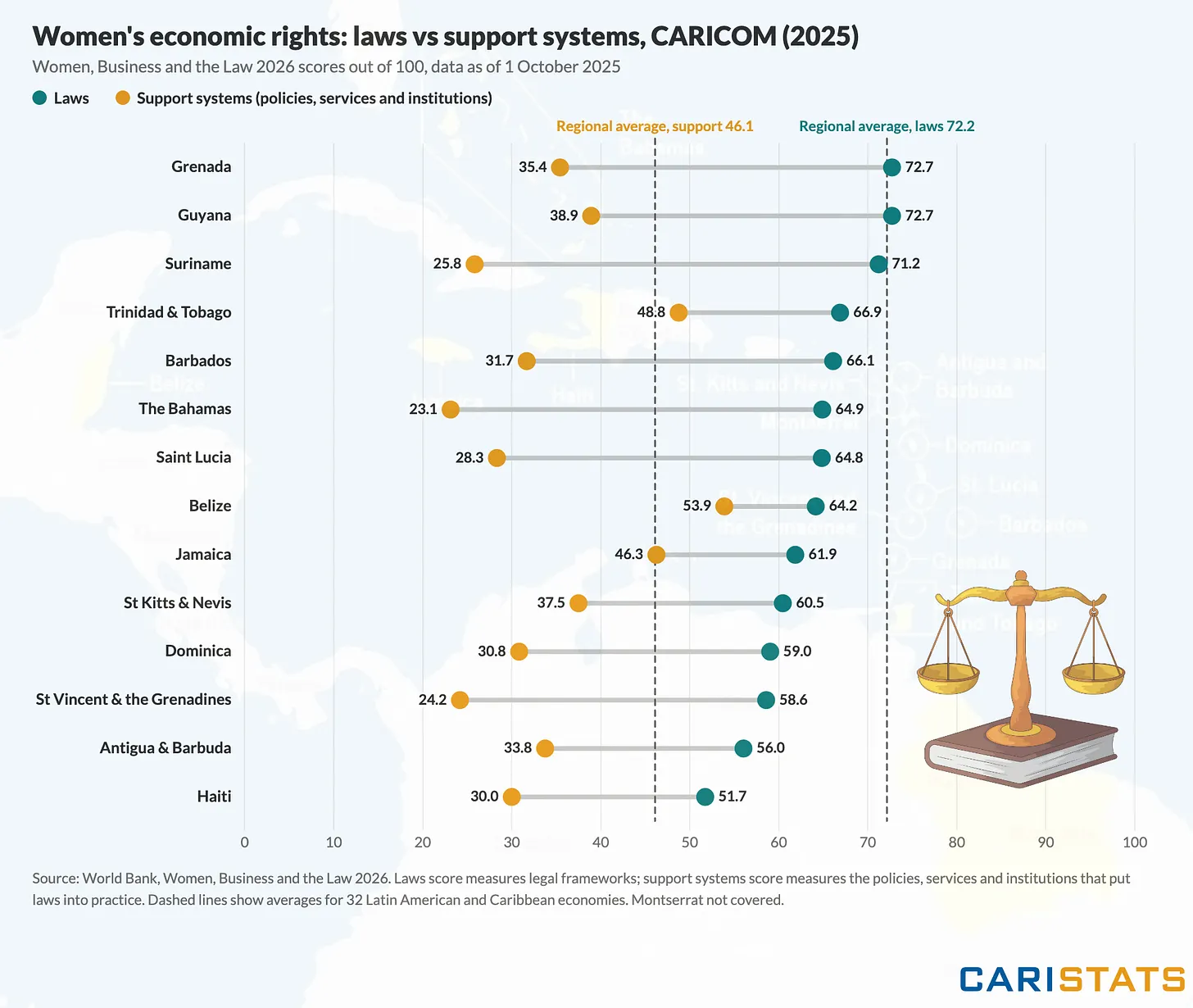
The 14 member states of the Caribbean Community (CARICOM) have made significant progress in enshrining women’s economic rights in national legislation, but critical gaps remain in building the institutional and service infrastructure needed to turn these legal protections into tangible daily benefits for working women, according to the World Bank’s latest *Women, Business and the Law 2026* report. The report, which draws on data collected as of October 1, 2025, evaluates economies through two complementary 100-point scoring frameworks to paint a complete picture of gender equity in economic participation. The first score measures progress on 40 core legal protections for women’s economic inclusion, ranging from equal pay for work of equal value to equal property rights. The report finds that 10 of the 14 CARICOM members have already codified at least 60% of these targeted protections. Leading the regional ranking, Grenada and Guyana both posted a score of 72.7, edging just above the 72.2 average for the broader Latin America and Caribbean region. Yet when it comes to the second, equally important metric measuring the enabling systems that bring these laws to life, the entire region falls short. This second score assesses 40 on-the-ground implementation measures, including accessible affordable childcare infrastructure, dedicated anti-discrimination bodies to investigate workplace gender bias, and targeted support for women entrepreneurs. In a stark finding, the report notes that every single CARICOM member state scored lower on implementation than it did on legal protections. Eleven of the 14 nations have put in place fewer than 40% of the required implementation measures. Only Belize, Trinidad and Tobago, and Jamaica exceeded the Latin American and Caribbean regional average implementation score of 46.1. The report’s analysis highlights a key structural challenge holding back progress: while legislative reforms can be adopted relatively quickly through parliamentary processes, building and sustaining the supporting systems requires long-term, consistent investment in public budgets, trained staffing, and robust data collection—resources that many small island developing states that make up CARICOM struggle to secure at scale. Until these gaps in institutional and service infrastructure are addressed, the report warns, the bulk of the unpaid burden of enabling women’s continued participation in the workforce will continue to fall disproportionately on individual families and private employers, limiting the broader economic gains that greater gender equity can deliver. Women’s labor force participation and entrepreneurship are widely recognized as core drivers of sustainable economic growth across the Caribbean, making the gap between legal progress and implementation a pressing issue for regional long-term development prospects.
World Bank Data Shows Gap Between Women’s Economic Rights and Support Systems in Antigua and Barbuda