### The Narrative of Two Trade Metrics
Belize’s international trade profile is often reduced to a single, alarming headline: the country consistently imports far more physical goods than it exports. However, a deeper dive into official economic data from both the Statistical Institute of Belize (SIB) and the Central Bank of Belize (CBB) reveals a more nuanced picture: a large and growing merchandise trade deficit is softened significantly by a robust services surplus, led overwhelmingly by the country’s critical tourism sector.
### SIB’s 2026 First-Eight-Month Merchandise Data Reveals Worsening Imbalance
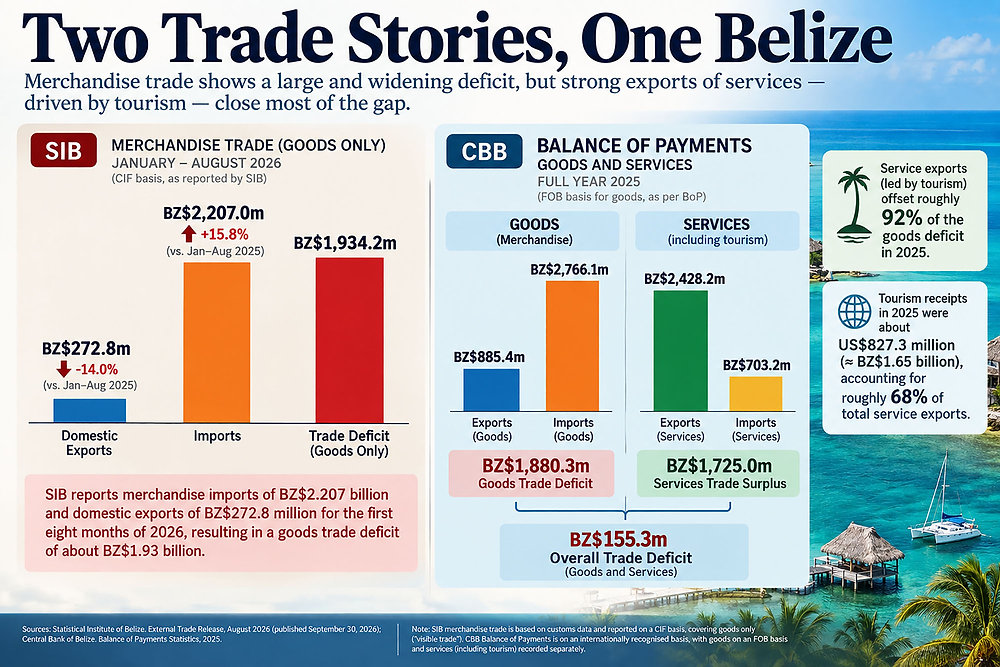
The SIB released its latest merchandise trade update on September 30, focusing exclusively on physical goods crossing Belize’s international borders. The data for January to August 2026 paints a clear picture of deterioration in the goods trade. Total merchandise imports climbed 15.8% year-over-year, rising from BZ$1.906 billion in the first eight months of 2025 to BZ$2.207 billion this year. At the same time, domestic merchandise exports fell 14% to just BZ$272.8 million.
Breaking down the import growth, two categories stand out for their outsized contribution to the increase. Fuel imports jumped BZ$131.2 million, rising from BZ$265.1 million to BZ$396.3 million, while machinery and transport equipment imports added another BZ$87.8 million to hit BZ$540.4 million. On the export side, key commodity sectors saw steep declines: sugar export earnings fell BZ$29.5 million to BZ$65.1 million, while citrus export earnings dropped from BZ$24.1 million to just BZ$9.9 million.
While there were minor bright spots for exports – cattle earnings rose to BZ$49.2 million, banana exports inched up to BZ$61.8 million, and marine products hit BZ$29.5 million – these gains were far too small to offset the broader downturn across merchandise exports. The result is a growing gap between what Belize buys from abroad and what it sells, creating a BZ$1.934 billion gap between gross imports and domestic exports for the first eight months of 2026.
### The CBB Balance of Payments Tells a Different Full Story
Merchandise trade data only captures one part of Belize’s international trade activity. The CBB’s comprehensive Balance of Payments (BoP) – which tracks all economic transactions between Belizean residents and non-residents, including both goods and services – offers a more complete view of the country’s external economic position. To understand the long-term structural balance, the CBB’s full 2025 BoP data is particularly illuminating.
In 2025, Belize recorded BZ$885.4 million in goods exports against BZ$2.7661 billion in goods imports, resulting in a massive BZ$1.8803 billion goods deficit. On the surface, that would suggest an extraordinary external imbalance. But when services are added to the calculation, the picture shifts dramatically.
In 2025, Belize exported BZ$2.4282 billion in services, while importing only BZ$703.2 million in services. That generated a BZ$1.725 billion surplus in services trade – enough to offset 92% of the country’s entire goods deficit. When combining both goods and services, the overall deficit shrinks to just BZ$155.3 million, a figure that reflects a very different economic reality than the standalone goods deficit would suggest.
### Tourism: Belize’s Invisible Export Industry
Many people struggle to conceptualize tourism as an export, but the logic is straightforward when comparing it to traditional goods exports. If Belize sells BZ$1,000 of sugar to a foreign buyer, the sugar leaves the country, foreign currency enters, and that transaction is counted as a goods export. If an American tourist travels to Belize’s San Pedro Island and spends BZ$1,000 on accommodation, food, tours, and local transport, no physical product leaves the country – the customer comes to Belize. But economically, this is still a sale of local output to a foreign resident in exchange for foreign currency, which makes it a service export.
For a tourism-dependent economy like Belize, excluding this activity from trade analysis omits the country’s single largest source of foreign export earnings. The 2025 CBB data confirms tourism’s outsized role: of the BZ$2.4282 billion in total service exports, BZ$1.6547 billion – roughly 68% – came from the travel sector. Transportation services added another BZ$119.2 million, with other services and government-related transactions contributing the remainder. This makes tourism far more than just a domestic industry: from the perspective of Belize’s external accounts, it is the country’s dominant export industry.
### Why the Two Datasets Cannot Be Interchanged
It is important to note that the SIB merchandise data and CBB BoP data serve different statistical purposes and should not be treated as interchangeable. The SIB data measures gross imports and domestic exports of goods, while the CBB BoP framework is designed to provide a consistent, full accounting of all cross-border transactions for both goods and services. For this reason, mixing the 2026 SIB merchandise figures with the CBB’s historical BoP framework would produce misleading results. The 2025 full-year CBB data, which already includes both goods and services measured within a consistent framework, is the most reliable source for understanding Belize’s overall trade position.
### A Structural Warning, Not An Existential Crisis
None of this context means that Belize’s widening merchandise deficit is a non-issue. It is a significant warning sign for the country’s economic structure. The services sector, led by tourism, currently carries most of the weight of financing Belize’s demand for imported goods. As the goods deficit grows, ever more foreign exchange earnings from services are required to offset it, and the latest SIB data shows this pressure is increasing. In just one year, the gap grew by more than BZ$346 million, as import spending rose by BZ$301.5 million and export earnings fell by BZ$44.6 million.
Policymakers are right to be concerned by this trend. Belize cannot rely indefinitely on tourism to offset rapidly growing merchandise imports. The tourism sector is inherently vulnerable to external shocks: recessions in key source markets, natural disasters like hurricanes, and global disruptions to travel – as seen most clearly during the COVID-19 pandemic – can quickly dry up service export earnings. Additionally, a large services surplus does not negate the economic benefits of expanding competitive merchandise exports, diversifying the country’s export base, and reducing unnecessary dependence on imports.
At the same time, it is incorrect to frame the merchandise deficit as Belize’s entire trade story. The full picture is simultaneously more concerning and more reassuring than headlines suggest. Belize does face a large and widening imbalance in physical goods trade, but it also boasts a formidable, underrecognized export industry in tourism-driven services that currently offsets almost all of the merchandise deficit. The merchandise deficit is a critical warning about Belize’s economic structure, but it is far from the full story on the country’s trade balance sheet.