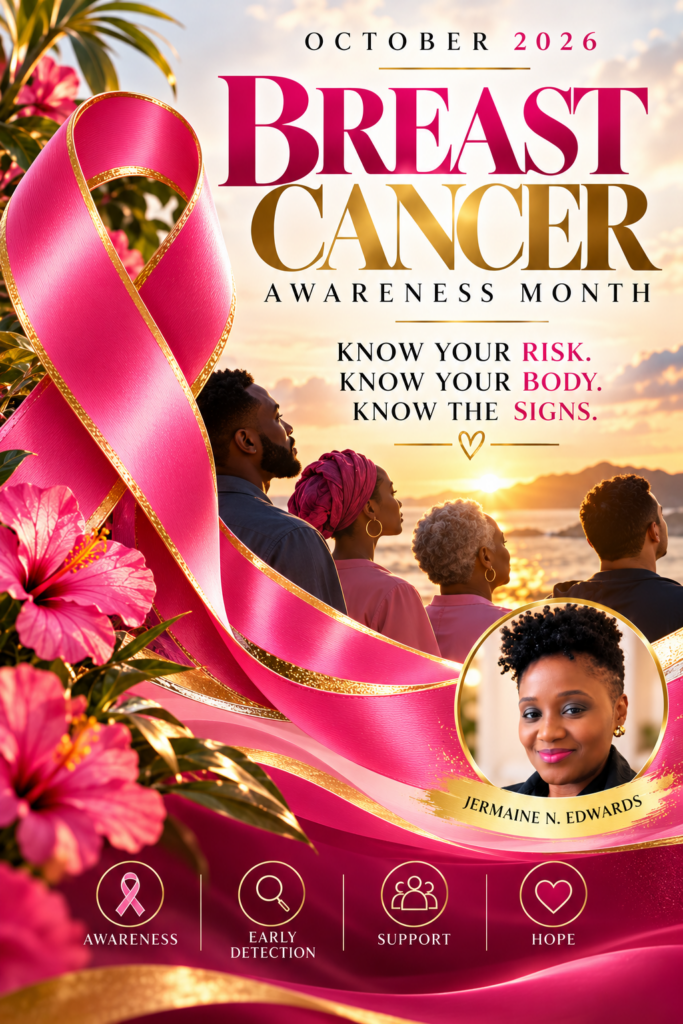
Every October, the global movement of Breast Cancer Awareness Month turns communities pink, drawing public attention to a disease that irreversibly reshapes millions of lives and family dynamics across the world. For 2026, the World Health Organization has centered its campaign around the powerful framing: “Every story is unique, every journey matters.” For author Jermaine N. Edwards, this theme carries far more than symbolic weight this year—after receiving a breast cancer diagnosis in September 2025, he underwent a double mastectomy on October 16 that same year, and this October marks one full year since that life-altering procedure.
While Edwards expresses profound gratitude that all detectable cancer was removed from his body, he is eager to dismantle a common, harmful misconception that many people hold about breast cancer treatment: that surgery marks the end of the battle. For him, and for countless other patients, the journey extends far beyond the operating room. In the year since his mastectomy, he has completed radiation therapy and continues ongoing treatment, navigating persistent physical side effects and emotional upheaval that the disease leaves in its wake.
Edwards emphasizes that no two breast cancer experiences follow the same script. Treatment paths vary wildly: some patients need only surgery, while others undergo chemotherapy, radiation, hormone therapy, or a combination of multiple interventions. Recovery trajectories differ just as dramatically: some people return to their usual routines quickly, while others live with years of complications, chronic side effects, and extended treatment. Scars may be visible or hidden, and support systems range from robust to nonexistent. That, he argues, is why it is never safe to assume that a patient who smiles, goes to work, and carries out daily tasks has fully “returned to normal” just because their outward appearance looks steady.
The diagnosis has shifted Edwards’ perspective on nearly every part of his life, altering his relationship with his body, his sense of personal safety, and his approach to daily living. He has walked through seasons of crippling fear, debilitating exhaustion, and constant uncertainty, but he has also found profound moments of gratitude along the way. Most importantly, he has redefined what strength actually means: it does not require pretending everything is fine when it is not. True strength, he says, can look like admitting you are tired, resting without guilt, accepting help from loved ones, or simply making it through a single difficult day. Learning to accept that version of strength has brought him a sense of peace he did not have before.
This firsthand experience has also reinforced how critical it is for all people to know their own bodies and take note of any unusual changes. Contrary to common belief, a new lump is not the only warning sign of breast cancer. Changes to the shape or texture of the breast or nipple, unusual tissue thickening, skin irregularities, or abnormal discharge all warrant prompt medical attention. Fear of a frightening diagnosis often leads people to delay checking worrying symptoms, but Edwards stresses that early awareness of a problem gives patients the chance to act early, when outcomes are often far better.
While Edwards acknowledges that pink-themed awareness campaigns have value—they bring the disease into public view and open up long-stigmatized conversations—they only tell a small part of the story. Behind every pink ribbon are real people navigating endless medical appointments, harsh medication side effects, visible and invisible scars, persistent fear, and daily uncertainty, all while trying to hold onto their normal lives. That is why true breast cancer awareness must go far beyond wearing pink for one month out of the year. It requires ongoing education about symptoms, encouraging regular self-checks and early screening, advocating for universal access to timely, high-quality care, and continuing to stand with patients long after their initial diagnosis.
As he approaches the one-year anniversary of his surgery, Edwards says gratitude is the emotion that dominates his heart: gratitude for the successful removal of his cancer, gratitude for the friends and family who have walked beside him, and gratitude for the strength he has received even on his hardest days. He is clear that he cannot write this reflection as someone who has closed the book on his cancer journey—he is still in the middle of treatment, still learning, still navigating the ups and downs, and still moving forward one day at a time.
This October, as communities gather for walks, hang pink decorations, and wear pink clothing to mark the awareness month, Edwards urges everyone to remember what the movement is really for. Check your own body for changes, encourage the people you love to do the same, show up for those currently in treatment, honor those who have lost their battles with the disease, and stand with everyone still fighting. Most of all, never assume that just because someone looks okay on the outside, they do not need your support.
The WHO’s 2026 theme rings true for Edwards: every story is unique, every journey matters. And his story, like so many others, is still being written.