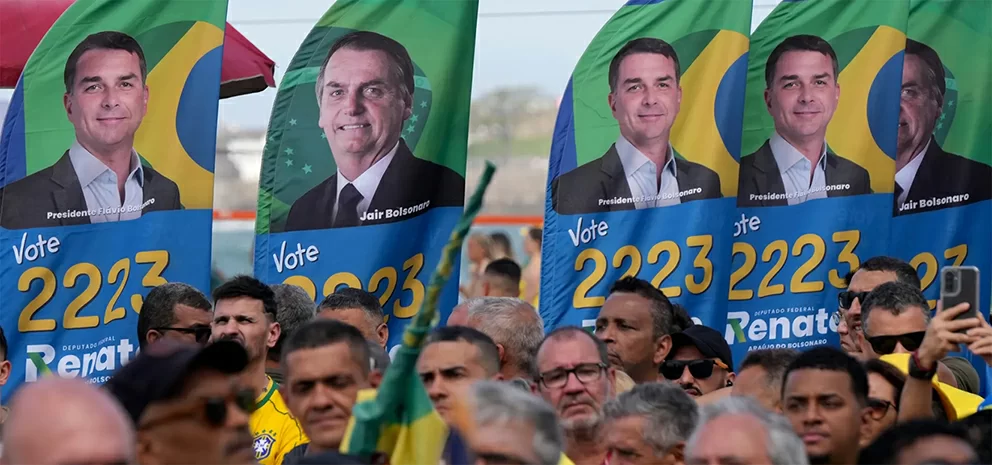
Brazil’s 2026 presidential election, scheduled for October 4 with a potential runoff on October 25, has thrust the question of the Bolsonaro family’s political future into the national spotlight — even though the family’s most famous figure, former president Jair Bolsonaro, cannot appear on the ballot. Convicted for his role in the 2022 election result overturn attempt and currently confined to home arrest with a ban from political office, Jair Bolsonaro still looms over every stage of the campaign, as his eldest son, Flávio Bolsonaro, a 45-year-old sitting senator from Rio de Janeiro, runs to carry the family’s political legacy forward.
Across campaign rallies, Flávio openly leans into his father’s name and image: he holds up portraits of Jair at public events, features the Bolsonaro surname prominently on all campaign materials, constantly references his father’s tenure and political legacy, and ties his own policy platform directly to Jair’s fate as a convicted politician. This strategy is deliberate: over the past eight years, the Bolsonaro brand has evolved from a single political personality to a full-fledged political dynasty, with multiple family members holding elected office and building independent bases of support.
Jair Bolsonaro first rose to national power in 2018 as a firebrand anti-establishment candidate, positioned against Brazil’s long-dominant Workers’ Party (PT) led by current president Luiz Inácio Lula da Silva. His platform blended conservative social values, hardline law-and-order policies, pro-military sentiment, and uncompromising opposition to left-wing politics. As Insper political scientist Carlos Melo told Reuters, Jair Bolsonaro became the face of a far-right movement that predates and extends far beyond his own political career. Today, that movement faces a critical test: can it survive and thrive without Jair Bolsonaro at its head?
The Bolsonaro family has spent years building a distributed political network that extends well beyond Jair. Alongside Flávio’s senate seat, son Carlos Bolsonaro has built influence in Rio de Janeiro politics and led the family’s digital communication strategy. Son Eduardo Bolsonaro serves as a national congressman and has built a broad international network, particularly with right-wing groups in the United States. Even the youngest son, Jair Renan, has entered politics, while former first lady Michelle Bolsonaro has cultivated her own loyal following among conservative and evangelical voters, emerging as a political figure in her own right rather than just a surrogate for her husband.
This structure brings both strengths and vulnerabilities. Open internal rivalries have already flared: Flávio and Michelle Bolsonaro had a very public split earlier this year, proving that control of Brazil’s right wing is not preordained to go to a single family member. Still, the dynasty model offers unique advantages: where a single candidate can only reach one group of voters at a time, the extended Bolsonaro family can simultaneously target different regions, demographic groups, and policy priorities, operating as a political franchise centered on the recognizable Bolsonaro name.
Flávio was not initially seen as the obvious heir to his father. When Jair was sidelined by legal convictions, many conservative voters looked to other leaders, most notably São Paulo Governor Tarcísio de Freitas, to lead the right. But breaking fully from the Bolsonaro name carries huge political risk: for core conservative supporters, loyalty to Jair Bolsonaro has become a core part of their political identity, and no right-wing candidate can claim to carry forward his movement while distancing themselves from Jair himself.
Instead, Flávio has adopted a deliberate middle path: he leans fully into his identity as a Bolsonaro, while positioning himself as a less confrontational, more moderate, business-friendly iteration of his father. He has not abandoned the core tenets of bolsonarismo — conservative values, opposition to left-wing politics, and unwavering support for his father — but has packaged them for a broader electorate. During a September campaign stop in Juiz de Fora, the city where Jair was stabbed during his 2018 campaign, Flávio retraced his father’s route to make his message explicit: Jair Bolsonaro’s political story is not over, and he is here to write the next chapter.
The strength of Flávio’s campaign is also deeply tied to the decades-long polarization that defines Brazilian politics, which pits lulismo against bolsonarismo as much as it pits candidates against each other. For many voters, the election is as much about rejecting the other side as it is about supporting their preferred candidate. Late September Datafolha polling found that 47% of voters would never vote for Flávio, and an identical share would never vote for Lula. This dynamic works heavily in the Bolsonaro family’s favor: a voter does not need to believe Flávio is the ideal candidate to vote for him — they just need to oppose Lula and the PT enough to back any alternative. This dynamic explains much of the family’s enduring political power despite Jair’s legal troubles.
Still, Flávio cannot escape the legal shadow that hangs over the Bolsonaro family. He is currently under investigation over his ties to disgraced former banker and businessman Daniel Vorcaro, with probes into alleged corruption, money laundering, and capital flight linked to the financing of a documentary about Jair Bolsonaro. Flávio has denied all wrongdoing and frames the investigation as politically motivated, a tactic straight out of his father’s playbook: he has turned the scrutiny back on his opponents, accusing them of selective prosecution and refocusing attention on alleged corruption in Lula’s orbit. This strategy has turned the legal case itself into a political weapon, fitting the Bolsonaro narrative of fighting a corrupt establishment.
The Bolsonaro dynasty’s influence also extends far beyond Brazil’s borders. Eduardo Bolsonaro has been based in the United States for the past two years, where he cultivated ties with former President Donald Trump’s political circle to build support for his father, even lobbying for action against Brazilian judges who oversaw Jair’s conviction. Flávio has also reached out to Trump for support, a connection that has brought both benefits and risks: Trump’s administration has imposed trade restrictions on Brazil, allowing Lula to frame the Bolsonaros as advance for foreign interests over Brazilian needs. The family is now firmly integrated into a global network of right-wing populist movements, which offers financial and political support but carries domestic political costs.
As more than 158 million registered Brazilian voters prepare to head to the polls, the election serves as a critical stress test for the future of bolsonarismo. If Flávio wins, it will prove the movement can successfully transition power from father to son, rebranding the Bolsonaro name from a single former president to a self-sustaining political dynasty. Even if he loses, the movement is unlikely to disappear: the Bolsonaros have built a broad base of support across Congress, local governments, evangelical communities, and party infrastructure, rooted in the deep-seated national polarization between the right and Lula’s PT.
Recent polling confirms how tight the race is: Datafolha puts Lula at 40% and Flávio at 36% in first-round polling, while an AtlasIntel/Bloomberg poll found Lula at 45.3% and Flávio at 42.2%, with both candidates virtually tied in projected runoff results. While these are just snapshots of voter sentiment ahead of election day, they confirm one clear truth: five years after Jair Bolsonaro left the presidency, the Bolsonaro name still holds enough power to put a family member in contention for Brazil’s highest office. Jair Bolsonaro may not be on the ballot, but his shadow and his legacy are already etched firmly in the mind of every Brazilian voter.