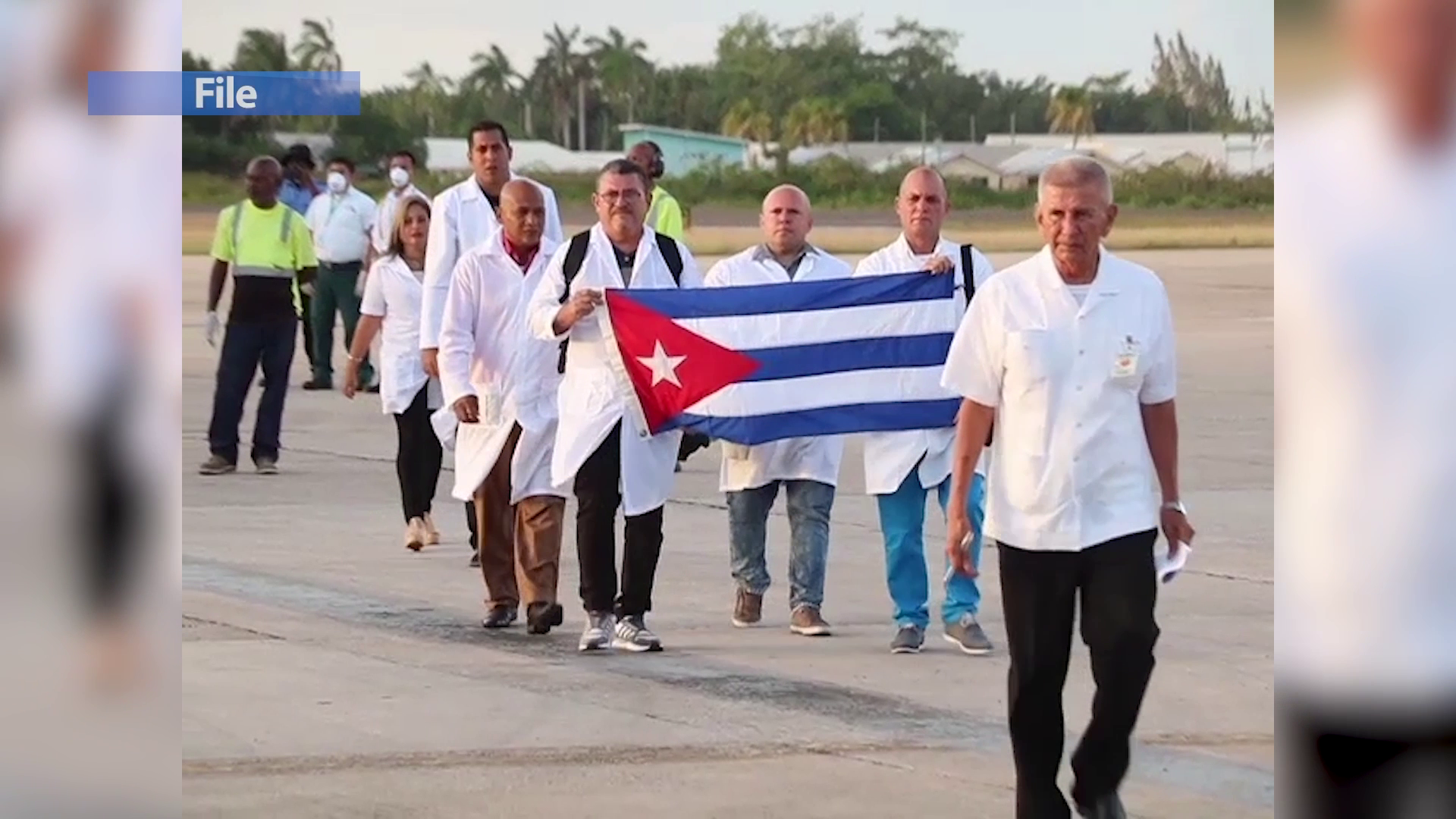
More than six months after the Belizean Cabinet ordered a top-level review of the country’s long-standing Cuban medical brigade partnership, the September 30 deadline for a formal recommendation has come and gone — and the Briceño administration has offered no public clarity on the team’s future.
In April this year, Cabinet gave the nation’s Ministry of Health and Ministry of Foreign Affairs six months to deliver finalized policy recommendations on the Cuban medical contingent by the end of September. To date, neither agency has released any outcome of their review.
Speaking to reporters Monday, Health Minister Kevin Bernard confirmed that diplomatic negotiations with the United States over the status of the brigade are still active, but declined to comment further on the ongoing review process, saying he would not speak publicly until a final decision is reached. Multiple requests for comment sent to the Ministry of Foreign Affairs by local media went unanswered by press time.
As the administration remains silent, the country’s former Prime Minister Said Musa has emerged as one of the most vocal opponents of removing the Cuban medical team from Belize, outlining his firm stance in a public comment earlier this month. Musa, who has personal experience receiving care from the brigade’s medical providers, argued that Belize has no ethical basis to cut ties with the Cuban medical contingent.
“I could never countenance supporting that. These people have stood with us, sending doctors and nurses to our country. Took care of me in fact, I had to go to them for some treatment as well, and many Belizeans,” Musa said in remarks on September 9. “Mexico and Cuba have been very faithful to Belize.”
Musa also connected the current debate over the medical brigade to Belize’s long-running territorial dispute with Guatemala, noting that the international community’s support has been critical to advancing the country’s position ahead of an expected International Court of Justice (ICJ) ruling on the dispute by the end of 2027. He argued that abandoning the long-standing partnership with Cuba, a steadfast ally, at this pivotal moment would be a betrayal of the relationships that have helped protect Belize’s territorial integrity.
“I think eventually with the ICJ giving its decision by the end of next year, that whole thing will be behind us and Belize will remain intact, from the Hondo to the Sarstoon,” Musa said. “We cant in this time now, when we are moving towards a complete solution to the problem, abandon Cuba, no, no. We have to find another way to deal with this problem.”
The core question hanging over the small Central American nation now is whether the Briceño administration will move to share its decision with the public once it is finalized, or continue to deliberate behind closed doors. The presence of the Cuban medical brigade has drawn pressure from the United States in recent years, as part of Washington’s broader diplomatic campaign to reduce Cuban influence across the Western Hemisphere.