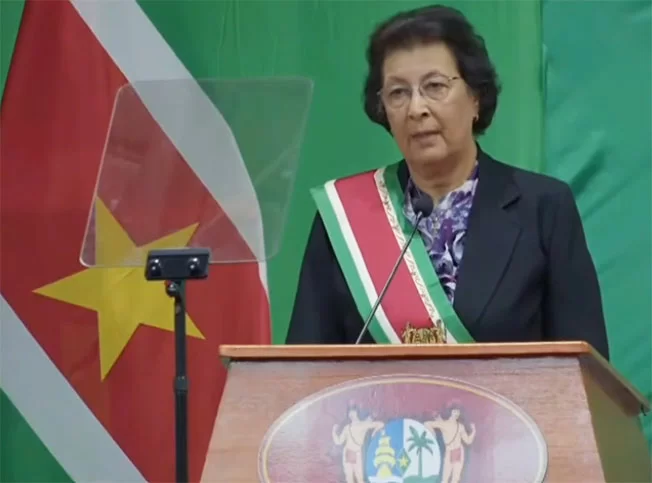
In her annual address delivered before a special public session of the National Assembly (DNA) at the Congress Hall on September 30, Suriname President Jennifer Simons laid out the government’s 2027 policy agenda, emphasizing the urgent need to put the country’s public finances on a sustainable path before large-scale revenues from the nascent offshore oil sector begin to flow into state coffers.
Simons acknowledged that while the current administration has made measurable progress in stabilizing the Surinamese economy through 2026, significant systemic fiscal challenges remain unresolved. As of August 2026, the country’s total national debt stood at 100.4% of gross domestic product (GDP), far above the legal maximum threshold of 60% that the government is legally required to meet. Addressing this debt overhang has become the top fiscal priority for the administration heading into 2027, Simons stressed.
The president noted that in its first term, her government has been forced to prioritize foundational recovery work, including strengthening weakened state institutions and state-owned enterprises, and addressing deep-seated crises in critical public sectors ranging from education and healthcare to core government administrative functions. Parallel to this recovery work, the administration has also placed heavy emphasis on advancing economic stabilization and securing political and social peace. Early tangible results from these efforts are already visible, Simons told assembled lawmakers, pointing to preliminary 2026 economic indicators that show marked improvement.
According to the data Simons presented, the country’s primary fiscal balance improved from a deficit of 5% of GDP in 2025 to a surplus of 5.2% in the second quarter of 2026. Average inflation through the end of July 2026 hit 8.9%, a notable cooling from previous periods of hyperinflation. International reserves have climbed to nearly $2 billion, a historic high for the country, boosting import coverage to approximately 8.2 months of total import costs. Full-year 2026 economic growth is projected to reach around 3.9%, a solid expansion that outperforms many regional peer economies. On the currency front, after an initial period of adjustment following the current government took office, the exchange rate has seen a mild decline and has since remained broadly stable, Simons added, warning that continued vigilance is critical, as exchange rate stability directly impacts inflation, household livelihood security, and business operating conditions across the country.
Despite the progress achieved in economic stabilization, Simons emphasized that the country’s public financial position remains far from healthy. To put the national debt on a sustainably downward trajectory starting in 2027, the government will implement a multi-pronged strategy centered on strict budget discipline, continued broad-based economic growth, increased state revenue collection, improved prudent debt management, and a ban on new unfunded government obligations. “Before large oil revenues arrive, the state’s financial house must be put in order,” Simons said.
The president clarified that this fiscal consolidation push will not derail necessary public investment. However, productive investments in sectors that can drive growth, expand exports, create jobs, and boost state revenue should be financed through alternative mechanisms rather than direct state borrowing, she said, adding that the government will actively attract private domestic and foreign investment to fill this gap.
For 2027, the administration also targets increased revenue from traditional natural resource sectors that Simons says should have contributed more to state revenues far earlier, including gold mining, timber, and fisheries. Firms already generating revenue from pre-production development of offshore oil projects and local content suppliers will also be required to contribute their fair share to public finances, the president added. Simons also noted that Suriname has wasted valuable time in recent years preparing society for the transformative economic shifts that offshore oil production will bring, so the government will accelerate preparations ahead of production launch.
To that end, the administration will strengthen regulatory frameworks and institutions to ensure sound management of future oil and gas revenues. It will also push for broader economic diversification to avoid over-reliance on the natural resource sector, and invest heavily in workforce skills development to prepare Surinamese workers for new jobs in the emerging energy sector. Simons stressed that all revenue generated from the country’s natural resources must ultimately deliver shared benefits for all Surinamese people. Improving access to high-quality healthcare and expanding affordable housing access will also remain core policy priorities for the coming term, she added. As of the initial reporting, the annual address is still ongoing.