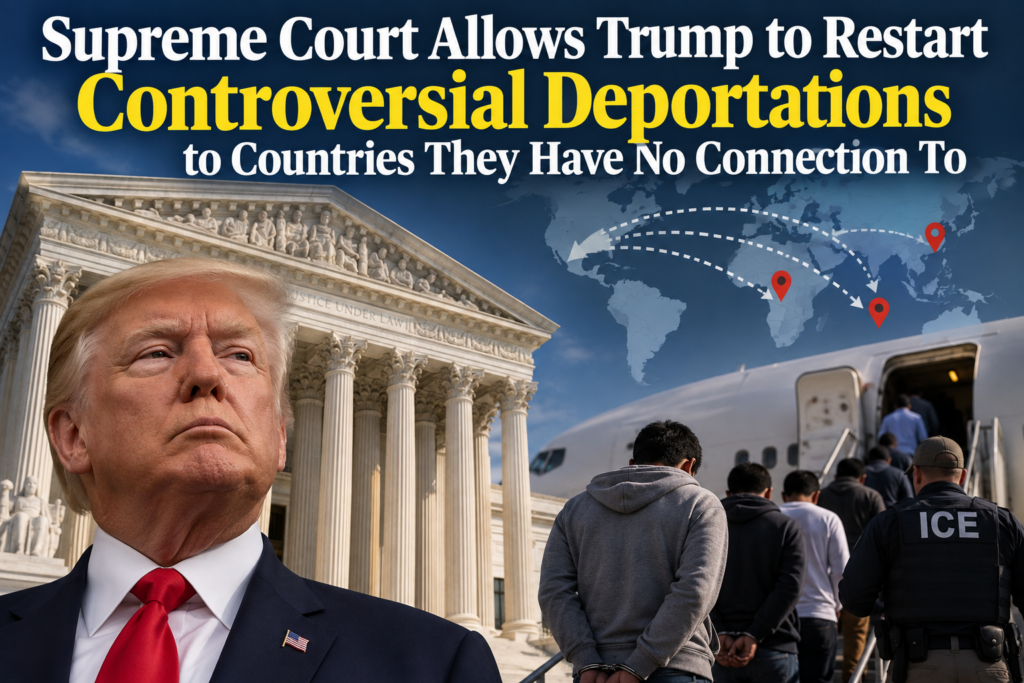
In a closely watched ruling that has reignited debate over U.S. immigration enforcement, the U.S. Supreme Court announced on Tuesday that it would permit the Trump administration to restart deportations of migrants to third-party nations with which those migrants have no prior connection. The 5-4 decision, split along ideological lines, puts on hold a prior ruling from lower courts that had struck down the administration’s so-called “third-country” deportation policy as unlawful. The high court is set to hear full oral arguments on the policy’s legality in December, when it will issue a final, binding ruling on the question.
The contested policy, which the administration rolled out last year, grants U.S. immigration officials the authority to transfer migrants with finalized removal orders to countries other than their nation of origin. This framework was designed to address longstanding logjam in the immigration system that occurs when a migrant’s home government refuses to accept their repatriation, or when legal barriers block their return to their home country. Since the policy was implemented, official data shows that more than 25,000 migrants have been deported to 29 different countries around the world. The vast majority of these deportees have been sent to neighboring Mexico, while smaller groups have been transferred to far-flung nations including South Sudan, Uganda, Equatorial Guinea, Liberia, and the Central African Republic.
The core of the legal challenge to the policy revolves around the procedural protections owed to migrants before they are transferred to a third country. Last year, U.S. District Judge Brian Murphy ruled that the initiative violated federal immigration statutes and the due process guarantees enshrined in the Fifth Amendment of the U.S. Constitution. Murphy found that migrants were not given sufficient advance notice of the planned deportation, nor were they afforded a meaningful opportunity to argue that transfer to the proposed third country would expose them to torture, persecution, or other grave harm. Earlier this month, the 1st U.S. Circuit Court of Appeals upheld nearly all of Murphy’s ruling, setting the stage for the administration to appeal to the Supreme Court.
The Trump administration has defended the policy as an critical law enforcement tool, arguing that it allows authorities to remove migrants who cannot be sent home—including individuals with prior criminal convictions—who would otherwise remain in the United States indefinitely. But legal representatives for the migrants challenging the policy warn that it carries severe human rights risks. They note that even migrants with no criminal record can be transferred under the policy to countries where they have never resided, leaving them vulnerable to violence, abuse, and systemic human rights violations that violate international and U.S. law.
All three of the Supreme Court’s liberal justices issued dissents in Tuesday’s temporary order, arguing that the majority had erred in allowing a unlawfully implemented policy to resume while the legal challenge proceeds. The current order remains in place only until the Supreme Court issues its final ruling after hearing arguments in December. Analysts note that the decision will likely mean thousands more deportations are carried out over the coming months before the high court settles the policy’s legality once and for all.