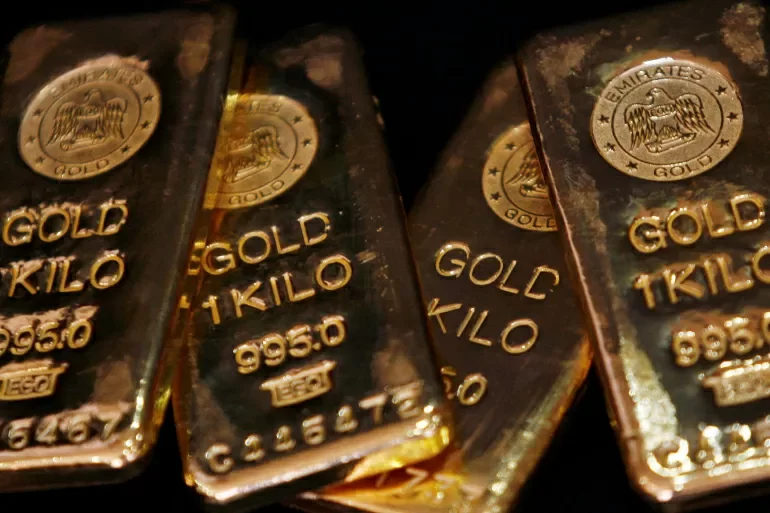
Global commodity markets are facing major cross-currents this week, with gold hovering near its lowest level in more than seven weeks after a sharp sell-off on Monday. The slump and subsequent stagnation come as investors weigh conflicting pressures: growing geopolitical tension around Middle Eastern energy supplies that stoke inflation fears, and a simultaneous shift in expectations that the U.S. Federal Reserve will keep interest rates higher for longer.
On Monday, spot gold hit an intraday low of $4,110.55 per troy ounce, its weakest point since August 5. It closed the trading session at $4,136.81, while U.S. gold futures finished 3.5% lower at $4,168.40. Markets saw limited stabilization on Tuesday, with spot gold trading around $4,124.57 per ounce in early dealings and U.S. gold futures dipping an additional 0.3%. Through the rest of the trading day, gold held steady near $4,130, remaining close to the previous session’s multi-week low.
A primary driver of recent market volatility has been shifting conditions in global oil markets, spurred by escalating tensions between the United States and Iran. Uncertainty around the Strait of Hormuz, a critical chokepoint for global oil shipments, has sparked widespread concerns over potential supply disruptions from the Middle East. Oil prices jumped 3% on Monday after U.S. President Donald Trump rejected an Iranian proposal to de-escalate the conflict, amplifying fears that energy supplies could face prolonged disruption.
Market sentiment shifted in a more mixed direction on Tuesday. Brent crude fell 54 cents to settle around $104.74 per barrel, while U.S. West Texas Intermediate crude dropped 77 cents to $91.83 per barrel, according to Reuters data. The news outlet also reported that Middle Eastern oil exports rose to 12.8 million barrels per day in September, the highest volume recorded since February. Resumed operations at key infrastructure including Saudi Arabia’s Yanbu port and the East-West Pipeline have partially eased supply concerns, though the overall outlook remains tightly tied to both military and diplomatic developments. Mediators continue to work toward an agreement between Washington and Tehran to end hostilities and reopen the Strait of Hormuz, but no breakthrough has been achieved to date.
For gold markets, the reaction in global bond markets has been the most impactful factor. Unlike interest-bearing assets such as government bonds, gold generates no yield or dividend returns for holders. When U.S. Treasuries offer increasingly attractive returns, the opportunity cost of holding non-yielding gold rises sharply, dragging down its appeal.
The Federal Reserve raised its benchmark policy rate by 25 basis points at its September 15–16 meeting, bringing the target range for the federal funds rate to 3.75% to 4%. The recent run-up in oil prices has refocused attention on the risk that higher energy costs will make inflation more persistent. That dynamic limits the central bank’s room to cut interest rates, explaining why investors are now pricing in a longer period of restrictive monetary policy. Market pricing also reflects growing expectations for another rate hike before the end of 2025, though the exact timing and size of any additional increase will depend on upcoming inflation, labor market, and growth data.
The sell-off extended across the entire precious metals complex on Monday. Silver fell between 4.5% and 4.7% to close around $61.39 per ounce, while platinum dropped 2.8% to $1,727.88. Palladium recorded a 3.6% decline to settle at $1,220.65. Most precious metals remained under selling pressure on Tuesday, with silver trading around $60.6, platinum near $1,700, and palladium around $1,209 per ounce in early updates.
At first glance, the recent price action may appear counterintuitive: gold is traditionally viewed as a safe-haven hedge against inflation and geopolitical uncertainty, so rising geopolitical risk and higher inflation pressures would typically support higher gold prices. But the current market environment shows multiple competing forces acting on commodity valuations simultaneously. When higher oil prices push inflation up, central banks are more likely to keep interest rates elevated, which lifts Treasury yields and makes non-yielding gold less attractive by comparison. Additionally, a stronger U.S. dollar makes gold more expensive for buyers purchasing the commodity in other currencies, creating additional downward pressure.
For the moment, the combination of a stronger dollar, rising Treasury yields, and shifting interest rate expectations is outweighing gold’s traditional role as an inflation and crisis hedge. This does not mean gold has lost its safe-haven status entirely; it simply demonstrates that short-term gold prices are driven by a complex mix of overlapping factors, including geopolitical risk, oil prices, inflation expectations, interest rate policy, and dollar valuation.
Looking ahead, investor attention is now turning to upcoming U.S. economic data and further signals around the Federal Reserve’s interest rate path, while the situation around Iran and the Strait of Hormuz remains a key source of uncertainty for both energy and financial markets. If oil supplies continue to normalize and inflation pressure eases, that could take pressure off U.S. interest rates and remove a key headwind for gold. Conversely, a further escalation of the Middle Eastern conflict or new energy supply disruptions could push oil prices and inflation fears higher again, keeping upward pressure on interest rates. For now, gold remains caught between two opposing forces: geopolitical uncertainty that typically supports safe-haven assets, and higher interest rates and dollar strength that act as significant drags on prices.