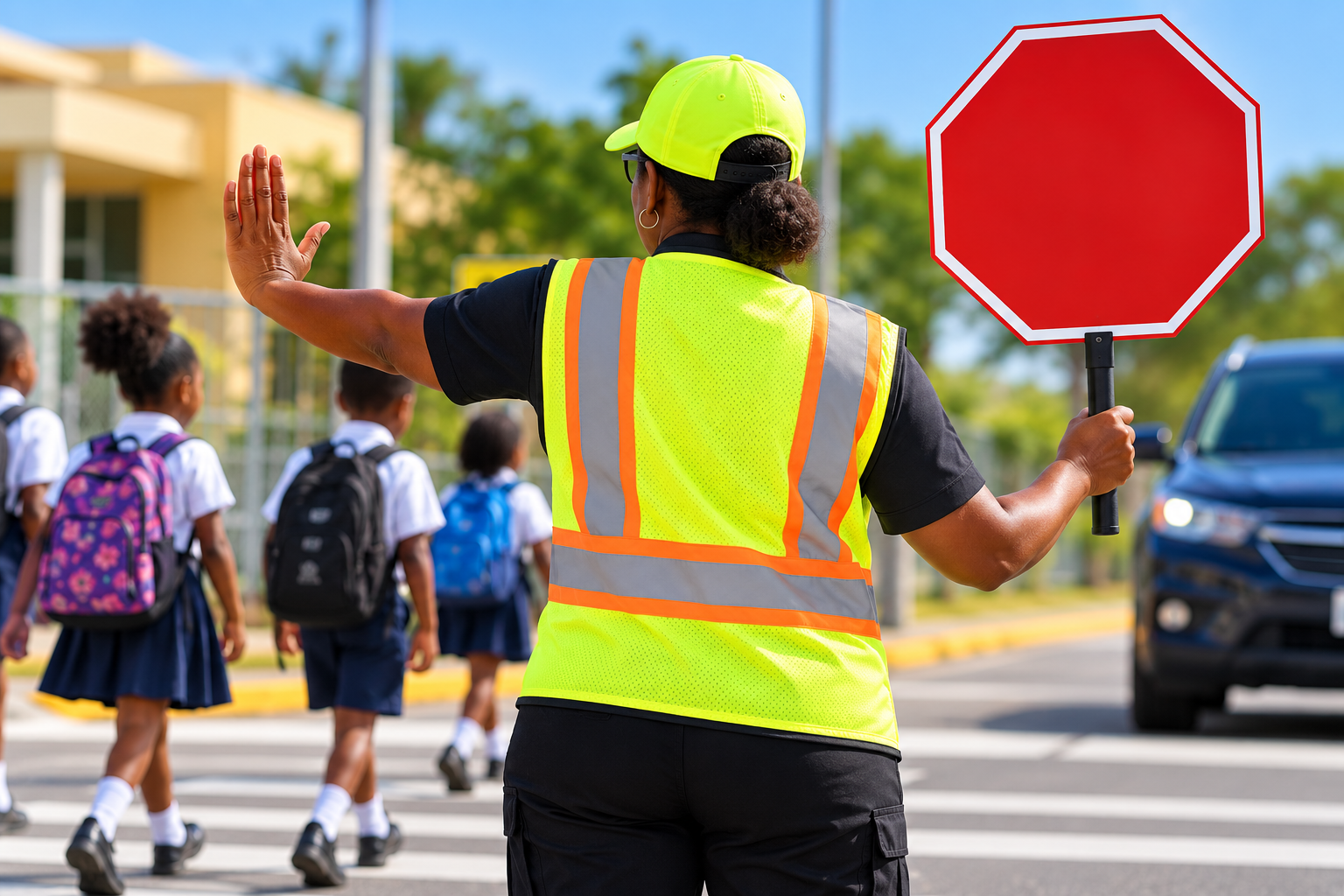
Across school districts, a group of school crossing guards has submitted an open letter to the Minister of Education, calling for urgent reforms to unfair working conditions that have been overlooked for far too long. The frontline safety workers, who protect child pedestrians at primary and secondary school crossings every school day, are pushing for two core changes: location-specific scheduling aligned to actual school hours, and a meaningful wage increase that reflects the risks and importance of their role.
Currently, all crossing guards are bound to a uniform one-size-fits-all shift schedule, requiring attendance from 7:00 a.m. to 9:15 a.m. and 1:30 p.m. to 3:30 p.m. regardless of the schools they are assigned to. This rigid structure ignores the stark differences in opening and dismissal times between primary and secondary institutions: most secondary schools start classes as early as 7:45 a.m., meaning the bulk of student morning traffic clears long before the 9:15 a.m. end of the mandatory shift. For primary schools, which typically start closer to 9:00 a.m., the early 7:00 a.m. start of the uniform shift requires guards to report for duty hours before any students begin arriving.
The crossing guards have put forward evidence-based, flexible adjustments that would match shift times to actual student traffic patterns. For secondary school posts, they propose shifts of 7:00 a.m. to 8:30 a.m. and 1:30 p.m. to 2:30 p.m., adjusted for local traffic volumes where needed. For primary school crossings, the proposed schedule of 8:00 a.m. to 9:15 a.m. and 2:30 p.m. to 3:30 p.m. would align coverage with when students actually need protection, eliminating redundant unpaid standing time.
Beyond inefficient scheduling, the letter also highlights a problematic power dynamic: a small number of guards assigned to one school tier have been allowed to influence or dictate shift terms for all guards, even though primary and secondary school operations are entirely separate. This has resulted in mandatory idle time for many guards, who are forced to stay at posts with no student crossings simply to comply with rules written for a different school schedule. The workers emphasize that this is not a request to cut working hours, but to align working time with actual public safety needs.
The second core demand addresses longstanding inadequate compensation. Crossing guards note that their role places them in constant proximity to moving traffic on busy roads, requiring constant alertness and carrying inherent risks to their own safety to protect children and other pedestrians. Despite this critical public responsibility, wages have stagnated, forcing many guards to take on second jobs just to cover basic living costs.
While the workers explicitly recognize the value of work done by teachers and other education staff, they argue that their own contribution to student safety is no less important. Every worker supporting children’s education and well-being deserves to feel their work is recognized and fairly compensated, they say.
In addition to adjusted scheduling and wage reform, the crossing guards are calling for three key procedural changes: full consultation with guard representatives before any changes to working conditions, clear official guidelines to prevent any single group of guards from setting terms for all other workers, and formal formal recognition of the unique risks and responsibilities tied to the role.
The letter closes with a powerful reminder that crossing guards are core members of the school safety ecosystem, showing up to their posts in rain, extreme heat, heavy traffic, and other challenging conditions to fulfill their responsibility to protect children. They are not invisible workers, the letter stresses, and they deserve fair treatment, dignity, respect, and pay that matches the importance of their life-saving work.
The crossing guards have called on the Ministry of Education to take their concerns seriously, meet with elected worker representatives to discuss the demands, and deliver meaningful policy changes that advance fairness for all frontline crossing safety staff.