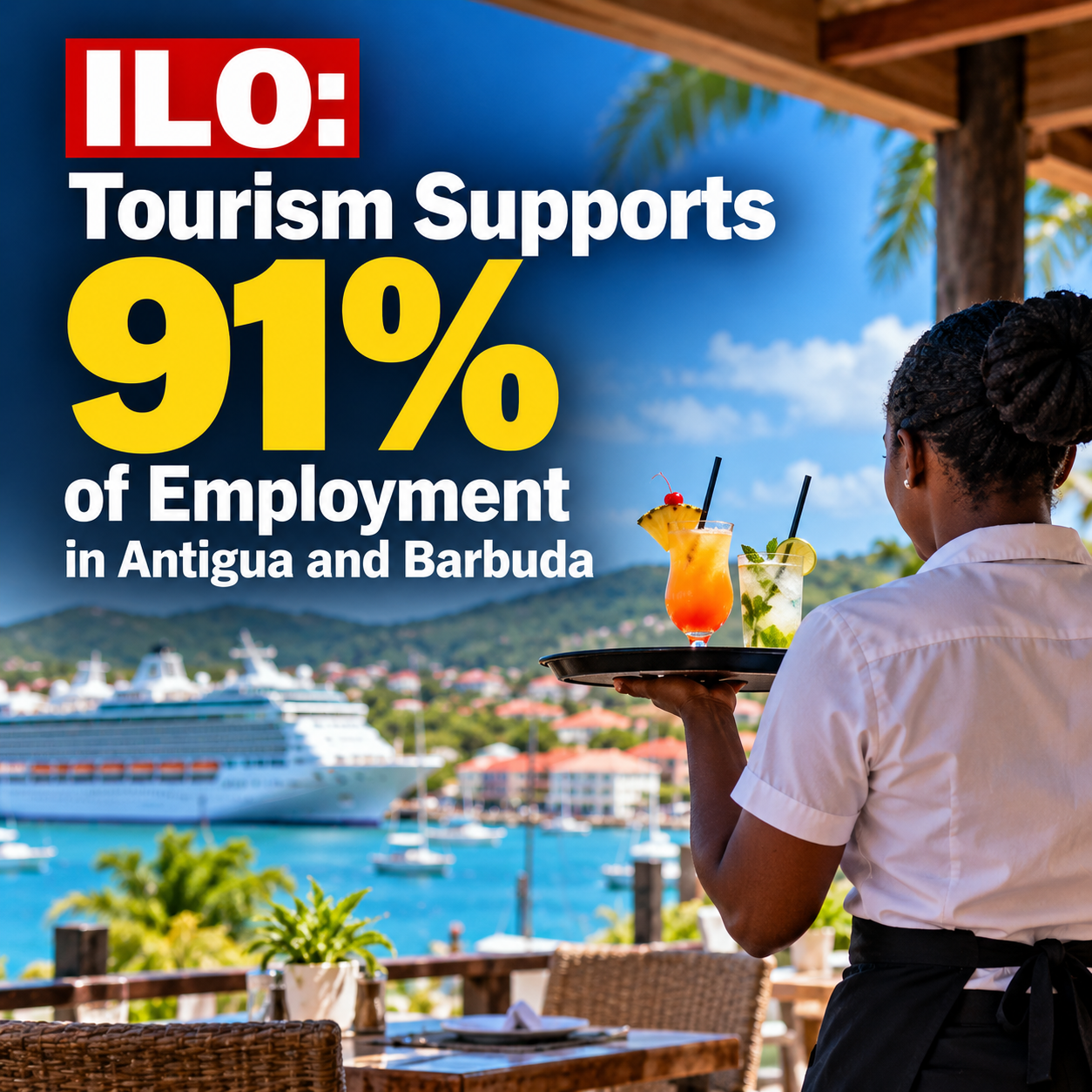
A new analysis released by the International Labour Organization (ILO) on September 25 has underscored the unprecedented dependence of Antigua and Barbuda’s national economy on the tourism sector, revealing that when accounting for direct, indirect and induced employment streams, tourism supports a staggering 91% of the country’s total workforce. This figure, drawn from 2019 baseline data included in the ILO’s *Informality in the Tourism Sector in the Eastern Caribbean* report, tops all five Eastern Caribbean nations evaluated in the study, outpacing Saint Lucia at 78%, Grenada at 41%, Dominica at 38%, and Barbados at 31%.
It is critical to clarify that this 91% metric does not mean nearly all of Antigua and Barbuda’s workers are directly hired by hotels, tour operators, restaurants or other direct tourism-facing businesses. The total estimate integrates three interconnected layers of tourism’s economic ripple effect. Direct employment covers workers directly employed at tourism establishments; indirect employment accounts for positions at upstream suppliers that provide goods and services to tourism operations; induced employment captures additional jobs created across the broader economy when tourism workers and business owners spend their earnings locally. To contextualize this breakdown, the report notes that in Grenada, direct tourism employment makes up just 17.1% of total employment, with indirect linkages contributing an additional 25.8% to reach the 41% total.
Beyond its outsized role in the labor market, the report confirms that Antigua and Barbuda also holds the highest share of GDP contributed by tourism among the study’s five nations. Data from the World Travel and Tourism Council projects that tourism will account for 77.3% of the country’s total GDP in 2025, well ahead of Grenada’s 60%, Saint Lucia’s 57.4%, Barbados’ 23.1% and Dominica’s 22.3%. Separate International Monetary Fund data cited in the report estimates Antigua and Barbuda’s gross tourism receipts hit roughly $1 billion in 2024, equal to 46.8% of total national GDP, with that share projected to climb to 48.5% by 2029. The ILO characterizes Antigua and Barbuda’s tourism sector as one of the earliest established and most structurally consolidated in the entire Eastern Caribbean. Unlike many regional destinations, cruise tourism makes up a substantial share of its visitor economy: Caribbean Tourism Organization data included in the study shows 70% of all visitors to the country arrive by cruise ship, with 563,699 cruise passenger arrivals recorded through October 2024, alongside roughly 330,000 overnight stayover visitors for the full year 2024.
However, the report warns that the massive size of tourism’s contribution to Antigua and Barbuda’s economy does not inherently translate to high-quality, secure employment for workers across the sector. The core challenge identified across all five studied nations, and one of particular urgency for Antigua and Barbuda, is the widespread prevalence of informal economic activity within tourism. Informal workers typically lack the legal protections, benefits and labor rights guaranteed to formal employees, and commonly face low and unstable wages, unpredictable or excessively long working hours, limited access to social safety nets, systemic gender discrimination, and inadequate occupational health and safety standards. For small informal tourism businesses, barriers to formalization include difficulty accessing affordable financing, limited capacity to reach digital markets, challenges integrating into formal regional tourism value chains, burdensome administrative requirements, and a widespread perception that the costs of formal registration outweigh the potential benefits.
Against the backdrop of Antigua and Barbuda’s extreme economic reliance on tourism, this informality challenge carries outsized national stakes. Supplementary data accompanying the report shows that the country’s overall informality rate rose from 12.7% in 2018 to 19.3% in 2023, even as the tourism sector continued to expand throughout that period. Rejecting a one-size-fits-all approach that relies solely on stricter enforcement of labor regulations to address informal activity, the ILO instead proposes a proactive set of policies designed to make formalization more accessible and beneficial for both workers and small businesses. Key recommendations include expanding access to affordable financing for micro, small and medium-sized tourism enterprises, strengthening targeted skills development programs for tourism workers, expanding universal social protection coverage, improving compliance with core international labor standards, and increasing targeted institutional support for small tourism businesses.
The report’s findings highlight that tourism’s economic footprint in Antigua and Barbuda extends far beyond the frontlines of hotels and resorts, rippling through local transportation, retail, food production, entertainment, and a wide range of other local sectors that depend on visitor spending. With 91% of all national employment tied directly or indirectly to tourism performance, shifts in global travel demand or sector conditions impact the vast majority of the country’s workforce. This reality makes addressing informal employment and improving job quality as critical to national economic stability as growing overall visitor numbers.