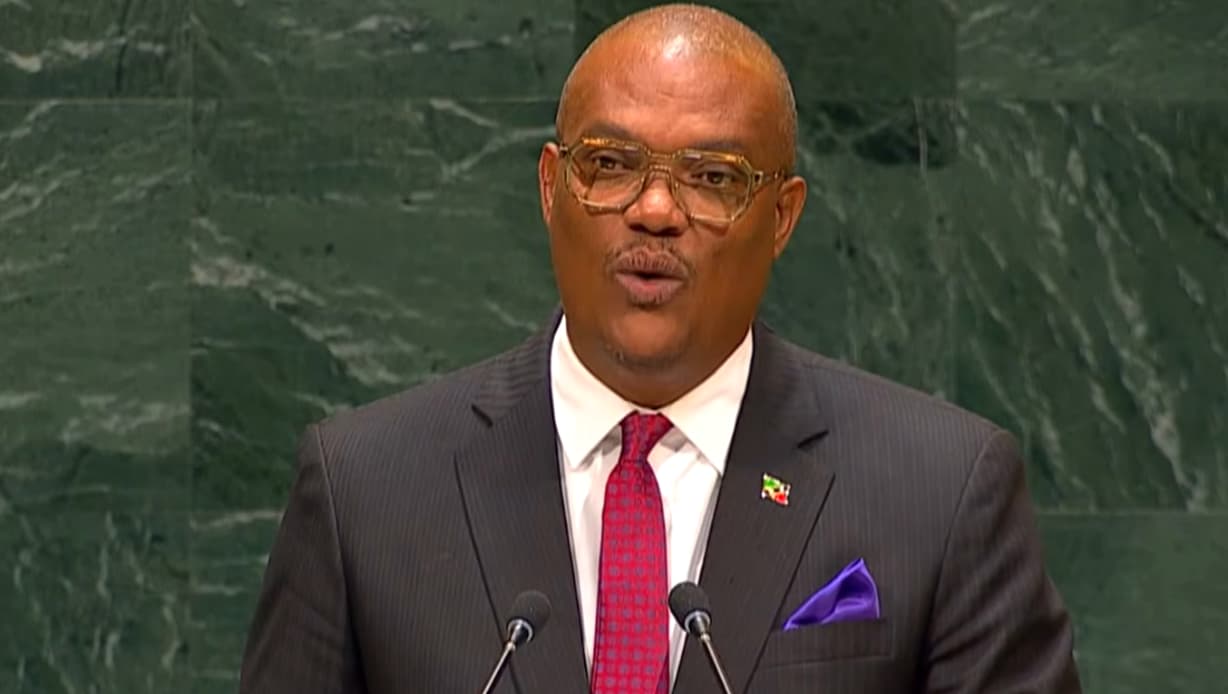
At the 81st session of the United Nations General Assembly held on September 25, 2026, Acting Prime Minister Dr. Geoffrey Hanley of St. Kitts and Nevis delivered a bold, principle-driven address centered on equity for small nations, consistent application of global rules, and urgent action on longstanding injustices and regional crises.
Hanley opened by framing Caribbean nations’ approach to global challenges as rooted in unwavering respect for core foundational values: national sovereignty, territorial integrity, consistent international law, and diplomatic dialogue. Reaffirming the regional bloc CARICOM’s longstanding position on ongoing border disputes in the Western Hemisphere, he made clear that the organization endorses the International Court of Justice as the legitimate, peaceful pathway to resolve the ongoing border dispute between Guyana and Venezuela, as well as the existing judicial process addressing territorial differences between Belize and Guatemala.
Beyond regional territorial disputes, Hanley called for the uniform application of international law across all active global conflicts, including Gaza, Ukraine, Sudan, Yemen, Chad, and the Democratic Republic of the Congo. For small island states like St. Kitts and Nevis, he argued, inconsistent application of global rules creates a dangerous precedent where might overrides right, leaving vulnerable nations at constant risk. “Civilians continue to bear an unconscionable burden” in all these conflicts, Hanley stated, emphasizing that the global community must uphold a single, universal standard for international law, applied consistently rather than selectively, and extend moral conscience evenly rather than for political convenience. “There can be no hierarchy of human suffering,” he stressed.
On the matter of global leadership representation, Hanley announced that St. Kitts and Nevis joins the full CARICOM bloc in endorsing Carolyn Rodrigues-Birkett of Guyana for the position of United Nations Secretary-General. He framed her candidacy as a landmark step for equitable global representation: as a woman and a leader from a small developing nation, Hanley noted, her candidacy demonstrates that global leadership is defined by vision and integrity, not the geographic or economic size of a candidate’s home country.
Hanley also highlighted a historic milestone in reparatory justice cooperation between African and Caribbean nations. In March 2026, the African Union’s reparations mechanism and the Caribbean Reparations Commission held their first official meeting, building on the framework of the Addis Ababa Declaration signed during the second Africa-Caribbean summit. Hanley argued that collaboration between the two regions must move beyond shared historical sympathy to tangible action across investment, trade, technology exchange, knowledge sharing, cultural cooperation, and coordinated global diplomacy. He referenced General Assembly Resolution 80/25/250, which formally classified the trafficking and racialized chattel enslavement of African peoples as the gravest crime against humanity, and called for the global movement for reparatory justice to transition from formal recognition of harm to concrete remediation. “Reparatory justice must move from recognition to remedy, and from words to action,” he said.
Turning to the ongoing humanitarian and security crisis in Haiti, Hanley drew global attention to the deteriorating conditions ahead of the country’s first round of presidential and legislative elections: approximately 1.47 million Haitians remain internally displaced, and nearly half of the national population faces acute food insecurity. He called for the rapid deployment of the UN-authorized multinational gang suppression force, timely renewal of the mission’s mandate, and coordinated international support for Haitian-led recovery and governance efforts.
Addressing other regional and global priorities, Hanley shared that St. Kitts and Nevis has delivered humanitarian relief to the Cuban people and to St. Kitts and Nevis nationals studying in Cuba, and urged constructive diplomatic dialogue between the governments of Cuba and the United States to resolve longstanding tensions. He also reaffirmed St. Kitts and Nevis’ support for Taiwan’s meaningful participation in international bodies including the World Health Organization and the International Civil Aviation Organization, and called for cross-strait differences to be resolved exclusively through peaceful means.
Closing his address, Hanley emphasized that trust between nations is built through delivered action, not empty promises. “Let this assembly be remembered not for what was said here but for what was done after,” he concluded.