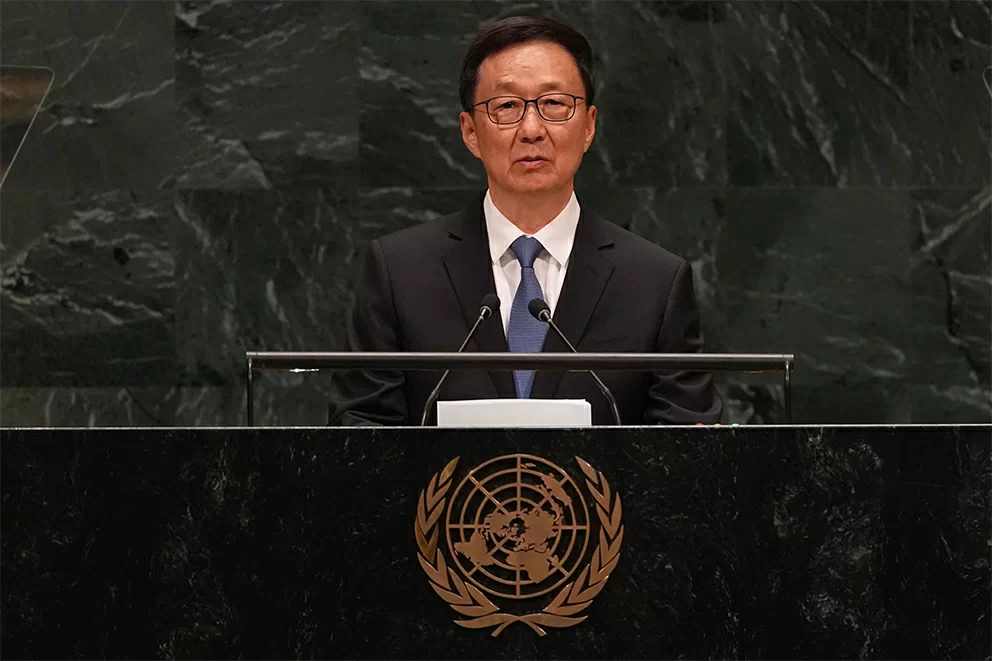
Against the backdrop of rising global geopolitical divisions and strained multilateral cooperation, Chinese Vice President Han Zheng delivered a key address on behalf of China during the general debate of the 81st United Nations General Assembly at UN Headquarters in New York on Saturday, one day after Chinese President Xi Jinping’s state visit to the U.S. and his meeting with U.S. President Donald Trump.
Prior to the address, Beijing had confirmed that Han would lay out China’s official positions on global and regional affairs, as well as the country’s vision for the role of the United Nations. Diplomatic sources emphasized that sending Han to represent China at the assembly does not signal a reduced commitment to the UN — the body remains a core platform for multilateral cooperation for Beijing, and Han is far from the first senior Chinese official to stand in for the Chinese president during UN General Assembly week.
The central theme of Han’s speech was global development. He framed economic and social progress as a fundamental precondition for lasting international peace and stability, and highlighted the priority needs of developing countries in this area. Han pointed to China’s own experience, citing what the Chinese government describes as two domestic “miracles”: decades of rapid economic expansion paired with long-term social stability, as an example of what sustained, targeted development can achieve. This framing is a longstanding core element of China’s official diplomatic narrative, and not an independent assessment by the UN.
Two of China’s signature global development efforts took center stage in the address: the Global Development Initiative (GDI), launched five years ago to strengthen international development cooperation with a specific focus on the Global South, and the Belt and Road Initiative (BRI), through which Beijing says it now partners with dozens of countries around the world. The BRI has long drawn debate: while Beijing frames it as a vehicle for infrastructure growth and shared development, critics argue the projects also expand China’s economic and geopolitical influence, a tension that remains central to broader discussions of China’s role in the developing world.
On economic policy, Han issued a clear warning against protectionism, in a nod to the long-running trade frictions that have shaped China-U.S. relations in recent years. “Protectionism produces no winners,” he stated, arguing that no country can achieve robust development in a closed, fragmented international economic environment. The statement aligns with China’s longstanding position opposing trade barriers and unilateral economic measures, and reflects Beijing’s consistent support for the multilateral trading system centered on the World Trade Organization. The timing of the message was notable, coming just days after Xi and Trump’s Washington meeting, where trade and bilateral economic tensions were top agenda items as the two countries work to manage their economic disputes through negotiation.
Han reaffirmed China’s commitment to multilateralism as the foundation of a rules-based international order anchored in the UN Charter. He called on all nations to resolve disputes through dialogue and diplomacy, and pushed back against unilateral military actions that bypass UN Security Council approval or violate the terms of the UN Charter. This is a core principle of China’s longstanding foreign policy, which holds that international disputes must be addressed through multilateral frameworks with full respect for national sovereignty. The message comes at a moment when the UN is grappling with multiple protracted conflicts and growing geopolitical rifts, echoing a warning issued by UN Secretary-General António Guterres at the opening of this year’s assembly, who highlighted rising global division and growing pressure on international cooperation and international law.
On tensions involving Iran and the broader Middle East, Han took a measured tone, stating that China insists on full respect for the sovereignty and security of all regional states, including Gulf countries. He called for preserving the post-war international order and warned against Cold War-era mentalities and bloc confrontation. The address did not offer an extended breakdown of China’s position on the ongoing regional conflict, consistent with Beijing’s longstanding approach of framing itself as a neutral supporter of negotiated political solutions to international disputes.
A notable absence from the speech was any direct reference to Taiwan, a core issue in China’s foreign policy that regularly features in Beijing’s diplomatic statements, particularly in the context of its relations with the United States. While the omission is clear, analysts note its meaning remains ambiguous: without additional official comment from Beijing, it cannot be interpreted as a shift in China’s longstanding Taiwan policy.
Han also touched on global technological governance, including the fast evolution of artificial intelligence, a top priority for this year’s UN General Assembly, where global regulation of AI has been a central topic of debate. China has pushed for greater multilateral cooperation on AI governance in recent years, and has called for increased representation for developing countries in the process of setting international technological rules. This emphasis aligns with the broader agenda of this year’s assembly, where Guterres has named the rapid advancement of AI as one of the key global challenges that requires coordinated cross-border collaboration.
Overall, Han’s address offered few departures from China’s existing foreign policy framework, with core priorities of development, multilateralism, respect for national sovereignty, opposition to protectionism, and rejection of unilateral military action that have been consistent in Beijing’s public statements for years. The dual diplomatic events of the past week — Xi’s meeting with Trump in Washington and Han’s address at the UN — underscore Beijing’s parallel diplomatic tracks: active engagement in multilateral institutions alongside direct high-level negotiation with the United States. For China, the UN General Assembly address served primarily as a platform to reaffirm its broader global vision: that lasting international stability can only be built through inclusive economic development, widespread multilateral cooperation, and deliberate efforts to avoid conflict escalation. Whether this approach will deliver concrete progress on ongoing disputes from trade and AI governance to Middle East tensions and U.S.-China rivalry will ultimately depend on the willingness of all involved parties to translate shared stated principles into actionable policy.