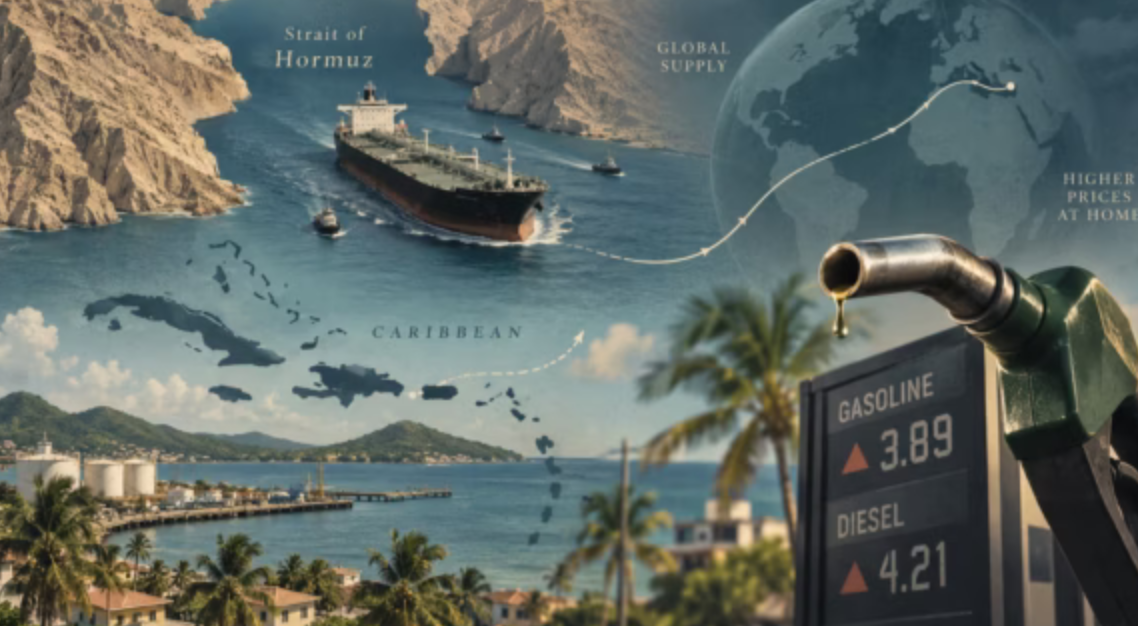
When motorists across Antigua and Barbuda pulled up to fuel pumps in September, they encountered a sharp price shock: a EC$2 per gallon increase that pushed gasoline from EC$14.50 to EC$16.50 and diesel from EC$14.25 to EC$16.25, a roughly 14% jump across both fuels. But this latest price increase is not solely the outcome of ongoing disruptions at the Strait of Hormuz, a critical global oil chokepoint. It also reflects a deliberate policy choice by the Antiguan government to roll back existing consumer subsidies that previously buffered households from rising global import costs. This dual driver of price hikes puts a sharp spotlight on a question facing nearly every Caribbean household and business: what share of local fuel price increases can actually be traced to geopolitical disruptions thousands of miles away, and how much stems from domestic policy decisions?
Data from global energy regulators confirms that a substantial international supply shock is indeed pushing up fuel prices worldwide, with diesel facing particular strain. However, there is no one-size-fits-all percentage that can be applied uniformly to pump prices across every Caribbean island to isolate the Hormuz effect. Between a disrupted cargo shipment in the Gulf and a motorist’s receipt at the pump lie a web of independent regional markets, pre-negotiated supply contracts, and domestic fiscal policy choices that shape final retail costs.
To understand why Hormuz ripples across global fuel markets even for countries that do not import directly from the Gulf, it is critical to contextualize the chokepoint’s outsize role in global energy trade. According to the U.S. Energy Information Administration (EIA), roughly 20 million barrels of petroleum liquids pass through the Strait of Hormuz every day in 2024 — equivalent to one-fifth of total global oil consumption. Alternative pipeline networks can only absorb a fraction of that volume if Hormuz traffic is restricted. While the strait has not been fully closed to all traffic, Reuters reporting from September 22 confirms that total vessel movement remains far below pre-conflict levels, and the International Energy Agency (IEA) estimated that more than 10 million barrels of daily Gulf oil production remained shut in during August.
The interconnected nature of global fuel markets means even Caribbean importers that source all their fuel from non-Gulf suppliers still feel the impact of the Hormuz disruption. A September EIA analysis of global fuel markets explains that constrained international gasoline supplies have driven up both the cost of U.S. domestic imports and demand for U.S. fuel exports. As buyers around the world scramble to secure replacement supplies from alternative producers, they end up competing for output from Atlantic Basin refineries that would normally serve existing regional customers. This competition pushes up prices for all cargoes — even those that never travel near the Gulf. This dynamic is why simply measuring the share of global oil that passes through Hormuz cannot give an accurate percentage for local fuel price increases: the final impact depends on how much total supply is actually taken off the market, how quickly alternative production can come online, available global inventory levels, and how consumer demand responds to higher prices.
Diesel has faced far steeper price increases than gasoline through this crisis, a gap that requires explanation beyond just crude oil supply disruptions. The IEA estimates that Gulf net exports of diesel and gasoil averaged just 390,000 barrels per day in August, only slightly more than a quarter of their pre-crisis level. Ongoing disruptions to Russian refinery operations have only compounded this shortage, making clear that the entire price increase cannot be pinned on Hormuz alone. In energy trading, the difference between the wholesale price of finished fuel and the cost of crude oil is called the crack spread. The EIA reports that since May, the New York Harbor gasoline crack spread has averaged roughly US$1 per gallon above its 2025 baseline, while distillate and jet-fuel crack spreads have seen even larger increases, because the disrupted production facilities disproportionately supplied these refined products. This confirms a global shortage of finished fuel products, not an automatic surcharge passed directly to Caribbean consumers, and the spread itself includes refining operating costs, not just pure profit.
Local industry accounts align with this global trend. In a March 9 interview with antigua.news, West Indies Oil Company chief executive Gregory Georges noted that recent fuel shipments had arrived at dramatically higher costs, with the sharpest increases recorded for diesel and jet fuel, matching the global market dynamic.
To understand how global price increases translate to local pump prices, it is important to start with the actual product Caribbean importers purchase, rather than assuming retailers buy crude directly. A standard petroleum barrel holds 42 U.S. gallons, or roughly 159 liters. If the landed cost of finished gasoline or diesel rises by US$20 per barrel, that adds approximately 12.6 U.S. cents per liter to the import cost — a total of roughly US$6.29 for a 50-liter tank. For a US$10 or US$30 per barrel increase, that translates to 6.3 or 18.9 U.S. cents per liter respectively. These are illustrative conversions, not official estimates of the Hormuz-specific premium, and they assume full pass-through of costs before percentage-based taxes, with no changes to domestic retailer margins or government support. Percentage-based taxes can amplify retail price increases, while expanded government support can absorb part of the rise.
Accurate accounting is critical to avoiding double-counting: the landed price of finished fuel already includes the supplier’s product cost and agreed delivery fees, so adding a separate crude price increase on top inflates the final bill. Domestic storage, distribution, retail margins, and net fiscal charges then complete the journey from global supplier to local pump. The same logic applies to shipping costs: an insurance surcharge for vessels traveling through the Gulf cannot be automatically applied to a Caribbean-bound voyage that takes a different route; calculating that surcharge requires access to the actual voyage route, contract terms, and insurance policy details, not just a reference to the Hormuz conflict.
Antigua’s September price hike perfectly illustrates the difference between the global economic cost of higher fuel and the immediate amount passed through to motorists. Explaining the government’s decision to scale back fuel price support, Prime Minister Gaston Browne stated that the government had forgone roughly EC$24 million in revenue over the previous six months. This figure is an official government attribution, not an independently audited finding, and foregone revenue should also be distinguished from direct cash subsidy payments. When rising import costs are absorbed through lower tax collection or other government support, a stable retail pump price does not mean the global supply shock has disappeared. Rolling back part of that support can raise retail prices even without a new increase in current wholesale prices — it only shifts who pays the cost, and when.
Saint Lucia offers a clear example of how different policy frameworks and pricing timelines produce different outcomes across the Caribbean. A September 14 pricing notice from the government set both gasoline and diesel at EC$3.79 per liter, up from EC$3.68, for the period ending October 4. The new prices reflect international price movements between August 17 and September 6, and the government continues to maintain subsidies for diesel. This means retail prices set using a lagged reference window cannot be judged against current daily crude price quotes alone, and identical retail prices for gasoline and diesel do not mean identical underlying wholesale costs. Pricing formulas and ongoing subsidy levels play a major role in shaping final prices. This makes cross-island fuel price comparisons far more complex than just comparing photos of forecourt price signs; purchase dates, fuel specifications, tax rates, subsidy levels, and measurement units (including whether a quoted gallon is U.S. or imperial) all must be aligned to make an accurate comparison.
The impact of higher fuel prices extends far beyond private motorists across the Caribbean. Diesel is a core input for nearly every sector of regional economies: it powers freight transport, agricultural machinery, and construction equipment, meaning higher diesel costs will eventually feed through to higher prices for a wide range of goods and services. Fuel is only one component of final consumer prices, however, so the increase will not be one-to-one.
Electricity prices face separate pressure, as power generators rely on fuel purchases to operate, with their own tariff structures governing how costs are passed to consumers. In an official August 26 statement, the Antigua Public Utilities Authority reported that its monthly fuel bill had nearly doubled between January and July, attributing the increase to elevated international prices. This is a total spending figure, not a unit price index, so additional data on total volume consumed and the power generation mix would be needed to isolate how much of the increase comes from higher per-unit prices, let alone how much can be traced specifically to Hormuz.
The region’s critical tourism sector also faces exposure from the supply shock. As antigua.news has previously reported, higher jet fuel costs put upward pressure on airfares for routes bringing visitors to the Caribbean. While the jet fuel market is separate from retail road diesel, both markets face the same broader strain on global refined fuel supplies. An April International Monetary Fund assessment found that net energy imports for tourism-dependent Caribbean economies average roughly 6% of gross domestic product. This is a group-wide estimate, not an Antigua-specific figure, and energy exporting countries in the region such as Guyana and Trinidad and Tobago have very different external exposure, though higher global energy and food costs still impact their domestic households.
The core outstanding question for Caribbean consumers is not whether the Hormuz disruption creates upward price pressure — it is how to separate that contribution from other global supply pressures and domestic pricing decisions. There is already a local dispute over one key component of retail prices: in an April statement published by antigua.news, Antiguan service station operators pushed for higher retail margins, citing long-running increases in operating costs, and called for the full publication of official fuel price breakdowns. That statement confirms demand for a change in margins, not proof that an increase was approved or that existing margins are excessive.
A full transparent reconciliation of pump prices would require accounting for the appropriate wholesale benchmark for gasoline or diesel, the pricing date of the supply contract, actual purchase and delivery costs, inventory accounting methods, local retail margins, and existing taxes or government support. Only these detailed records can fully explain the observed pump price. Isolating the specific contribution of Hormuz would require an additional counterfactual estimate of what the same fuel would cost without the disruption, while also accounting for other independent refinery outages and shifts in global demand.
The duration of the crisis also matters. The IEA recorded a 507 million barrel drawdown in global oil inventories between February and August, as stocks have been used to cushion the loss of supply. But drawing down existing inventories is not a long-term replacement for sustained production flows.
The public data reviewed for this analysis does not provide a cargo-by-cargo reconciliation for Antigua that would allow for a precise attribution of the September pump price increase to the Hormuz disruption. This lack of detailed public data supports neither the claim that every cent of the increase is an unavoidable result of global events, nor the claim that the disruption is merely a political excuse for higher prices.
For Caribbean consumers, the most evidence-based conclusion is that the Hormuz disruption is creating real, sustained upward pressure on fuel costs, particularly for diesel. How much of that pressure reaches a specific local pump depends on what type of finished product was purchased, the contractual terms of its delivery, and who chooses to absorb the cost of the increase. The global refined fuel shortage is well-documented. A precise local attribution of costs will require full access to detailed supply chain and pricing accounts that are not currently public.