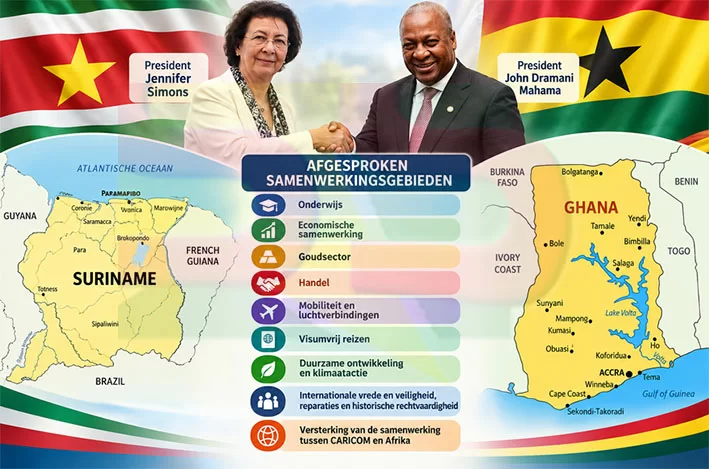
On the sidelines of the 81st United Nations General Assembly in New York, the presidents of Suriname and Ghana have announced a major push to deepen their long-standing historical and cultural ties into a comprehensive bilateral partnership spanning trade, diplomacy, natural resource development and people-to-people exchange.
Suriname’s President Jennifer Geerlings-Simons and Ghana’s President John Dramani Mahama held bilateral talks September 26 on the margins of the annual global summit, laying out a shared agenda that includes exploring visa-free travel, expanding air connectivity, boosting educational exchanges, growing bilateral trade, and advancing joint collaboration in the gold mining sector. Following their discussions, foreign ministry leaders from both nations formalized the new framework of cooperation during a signing ceremony witnessed by the two heads of state, signing a Joint Declaration and updating a bilateral roadmap for cooperation spanning 2026 to 2029.
According to Suriname’s Communication Service (CDS), the talks centered on translating the deep historical and cultural connections between the two nations into tangible cooperation that delivers shared economic and social benefits for both populations. Specific priority areas were identified, including educational partnership, broad-based economic collaboration, and sustainable development of the gold sector. Both leaders committed to expanding existing cooperative frameworks into targeted initiatives aligned with global sustainable development goals.
Melvin Bouva, Suriname’s Minister of Foreign Affairs, International Trade and Cooperation, and his Ghanaian counterpart Samuel Okudzeto Ablakwa carried out the official signing of the Joint Declaration and updated roadmap. The revised 2026-2029 Bilateral Roadmap will serve as a practical operational framework to set clear priorities, track the implementation of agreed commitments, and ensure agreed initiatives are delivered on the ground. Beyond bilateral projects, the two nations also agreed to hold more regular high-level political dialogue between their capitals Paramaribo and Accra, and to strengthen coordinated positions within multilateral bodies including the United Nations, African Union (AU) and the Caribbean Community (CARICOM).
Key areas for enhanced multilateral coordination include sustainable development, climate action, international peace and security, reparations, and historical justice. Both countries have pledged to prioritize amplifying the collective interests of developing nations, small island states, and vulnerable global economies in international forums.
During the discussions, leaders addressed cross-border people mobility, with President Mahama expressing particular interest in establishing a visa-free travel regime for holders of ordinary passports between the two countries. Such an arrangement would lower barriers to travel, and support growth in business, tourism, and cultural exchanges between Ghana and Suriname. As of the announcement, no final agreement has been reached on the policy. For its part, Suriname highlighted the importance of improving air connectivity, noting that a bilateral aviation agreement has already been signed, and further implementation will strengthen transport links between South America and West Africa.
On the economic front, collaboration in the gold sector was a key topic of discussion. Ghana is home to one of Africa’s largest gold mining industries, and both governments see significant opportunities to expand joint development and knowledge sharing in this area, though concrete details of the partnership have not yet been released. Additional economic priorities include expanding overall bilateral trade, advancing educational partnerships, and boosting people-to-people mobility to support inclusive sustainable growth.
The partnership extends beyond bilateral cooperation, with both nations leveraging their regional positions to strengthen ties between the Caribbean and African continents. Ghana is set to assume the rotating presidency of the African Union in 2027, while Suriname will take over the presidency of CARICOM next year. The two countries plan to use their leadership roles to elevate shared priorities including trade, education, mobility, sustainable development, and South-South cooperation on the joint agenda for African and Caribbean regional blocs.
In line with this regional cooperation goal, President Geerlings-Simons announced that as incoming CARICOM president, she will propose inviting President Mahama as a Special Guest to the 2027 CARICOM Heads of Government Meeting, which will be held in Suriname from February 16 to 19, 2027.
The talks also dedicated significant attention to the shared historical ties between the two nations. President Mahama thanked Suriname for its support of United Nations General Assembly Resolution A/RES/80/250, which addresses the trans-Atlantic slave trade and racially based chattel slavery. For Ghana, advancing global recognition, justice, and reparations for the harms of slavery is a core international priority, and the Joint Declaration identifies reparations and historical justice as areas where the two nations will strengthen coordinated international advocacy. The joint statement recognizes Ghana as holding special significance in Suriname’s national cultural heritage, rooted in shared historical connections.
To mark the deepening of ties, President Mahama extended an invitation to President Geerlings-Simons to attend Ghana’s 70th independence anniversary celebrations in 2027. With the signing of the Joint Declaration and updated roadmap, Paramaribo and Accra have moved to anchor their centuries-old cultural and historical relationship in a concrete, modern cooperation framework. Over the coming three years, the 2026-2029 Bilateral Roadmap will guide the rollout of new projects across economic development, education, gold sector collaboration, mobility, and deeper integration between the Caribbean and African regions.