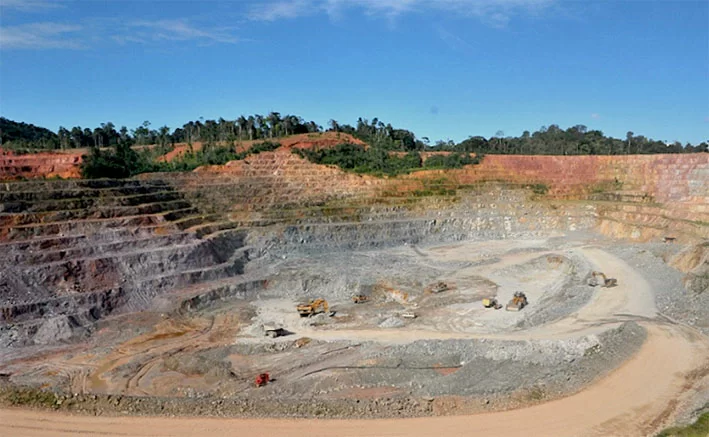
A growing controversy over unauthorized gold mining in Suriname’s Pelin Bergi region has entered the public spotlight this week, after state-owned mining firm Rosebel Gold Mines (RGM) broke its silence to reveal that the Surinamese government has been aware of the illegal operations for more than six years.
The revelation comes after two members of Suriname’s National Assembly (DNA), Rabindre T. Parmessar and Michael S. Marengo, recently visited the Pelin Bergi area — part of the broader Overman mining region — and issued a public call for an immediate temporary suspension of all extraction activities. During their site visit, the lawmakers raised urgent alarms over potential environmental harm and regulatory non-compliance, prompting RGM to issue its first official statement clarifying its role in the dispute.
In the statement, RGM confirmed that the Pelin Bergi area falls within its licensed contract area, but emphasized a key distinction: the company only holds exploration rights for the region, not commercial extraction rights. That means RGM is legally permitted to conduct geological survey and pre-development work in the area, but has no authorization to mine gold or other minerals for commercial sale. Most critically, the firm stressed that it has never granted any third party permission to conduct mining activities in Pelin Bergi. “These activities are not carried out by or on behalf of RGM,” the company’s statement read, adding that the ongoing unauthorized operations violate its contractual rights and block its own legal exploration work.
Most notably, RGM laid out a timeline that puts bureaucratic inaction at the center of the controversy. According to the company, it first detected the unlawful mining activities back in January 2020, and notified relevant Surinamese government authorities that same month, formally requesting intervention to remove the unauthorized miners. RGM says it has maintained constant communication with government officials on the issue ever since, but the unauthorized miners have remained active on the site. Since China’s Zijin Mining acquired RGM in 2023, the company has attempted to resume its legal exploration work in Pelin Bergi, but has been unable to do so due to safety risks created by the presence of illegal miners, the statement added.
The DNA lawmakers’ letter to President Jennifer Simons echoed many of the questions raised by RGM’s timeline. The pair asked the president to disclose which government agencies oversaw the region in recent years, what inspections were conducted, and what actions were taken after any prior reports of irregularities. They also demanded clarity on the identity of the operators, their legal (if any) permitting status, and how long the unauthorized mining has been ongoing.
On the issue of environmental risk, RGM aligned with the concerns raised by the parliamentary delegation. The lawmakers reported finding evidence that illegal operators may be using cyanide in gold processing, a chemical that poses severe risks to local water systems, soil health, native ecosystems, and public health. Though the pair did not have access to lab results to confirm contamination, they called for independent soil and water testing to assess damage. RGM echoed this call in its statement, saying that on-site investigations, sample collection, and independent laboratory testing are critical to confirm what chemicals are being used, whether regulatory standards have been violated, and the full extent of environmental harm.
RGM confirmed that it has already asked relevant Surinamese authorities to coordinate urgent site inspections, evidence collection, and environmental assessments. The company also called for immediate regulatory action to shut down the illegal operations and prevent further environmental damage, aligning with the DNA’s core demand for a temporary suspension of all activities until a full investigation is completed.
The lawmakers have further called for an inquiry into how much gold has been illegally extracted from Pelin Bergi over the years, where the gold has been sold, and whether all required taxes and royalties have been paid to the Surinamese state. In its statement, RGM said it stands ready to provide all relevant information and logistical support to the official investigation, as soon as safe access to the site can be secured. The company also added that it will pursue all available legal channels to protect its formal exploration rights to the Pelin Bergi region.