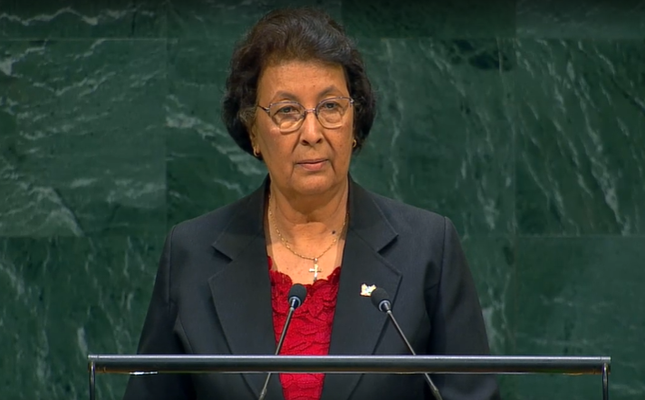
NEW YORK, MANHATTAN – Speaking during the annual United Nations General Assembly General Debate on September 24, 2026, Suriname President Jennifer Geerlings-Simons has issued a pressing call for sweeping reform of the United Nations, a renewed global commitment to upholding international law, and targeted, expanded support for vulnerable developing economies grappling with cascading global crises.
Against a backdrop of growing global instability marked by spreading armed conflicts, escalating geopolitical frictions, and spiraling food and energy insecurity, Geerlings-Simons framed UN reform as a critical step to rebuild global trust in the institution’s ability to advance lasting peace, inclusive growth, and equitable sustainable development. She emphasized that for small, vulnerable sovereign states like Suriname, a rules-based international order rooted in consistent enforcement of international law is not an abstract ideal – it is a foundational requirement for survival.
“As we depend on a rule based international order without which, like many other vulnerable nations, we simply cannot exist as sovereign countries,” Geerlings-Simons stated during her address. She added that strengthening international legal frameworks and their supporting institutions is indispensable to upholding global peace and security, protecting universal human rights, and delivering sustainable development that benefits all nations, regardless of size or economic power.
The Surinamese leader drew direct connections between rising geopolitical tensions and the everyday suffering of ordinary people across the Global South, noting that even conflicts thousands of miles from developing nation borders can trigger sudden, sharp spikes in food and energy costs that erode quality of life and reverse years of development progress. She pointed to ongoing volatility in the Strait of Hormuz as a clear example of how regional instability can quickly roil global energy markets, driving up costs and undermining social and economic progress in developing states. “Common people suffer when food and energy prices rise, so the quality of life of our people is directly threatened, even by wars in regions far from their homes,” she said, adding that mounting conflicts have already unleashed unprecedented humanitarian harm, including exposing children to unspeakable violence and driving mass global displacement.
In response to these interconnected challenges, Geerlings-Simons called for a global recommitment to the core principles of the UN Charter, chief among them the peaceful resolution of international disputes. “Dialogue is paramount for safeguarding a solid and proven UN system,” she argued.
Turning to pressing regional crises, the president called for an end to the economic, commercial, and financial embargo on Cuba, urging all involved parties to prioritize sustained dialogue and negotiation to de-escalate tensions and reach a resolution that prioritizes the well-being of the Cuban people. She also called for sustained, coordinated international support for Haiti as the Caribbean nation works to rebuild security, restore constitutional order, and advance democratic governance, noting that Suriname backs solutions that center the needs and leadership of the Haitian people.
Geerlings-Simons reaffirmed Suriname’s full backing for ongoing UN reform efforts, including the UN80 process focused on mandate rationalization, improving institutional coherence, and boosting overall organizational efficiency. She stressed that reform must strengthen the UN’s ability to deliver critical support to vulnerable nations, rather than reducing resources where they are most needed. She also reiterated Suriname’s longstanding support for UN Security Council reform, urging that the body be overhauled to become more representative, transparent, and accountable to the full UN membership, while also improving its capacity to respond rapidly to evolving global challenges. Specifically, Suriname supports Africa’s decades-long demand for permanent representation on the Security Council, and calls for enhanced representation for small island developing states and low-lying coastal developing nations, whose voices are often marginalized in global decision-making.
Looking ahead to Suriname’s assumption of the CARICOM chairmanship in 2027, Geerlings-Simons highlighted the central role that regional and international partnerships play in advancing the nation’s social and economic development. She noted Suriname’s active participation in key regional blocs and mechanisms including the Caribbean Community (CARICOM), the Community of Latin American and Caribbean States (CELAC), the Amazon Cooperation Treaty Organization (ACTO), and the Brasilia Process. Moving forward, Suriname will prioritize deepening collaboration with partners across key priority areas: food and energy security, climate resilience, cross-border connectivity, skilled labor mobility, and streamlined trade in goods and services. “These are essential to economic integration and our ability to withstand external shocks,” she explained.
In closing, the president addressed the ongoing global push for reparations and restorative justice for the transatlantic slave trade and centuries of colonial exploitation. She noted that the adoption of a UN resolution on the issue earlier in 2026 has injected critical new momentum into global discussions, a topic of particular urgency for Suriname and Caribbean nations that continue to grapple with the intergenerational harms of slavery and colonialism. “The discussion is no longer about whether slavery and colonialism have caused lasting consequences, negative consequences. We know we are living them,” she said. Geerlings-Simons argued that global conversations have now shifted from acknowledging harm to identifying actionable solutions, stating that the core question facing the international community today is how nations that benefited from centuries of exploitation will provide reparations and address the ongoing harm that continues to shape development outcomes across the Global South. “That is the important issue now,” she emphasized.