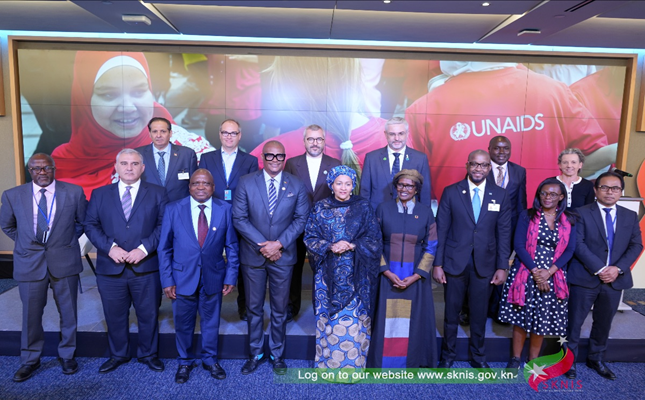
NEW YORK, September 24, 2026 — At a high-profile side event coinciding with the 81st session of the United Nations General Assembly, the Acting Prime Minister of Saint Kitts and Nevis, Hon. Dr. Geoffrey Hanley, delivered a resolute plea to the global community: reject any plans to downsize or wind down the Joint United Nations Programme on HIV/AIDS (UNAIDS), and instead commit to sustained, robust funding and international collaboration to meet the 2030 target of ending AIDS as a public health threat.
Dr. Hanley opened the UNAIDS Transformation Side Event by framing the ongoing fight against HIV/AIDS as both an urgent political priority and a defining measure of global collective solidarity. For small island nations like Saint Kitts and Nevis, and across the broader Caribbean Community (CARICOM) bloc, UNAIDS has proven irreplaceable, he explained, providing indispensable strategic direction, specialized technical expertise, and data-driven insights that underpin the design of effective national and regional HIV response policies.
“For Saint Kitts and Nevis, and indeed across the entire CARICOM region, the response to HIV/AIDS is not only a political imperative, but a profound test of our collective solidarity and our commitment to ending a pandemic that has taken too many lives,” Dr. Hanley told attendees, which included global leaders, public health stakeholders, and AIDS response advocates.
While acknowledging the meaningful progress that the global community has made in curbing the spread of HIV and improving access to life-saving treatment over the past four decades, Dr. Hanley emphasized that the mission remains far from complete. Hitting the 2030 end-goal, he stressed, depends entirely on three core pillars: unwavering political commitment from all member states, deepened cross-border international cooperation, and a fully empowered, resourced UNAIDS to coordinate the global response.
Dr. Hanley also highlighted the organization’s longstanding leadership in keeping HIV/AIDS at the top of the global policy agenda, noting that UNAIDS has consistently provided critical technical and political backbone for every UN General Assembly High-Level Meeting focused on the pandemic, helping align global action around shared targets.
“Our collective task is not to wind down UNAIDS, but to support it, fully resource it, and leverage its unique multisectoral expertise to end AIDS once and for all,” Dr. Hanley stated.
He pointed to the 2026 UN High-Level Meeting Political Declaration as clear proof of the global mandate for this approach, noting that the document explicitly calls on member states to expand support, utilize UNAIDS’ unique capabilities, and provide full, consistent resourcing for the Joint Programme.
In closing, Dr. Hanley reaffirmed the government of Saint Kitts and Nevis’ unwavering commitment to partnering with CARICOM, UNAIDS, and the entire global public health community to accelerate progress, remove gaps in access to care, and deliver on the shared promise of eliminating AIDS as a public health threat by 2030.