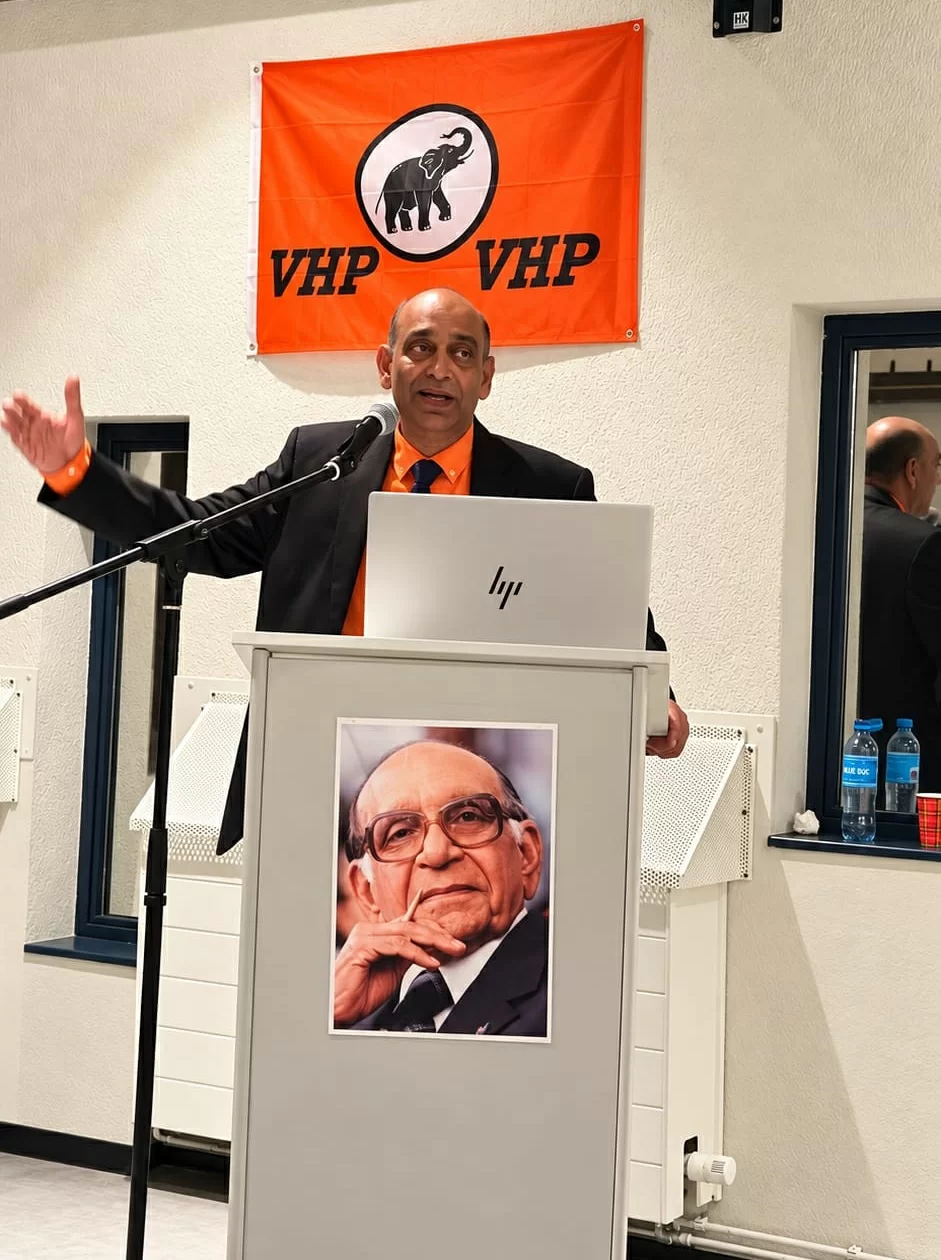
On Thursday, during the 10th annual Mr. Jagernath Lachmon Lecture held in Amsterdam, Lachman Soedamah, chair of the Dutch chapter of the Surinamese VHP party, presented a comprehensive long-term strategy called Diaspora Vision 2050, calling on Suriname to build a permanent, institutionalized framework for collaboration with its global diaspora community.
Soedamah argues that Suriname’s current approach to engaging with Surinamers living abroad relies too heavily on informal personal connections, one-off projects, and shifting short-term political priorities, rather than a sustainable structure that can deliver consistent benefits for national development. Under his vision, the diaspora should be far more than just a source of remittances or occasional emergency aid. Surinamers across the globe hold specialized knowledge, decades of professional experience, expansive international networks, and untapped investment capital that can be mobilized to drive long-term growth in Suriname, he says, framing this potential as the foundation for a “global Surinamese nation” that extends beyond the country’s borders.
At the core of Soedamah’s proposal is the establishment of a National Diaspora Council. This body would not replace the existing Surinamese government or National Assembly, but would instead serve three core functions: advising policymakers on diaspora-related issues, collecting input and feedback from Surinamers living abroad, and connecting individuals and organizations to facilitate collaborative projects. Beyond the central council, Soedamah also proposes launching dedicated diaspora institutions in Suriname and in countries that host large Surinamese communities, such as the Netherlands. These institutions would act as permanent, reliable touchpoints for diaspora members who want to contribute their skills to Suriname’s development, filling a critical gap that currently leaves many willing contributors without a clear path to action.
To illustrate this gap, Soedamah points to a range of common examples: a Surinamese physician based in the Netherlands who wants to mentor early-career doctors in Paramaribo, an engineer with specialized expertise in water management eager to share knowledge, an entrepreneur with established access to global international markets looking to support local Surinamese businesses, an educator able to deliver digital learning opportunities, and a legal professional with experience in institutional strengthening who wants to pass on that knowledge. In each case, Soedamah notes, the willingness to contribute already exists, but there is no trusted, consistent structure to connect these initiatives to communities and institutions in Suriname. A formal legal framework for diaspora engagement would also ensure that policy does not shift dramatically with every change of government or depend on personal connections between individual officials and diaspora members.
Soedamah also calls for a major expansion of the existing Persons of Surinamese Origin (PSA) scheme. Currently, the program primarily facilitates entry and residency for people with Surinamese ancestry traveling to or relocating in Suriname. Under his proposal, it would be transformed into a broad gateway for engagement, opening up access to knowledge exchange programs, internship placements, entrepreneurship support, cultural exchanges, and youth participation. Of particular focus in this expansion is outreach to second-, third-, and fourth-generation Surinamers born and raised outside the country, who often have weaker inherent ties to Suriname than first-generation emigrants. Soedamah emphasizes that these younger generations should be given structured opportunities to experience Suriname firsthand, pursue study, complete internships, launch businesses, and join collaborative projects in the country to nurture that connection.
The VHP Netherlands chair also does not shy away from two long-debated, sensitive topics: dual citizenship and formal political representation for the diaspora. While he does not present a fully developed, final model for either issue in his lecture, Soedamah argues that Suriname can no longer avoid open discussion of these topics, and that they should be debated carefully and deliberately without rushing to a hasty conclusion.
Throughout the plan, Soedamah stresses that long-term development of Suriname must ultimately be led and owned by stakeholders within the country itself. Structured diaspora engagement does not mean that Surinamers living abroad should take control of the development process, he clarifies. Instead, he frames the diaspora as an equal knowledge and development partner that can contribute to stronger public institutions, improved education, expanded entrepreneurship, and more robust inclusive economic growth. Summing up his vision, Soedamah says, “The Surinamese nation is larger than its territory.”