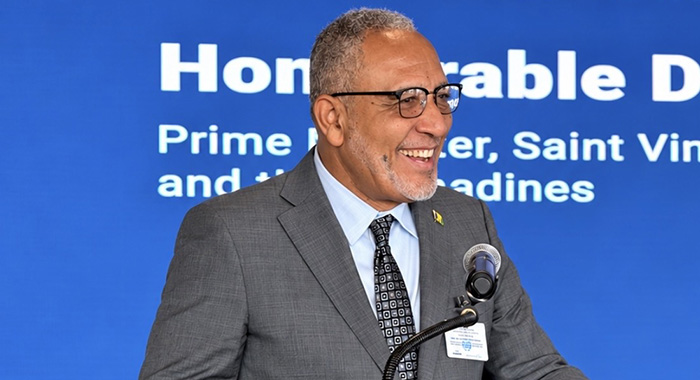
At a high-level sustainable development gathering hosted at the United Nations in New York on Wednesday, Prime Minister Godwin Friday of St. Vincent and the Grenadines (SVG) delivered a bold rebuke to the narrative that frames Small Island Developing States (SIDS) as inherently defined by their vulnerability, calling for strategic cross-sector partnerships to unlock sustainable, resilient growth for small island nations.
Speaking at the Family Offices for Sustainable Development Summit, Friday emphasized that while SIDS like SVG face outsized exposure to climate disasters and systemic economic challenges, their developmental ambitions are far from constrained by their geographic size. He centered his address on a people-first vision of progress, arguing that true development cannot be measured by abstract economic indicators alone, but by tangible improvements to daily life.
“Development means whether young people in my country, in Tonga, or across any SIDS can secure meaningful employment; whether all children can access high-quality education; whether smallholder farmers, artisanal fishers and local entrepreneurs can build stable, viable livelihoods and gain access to the capital they need to grow,” Friday explained. He added that for SIDS, development also hinges on whether core community infrastructure — from roads and healthcare clinics to power grids — can withstand the increasing frequency of extreme weather events.
Decades of firsthand experience have taught small island nations that a single catastrophic climate event can wipe out decades of hard-won developmental progress, Friday noted. This leaves SIDS caught in a persistent paradox: how can governments invest in climate-resilient infrastructure without jeopardizing national debt sustainability? This challenge shapes every decision his administration makes as it pursues long-term growth, he said.
Friday stressed that rather than accepting vulnerability as a permanent defining trait, SIDS can leverage their experience as a catalyst for innovative development models and more strategic global collaboration. For him, building resilience is not an optional discretionary expense — it is a core investment that secures the continuity of long-term development. This framing, he argued, reframes the global conversation about SIDS’ growth as fundamentally a conversation about targeted investment.
A recent joint analysis from the Organisation for Economic Co-operation and Development and the Inter-American Development Bank identified high-impact investment sectors that can deliver both strong economic returns and transformative developmental benefits for SIDS, Friday noted. These priority areas include climate-resilient infrastructure, renewable energy transition, sustainable tourism, climate-smart agriculture and agri-processing, sustainable blue economy development, digital transformation, entrepreneurship, and human capital investment.
Even with clear priorities in place, major barriers remain. Public sector budgets in small island states are never large enough to fund all ambitious developmental projects, particularly when governments are forced to repeatedly borrow to fund disaster recovery, Friday explained. At the same time, private capital providers often hesitate to enter SIDS markets, deterred by perceived higher risk, smaller transaction sizes, and uncertain long-term returns. This leaves a critical unanswered question: How can SIDS translate their developmental priorities into credible, investable opportunities, while addressing the reality that their inherent vulnerability makes investment more costly?
For Friday, the core solution lies in building intentional, cross-sector partnerships across every available stakeholder group. “Private capital, multilateral development institutions, civil society, regional bodies, and global development partners can collaborate with national governments from the earliest stages of project planning,” he said. This collaboration can support early project preparation and aggregate small individual projects into larger investment vehicles, creating bankable opportunities and ready-to-implement project pipelines for investors.
Since taking office in November, Friday’s administration has already taken concrete steps to attract responsible private investment. The government has implemented predictable, transparent regulatory frameworks, strengthened public investment management systems, and built clear, open processes that allow investors to easily identify opportunities and understand associated risks. “We have sent an unambiguous signal: we welcome private partnership and investment in our nation’s growth,” Friday stated.
For small Caribbean economies in particular, regional collaboration creates economies of scale that no individual small island can achieve alone, Friday added. Caribbean nations have already refined effective regional models to aggregate investment opportunities, align common regulatory standards, share specialized local expertise, and build collective investment platforms capable of attracting large institutional capital that would not be accessible to single nations.
Multilateral development institutions also have a critical catalytic role to play in unlocking investment for SIDS, he argued. “We need expanded use of risk-mitigating tools: guarantees, first-loss instruments, concessional development finance, targeted technical assistance, political risk coverage, and other forms of blended finance that lower risk for investors and draw responsible private capital into SIDS markets,” Friday explained. When public and multilateral resources are deployed strategically and effectively, they can unlock hundreds of billions in private capital for high-priority developmental projects that would otherwise go unfunded, he noted.
Friday called for a fundamental shift in how global development frameworks view private capital: rather than treating it as just a source of financing, it should be recognized as a core partner in sustainable development. It is possible to reduce risk to a level that attracts private participation while protecting and preserving public value, he emphasized. For example, a resilient infrastructure project is not just a physical asset — it protects lives, preserves ongoing economic activity, and avoids billions in future disaster losses. Global investment decision-making must better account for the long-term economic value of resilience and avoided disaster damage, he said.
The prime minister called on global development and financial institutions to update their investment and risk assessment methodologies to explicitly account for the long-term benefits of resilience-building in SIDS. “SIDS must not be an afterthought in global investment design. We need frameworks built for our specific needs from the ground up,” he said. He also encouraged expanded adoption of targeted financial tools for SIDS, including catastrophe risk financing, parametric insurance, contingent development financing, and climate-resilient debt mechanisms.
A new model of public-private collaboration for SIDS must be guided by a clear development compact, Friday argued. All public-private partnerships must be fully transparent, aligned with core national developmental priorities, and structured around measurable, people-centered outcomes. While national governments are responsible for building an enabling regulatory and policy environment, private sector partners must bring responsible investment, innovative practice, skills development, long-term commitment to local economies, and a willingness to transfer knowledge to local stakeholders. Multilateral institutions can act as a trusted bridge between public and private partners, aligning shared interests, he added.
Friday closed by reaffirming his administration’s commitment to building a better future for current and coming generations. “We have clear priorities, we have untapped opportunities, and we have unwavering ambition. What we need now is a stronger global ecosystem that connects our priorities to capital, innovation, expertise, and shared risk — and a willingness to rethink outdated models,” he said. “My goal is to see us build actionable investment pipelines, not just unfunded project wish lists, and build lasting resilience instead of repeatedly funding post-disaster recovery.”
He pointed to SVG’s recent string of cascading crises as a clear example of why this new model is urgent: the nation is still recovering from a major volcanic eruption when it was hit by a destructive hurricane, wiping out new progress. “This is the work we must undertake together: to build prosperous, resilient, sustainable small island nations for the next generation,” Friday said.