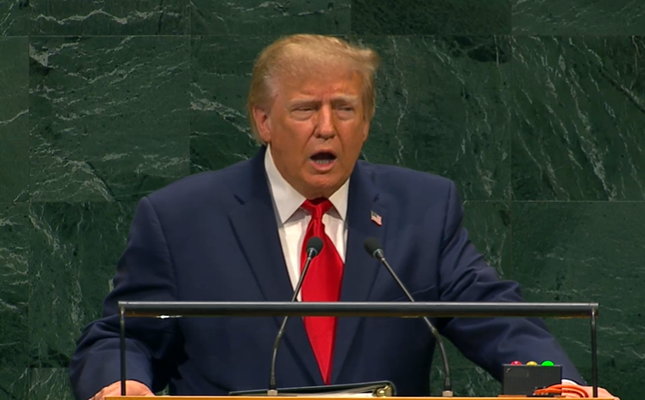
Speaking from the floor of the 81st United Nations General Assembly in Manhattan on Tuesday, September 22, 2026, U.S. President Donald Trump has outlined a pivotal impending “big decision” on Iran, pitting a new negotiated agreement with Tehran against expanded military action that could target the very existence of the Islamic Republic, as regional tensions spill over to disrupt global energy markets.
In his hard-hitting address to world leaders, Trump launched a sweeping condemnation of the Iranian government, framing it as the world’s leading state sponsor of terrorist activity. He argued that for more than half a century, the ruling regime in Tehran has fueled instability, violence, and bloodshed across the Middle East and beyond. “For 51 years, the fanatical Iranian regime has ruled by bloodshed and mass murder, spreading death and carnage and chaos across the entire Middle East and beyond,” Trump told the assembled delegates. “They were the bully of the Middle East, but they are the bully no more.”
The president recounted that shortly after returning to office, his administration initiated bilateral talks with Iran, putting forward an offer of comprehensive economic collaboration in exchange for Tehran permanently abandoning its nuclear program and ending its financial and military support for militant groups across the region. According to Trump, that overture was flatly rejected by Iranian leaders. The breakdown of those negotiations, he said, opened the door to current U.S. military operations, which are backed by longstanding U.S. ally Israel.
Trump emphasized that the core strategic goal of the ongoing campaign is to block Iran from crossing the threshold to develop a functional nuclear weapon, a red line he has repeatedly pledged to enforce. The escalating conflict has already generated ripple effects far outside the Middle East, most notably through widespread disruptions to commercial traffic through the Strait of Hormuz, the critical global chokepoint that carries roughly 20% of the world’s daily oil supply. Disruptions to shipping through the waterway have triggered widespread market anxiety over global energy security and upward pressure on crude oil prices.
Citing recent media reports, Iran has signaled it would reopen the strategic strait to full commercial traffic within seven days if the U.S. draws down its military presence in the region and lifts its ongoing blockade of Iranian ports. Pushback against that claim came from Trump during his address, who noted that the U.S. Navy has now escorted more than one billion barrels of oil through the strait, and current shipping volumes are higher than they were at the peak of recent disruptions earlier in the conflict.
The president also asserted that the U.S.-led military campaign has inflicted severe, lasting damage to Iran’s conventional military capabilities, including its naval forces, early-warning radar networks, air defense systems, ballistic missile stockpiles, and domestic drone production infrastructure. He used his address to praise the U.N. Security Council for its recent resolution condemning attacks on commercial shipping in the region and called on the international community to maintain coordinated pressure on Tehran to change its policy course.
Turning to the core choice his administration now faces, Trump laid out both options clearly for the global audience. “Do I make a new deal?” he asked delegates, before offering the far more severe alternative: “Or do I annihilate the Islamic Republic and do it quickly, never giving them a chance to kill and destroy people and countries again?”
Trump’s tough remarks came as both sides signaled continued openness to diplomatic progress. Iranian officials have already indicated they remain willing to return to negotiations under clearly defined terms, while U.S. Secretary of State Marco Rubio confirmed Tuesday that Washington is open to holding informal talks with Iranian representatives on the sidelines of the U.N. General Assembly, though no formal meeting had been scheduled as of Tuesday afternoon.
According to reporting from Reuters, Trump told reporters he anticipates a potential agreement with Iran could be reached after the November 2026 U.S. midterm elections, even as he reiterated his commitment to maintaining harsh economic sanctions on Tehran in the interim. To date, the conflict remains at an impasse, with parallel diplomatic overtures and rising threats of further military escalation unfolding alongside growing global concern over sustained disruptions to energy supplies and international commercial shipping.