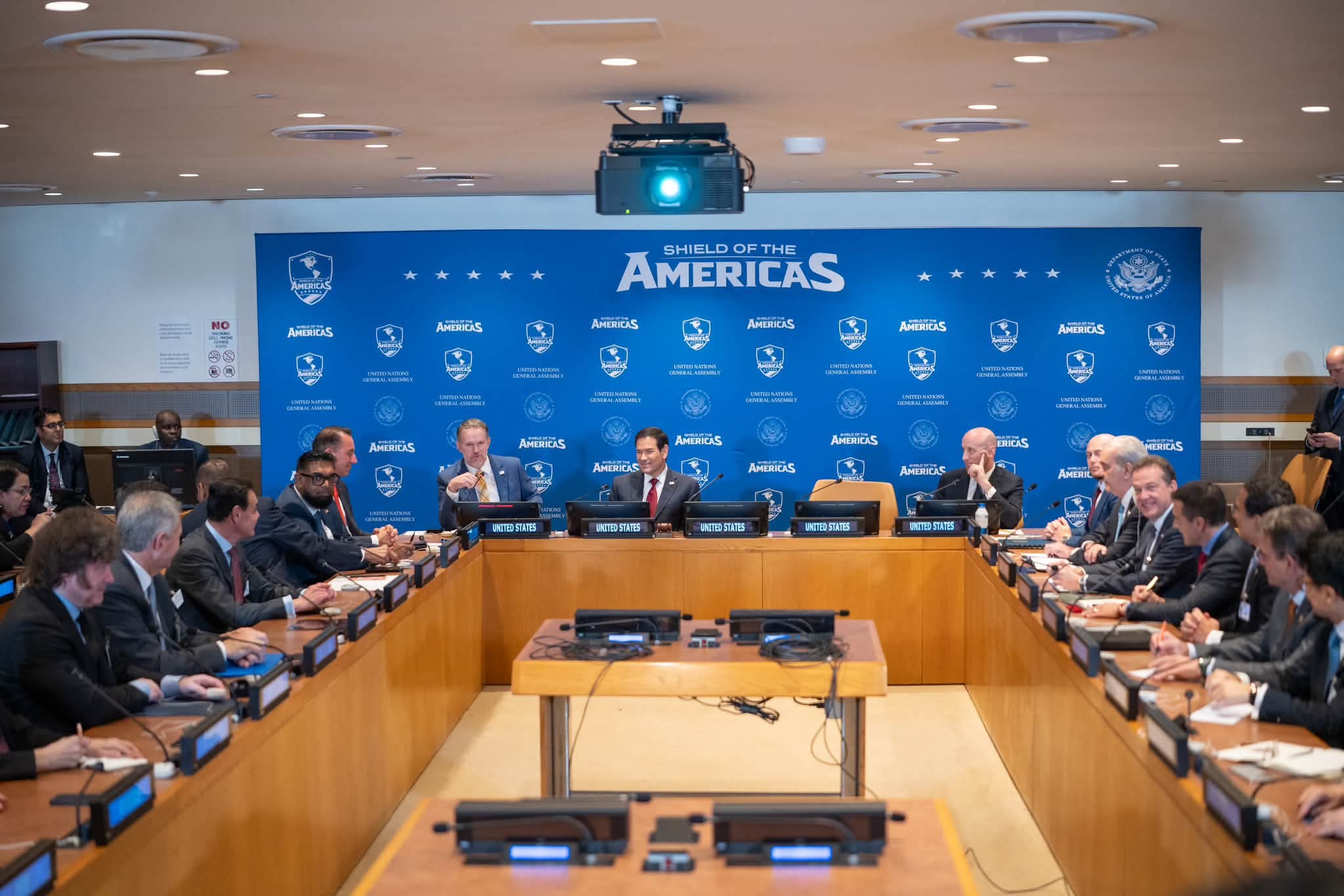
On September 23, 2026, member states of the U.S.-led Shield of the Americas initiative concluded a high-stakes meeting on the sidelines of the United Nations General Assembly in New York, unveiling a coordinated, historic crackdown on 24 transnational narco-terrorist organizations operating across the Americas, including Haiti’s most powerful violent gang coalition Viv Ansamn.
The collective punitive measures, laid out in a formal Joint Statement on Defending Hemispheric Sovereignty released after talks with U.S. President Donald Trump, cover a range of targeted actions aligned with each participating nation’s domestic legislation and international legal commitments. These steps include freezing assets held by the listed groups and their affiliates, imposing strict immigration and visa bans on group members, associates, and financial backers, and establishing criminal accountability for any individual that knowingly provides material or logistical support to the blacklisted organizations.
At the top of the sanctions list is Viv Ansamn, a large alliance of Haitian gangs headed by Jimmy “Barbecue” Chérizier, a notorious former police officer. The bloc holds the group directly responsible for fueling widespread political instability across Haiti and blocking democratic national elections unless it is granted a direct role in the political process.
Two major Venezuelan criminal groups—Tren de Aragua and Cartel de Los Soles—were also included in the first joint punitive action under the initiative’s new framework, which centers on coordinated individual and collective action to counter the spread of narco-terrorism. The Guyana government has previously raised repeated security alarms over incursions by Tren de Aragua members crossing the border from Venezuela into Guyana’s contested Essequibo Region. Notably, former Venezuelan President Nicolás Maduro, who was ousted from power by U.S. military forces on January 3 this year, had already been sanctioned by the U.S. Treasury’s Office of Foreign Assets Control for his documented ties to Cartel de Los Soles.
Brazil’s two most formidable criminal networks also feature on the 24-group blacklist: Primeiro Comando da Capital (PCC), the country’s largest criminal organization, and Comando Vermelho (CV), a decades-old major drug trafficking syndicate.
In justifying the unified sanctions regime, participating nations emphasized that transnational narco-terrorist groups represent an immediate, shared existential threat to the entire Western Hemisphere. These criminal networks undermine regional peace and security, and directly threaten the safety, stability, and long-term economic prosperity of all citizens across participating states.
To formalize and institutionalize the punitive measures, Shield of the Americas members announced plans to submit a joint formal request to the Chair of the Organization of American States Permanent Council. The request will call for a consultation meeting to vote on establishing a formal Organ of Consultation under Articles 6 and 13 of the Inter-American Treaty on Reciprocal Assistance, widely known as the Rio Treaty.
Beyond the sanctions framework, the 15 member bloc—made up of the United States, Argentina, Bolivia, Chile, Colombia, Costa Rica, the Dominican Republic, Ecuador, El Salvador, Guyana, Honduras, Panama, Paraguay, Peru, and Trinidad and Tobago—also agreed to a broader set of shared commitments. These include coordinated action to defend democratic governance against armed narco-terrorist networks, aligned sanctions designations, joint financial countermeasures against terrorists and criminal actors, expanded cross-border civilian law enforcement cooperation, and the delivery of humanitarian and public communications assistance to protect the popular democratic will across the hemisphere.
Member states also pledged to uphold and advance mutual respect for national sovereignty and each nation’s right to self-determination through multilateral channels. They committed to coordinating on shared priorities, from catalyzing coordinated international enforcement action against transnational organized crime to advancing targeted reforms of key hemispheric multilateral institutions.